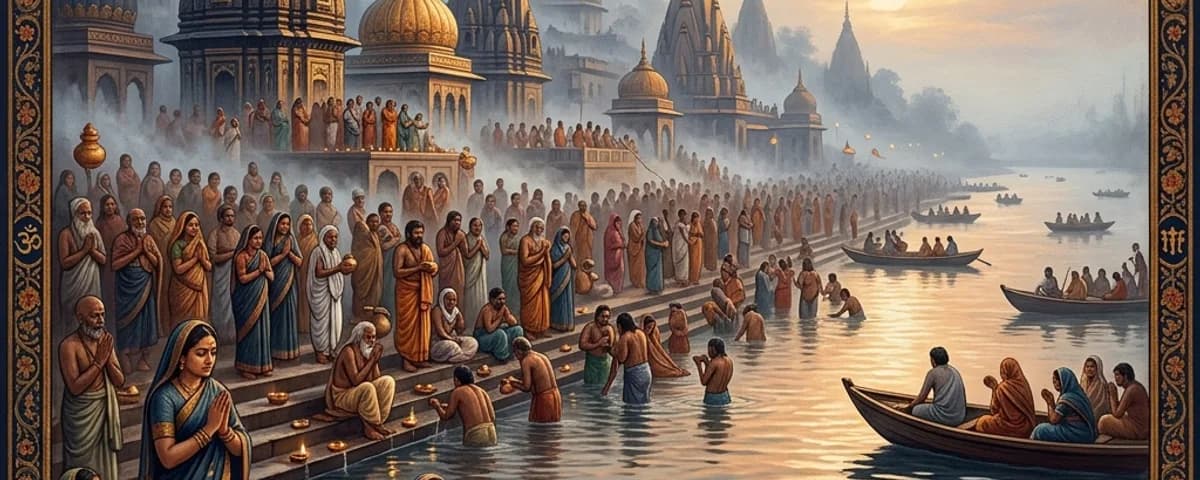
Two interlocking sacred-journey systems. The Char Dhamis the four-abode pilgrimage - Chota (Garhwal Himalayas) and Bada (Adi Shankara's pan-India cardinals). The 24 Ekadashis are the year-long tithi-pilgrimage of the devotee - one fast every fortnight, each with its own Purana-mahatmya.
Chota Char Dham - Garhwal Himalayan Circuit
The traditional Uttarakhand pilgrimage. Opens around Akshaya Tritiya (Apr-May) and closes around Bhai Dooj (Oct-Nov). The scripturally-mandated order is west-to-east, lower-to-higher: Yamunotri → Gangotri → Kedarnath → Badrinath. Each is a step in purification - water (Yamuna) → liberation (Ganga) → penance (Shiva) → moksha (Vishnu).
№ 1
Yamunotri · यमुनोत्री
3,293 m
Uttarkashi district, near Janki Chatti
Deity: Yamuna Devi (black-stone idol). Sister of Yama, daughter of Surya.
Access: 6 km steep trek from Janki Chatti to the temple. Ponies + palkis available.
Story - Sage Asita Muni meditated here in antiquity. Yamuna is the sister of Yama (death-lord) - a dip in the Surya Kund (the 88-degree hot-spring beside the temple) on Yama-Dwitiya is said to ensure no untimely death. Pilgrims first cook rice in the Surya Kund waters as naivedyam, then take darshan.
★ Significance - First stop of the circuit. Purification before going further. The Yamuna here is the pure glacial source - the same river that flows past Mathura + Vrindavan.
Season: Akshaya Tritiya (late Apr / early May) to Bhai Dooj (Oct-Nov). Avoid monsoon mid-Jul to mid-Aug - landslide risk.
№ 2
Gangotri · गङ्गोत्री
3,100 m
Uttarkashi district. ~250 km from Yamunotri.
Deity: Ganga Devi (silver idol in the temple). The true source is Gomukh - an 18 km trek beyond.
Access: Motorable road to the temple itself. Devout pilgrims continue 18 km to Gomukh (the actual snout of the Gangotri glacier).
Story - King Bhagiratha performed millennia of tapas to bring Ganga down from heaven to liberate his 60,000 ancestors (sons of Sagara), reduced to ashes by Kapila Muni's gaze. Ganga's full descent would have shattered the earth - Shiva caught her in his matted locks (jata) on Kailasa, then released her in measured streams. Gangotri is where she first touched earth.
★ Significance - Mokshadayini - the liberator-mother river. Bathing here is said to wash away seven generations of accumulated karma. The temple itself is closed Nov-Apr (extreme winter); the deity is moved to Mukhba village for the off-season.
Season: Akshaya Tritiya (Apr-May) to Diwali / Bhai Dooj (Oct-Nov).
№ 3
Kedarnath · केदारनाथ
3,583 m
Rudraprayag district. ~225 km from Gangotri via Tilwara.
Deity: Shiva as Kedareshwar - worshipped as the hump (vrishabha-prishta) of the bull-form Shiva took. Jyotirlinga #11 of the 12.
Access: 16 km trek from Gaurikund (gateway). Ponies, palkis, and helicopter services available. The trek follows the Mandakini river.
Story - After the Mahabharata war, the Pandavas sought Shiva to atone for the sin of killing kinsmen. Shiva, unwilling to grant audience, took the form of a bull (Nandi) and dived into the earth at Kedar. Bhima caught the bull's tail; the hump remained at Kedarnath, the face surfaced at Pashupatinath (Nepal), the arms at Tungnath, the navel at Madhmaheshwar, the matted-locks at Kalpeshwar, the head at Rudranath - together the Panch Kedar.
★ Significance - The penance-Jyotirlinga. Cleanses the karma of war, violence, and killing. The 2013 flash floods devastated the town but the temple itself survived - protected, devotees say, by the Bhim-shila (a giant boulder that diverted the flood). Pilgrimage continues with improved infrastructure.
Season: Akshaya Tritiya to Bhai Dooj. The murti is moved to Ukhimath (Omkareshwar temple) for winter darshan.
№ 4
Badrinath · बद्रीनाथ
3,133 m
Chamoli district. ~225 km from Kedarnath via Joshimath.
Deity: Badrinarayan - a one-metre saligrama-shila of Vishnu in dhyana-mudra (meditative posture), seated under a stone canopy.
Access: Fully motorable to the temple courtyard. The town sits between the Nar and Narayan parvats, with Neelkanth peak rising behind.
Story - Vishnu sat in deep meditation here under a badri-tree (jujube). The cold was so severe that Lakshmi took the form of the badri-tree itself to shield him with her leaves - hence Badrinath (lord of the badri-tree) and Badrayan (the meditating one). The entire Vishnu-Khanda of the Skanda Purana is devoted to this kshetra. Adi Shankara recovered the original murti from the Narada Kund (an icy pool) in the 8th century and re-established worship.
★ Significance - The final dham - the moksha-sthana. Vyasa is said to be composing the Mahabharata in a cave nearby (Vyasa Gufa); Ganesha's cave (Ganesha Gufa) is where the recitation happened. The Tapt Kund (hot spring) at the temple base - fed by underground volcanic heat at 3,133 m - is itself a marvel.
Season: Akshaya Tritiya to ~Vijayadashami / Karthik Purnima. Winter darshan at Joshimath's Narsingh temple.
Practical Pilgrimage Planning
Start pointHaridwar / Rishikesh (rail + air gateways).
Total distance~1,600 km loop from Haridwar (covering all four dhams + return).
Minimum days10-12 days by road. 2 days by helicopter (premium yatra).
Best seasonLate April to mid-June (post-opening), and September to October (post-monsoon). Avoid mid-July to August (monsoon, landslides).
RegistrationBio-metric registration is mandatory from 2023 onwards - register at the Char Dham Devasthanam Board portal or at the gateway towns. No registration = no darshan.
Cost - road yatraApprox. Rs 50,000 - 80,000 per person (includes shared transport, basic stay, food, registration).
Cost - helicopter yatraApprox. Rs 1.5 - 2 lakh per person (Dehradun-based circuit with VIP darshan).
Altitude warningAll four dhams sit at 3,000 - 3,600 m. Acclimatize at Joshimath / Uttarkashi for a day. Carry diamox if prone to AMS. Heart and respiratory patients should consult a doctor first.
Traditional orderYamunotri -> Gangotri -> Kedarnath -> Badrinath. The west-to-east, lower-to-higher progression is scripturally mandated - Vishnu (Badrinath) is the culmination.
Bada Char Dham -Adi Shankara's Pan-India Four
In the 8th century Adi Shankara consolidated a pan-Indian pilgrimage marking the four cardinal directions of Bharat -one for each Veda, one for each yuga, one for each goal of human life (dharma, artha, kama, moksha). Three of the four are covered in detail at /wisdom/famous-temples.
Badrinath
North
Uttarakhand
Deity: Vishnu (Badrinarayan)
The only dham common to both circuits. Adi Shankara established the present temple worship here in the 8th century.
Jagannath Puri
East
Odisha
Deity: Jagannath (Krishna), Balabhadra, Subhadra - wooden murtis renewed every 12 years (Nabakalebara).
The site of the annual Rath Yatra (Ashadha Shukla Dwitiya). The mahaprasad here is offered to crores of devotees without distinction of caste.
Rameswaram
South
Tamil Nadu
Deity: Ramanathaswamy - a Shiva Jyotirlinga (one of the 12), installed by Rama himself after the Lanka war.
The 22 sacred tirthas (wells) within the temple complex are bathed in order before darshan. Connects the Vishnu-circuit (Rama) with the Shiva-circuit (linga).
Dwarka
West
Gujarat
Deity: Dwarkadhish - Krishna as the king of Dwarka.
Krishna's own city. The original Dwarka is submerged off the Gujarat coast (recent ASI underwater surveys confirm structures dating ~1500 BCE). The Bet Dwarka island nearby is where Krishna actually resided.
The 24 Ekadashis - Year-Long Vrata Cycle
Each lunar month has two ekadashis (the 11th tithi of Shukla and Krishna paksha). Twelve months × two pakshas = 24 ekadashis in a regular year. When an Adhik Maas (intercalary 13th month) occurs (~every 3 years), two extra ekadashis appear -Padmini and Parama, the most exceptional of all. The Padma Purana Brahma-Khanda contains the full mahatmya for each.
1. Utpanna Ekadashi · उत्पन्ना एकादशी
Karthika Krishna (Nov-Dec) · Krishna
The day Ekadashi-devi herself was born - emerging from the body of Vishnu to slay the demon Murasura who had pursued him into the cave at Badari. She is the personified power of fasting.
Considered the adi (first) ekadashi - observing this one initiates the year-long ekadashi vrata. Grants the merit of all other ekadashis.
Vishnu wakes from his four-month yoga-nidra on Sheshanaga. This is also Tulasi-Vivaha - Tulasi (Vrinda) is married to Shaligrama (Vishnu). Chaturmasa ends. Gita Jayanti (the day Krishna spoke the Bhagavad Gita) falls here.
Liberates ancestors from preta-yoni. Marks the end of the inauspicious chaturmasa - weddings + new ventures resume.
3. Saphala Ekadashi · सफला एकादशी
Margashirsha Krishna (Dec-Jan) · Krishna
King Mahishmata's wicked son Lumpaka was exiled into the forest for thieving. Starving on this ekadashi, he involuntarily fasted and offered fruits to Vishnu - the deity restored him to the throne reformed.
Even involuntary observance yields fruit (saphala = fruit-bearing). All actions on this day succeed.
4. Putrada Ekadashi (Pausha) · पुत्रदा एकादशी
Pausha Shukla (Jan-Feb) · Shukla
King Suketuman of Bhadravati and his queen Shaibya were childless. The sage Lomasa advised this vrata. They observed, and a worthy son was born.
Grants progeny - especially to couples without children. Also for the welfare and longevity of existing children.
5. Shattila Ekadashi · षट्तिला एकादशी
Pausha Krishna (Jan-Feb) · Krishna
A miserly brahmana woman refused all charity in her lifetime. Vishnu, in a sage's form, taught her the six uses of til (sesame) - bathing with, offering oblations of, eating, giving as dana, ladling into the fire, applying to the body - to purify her hoarding.
Removes the dosha of stinginess. Purifies the hearth + family wealth.
6. Jaya Ekadashi · जया एकादशी
Magha Shukla (Feb-Mar) · Shukla
The Gandharvas Pushpadanta and Maladevi disrupted a divine assembly with their lust and were cursed by Indra to be pishachas (ghouls). They unknowingly observed this ekadashi by fasting in their misery, and were restored to gandharva form.
Liberates from pishacha-yoni and ghost-states. Cleanses sins of lust.
7. Vijaya Ekadashi · विजया एकादशी
Magha Krishna (Feb-Mar) · Krishna
Sri Rama, unable to cross the ocean to Lanka, was advised by sage Bakadalbhya to observe this ekadashi. He did - and the next day Samudra agreed to bear the bridge of stones, leading to the Lanka war victory.
Vijaya = victory. Grants success in battles, court cases, examinations, and seemingly impossible undertakings.
8. Amalaki Ekadashi · आमलकी एकादशी
Phalguna Shukla (Mar-Apr) · Shukla
King Chitrasena of Vaidisha and his subjects all observed this ekadashi with worship of the amalaki (Indian gooseberry) tree - said to have sprung from a drop of Vishnu's tears at creation. Brahma resides in the roots, Vishnu in the trunk, Shiva in the branches.
Purifies all sins. Worship of the amalaki tree on this day grants merit equal to a thousand cow-gifts.
9. Papamochani Ekadashi · पापमोचनी एकादशी
Phalguna Krishna (Mar-Apr) · Krishna
The sage Medhavi was seduced by the apsara Manjughosha; she eventually became a pishachi. When Medhavi observed this ekadashi as penance, the apsara was simultaneously released from her own curse.
Absolves the gravest of sins - even brahma-hatya (killing of a brahmana). The name means 'sin-releaser'.
10. Kamada Ekadashi · कामदा एकादशी
Chaitra Shukla (Apr-May) · Shukla
The gandharva Lalita was cursed to become a rakshasa for missing a heavenly performance. His wife Lalita observed Kamada ekadashi on his behalf - and he was restored.
Kamada = desire-fulfiller. Grants all righteous desires. Releases spouses from curses + bondages.
11. Varuthini Ekadashi · वरूथिनी एकादशी
Chaitra Krishna (Apr-May) · Krishna
King Mandhata of the Surya dynasty, attacked while meditating in the forest by a wild bear that bit off his leg, observed this ekadashi and was made whole again by Vishnu in the Vamana avatara.
Protection from misery, accidents, and sudden calamities. Grants wealth + leg-strength (relevant for yatra).
12. Mohini Ekadashi · मोहिनी एकादशी
Vaishakha Shukla (May-Jun) · Shukla
Vishnu took the Mohini avatar to distribute the amrita from the samudra-manthana exclusively to the devas. By appearing as the most enchanting woman, he proved that delusion (moha) itself is wielded by the divine for cosmic purpose.
Releases the sadhaka from moha - attachment, infatuation, illusion. Helps see through maya.
13. Apara Ekadashi · अपरा एकादशी
Vaishakha Krishna (May-Jun) · Krishna
King Mahidhwaja was wrongfully murdered by his own brother Vajradhwaja and became a vetala in a peepul tree. The sage Dhaumya advised that vrata be performed on Apara ekadashi for his liberation - and the spirit was released to the higher loka.
Apara = vast / limitless. Grants merit boundless as the ocean. Liberates ghost-attached souls.
Bhima, unable to fast on every ekadashi due to his enormous appetite, sought a single ekadashi-vrata equivalent to all 24. Vyasa advised Nirjala - the waterless fast - once a year. Bhima observed it and obtained the full year's ekadashi merit.
Observed once a year, gives the merit of all 24 ekadashis combined. The most demanding (no food, no water for 24+ hours). Falls in peak summer - significant tapas.
15. Yogini Ekadashi · योगिनी एकादशी
Jyeshtha Krishna (Jun-Jul) · Krishna
Hemamali, a yaksha gardener to Kubera, neglected his duties for the sake of his wife and was cursed to become a leper. The sage Markandeya advised this ekadashi-vrata - Hemamali was cured and restored to the yaksha-loka.
Cures chronic skin ailments and persistent diseases. Equal in merit to feeding eighty-eight thousand brahmanas.
Vishnu lies down to sleep on Sheshanaga for the four monsoon months (Chaturmasa). King Mandhata's kingdom was once drought-stricken; sage Angiras advised this vrata, and the rains returned.
Begins Chaturmasa - the four-month austerity. Weddings + new ventures are paused. Vishnu sleeps; the universe runs on tamas.
17. Kamika Ekadashi · कामिका एकादशी
Ashadha Krishna (Jul-Aug) · Krishna
A short-tempered brahmana from the village of Tinwada accidentally killed a fellow-brahmana in a quarrel. Refused atonement everywhere, he found peace only by observing Kamika ekadashi and worshipping Vishnu's caraNa-kamala (lotus feet).
Fulfils all righteous desires (kamika = desired-by). Frees from murder-dosha. A single observance equals a thousand cow-gifts.
18. Putrada Ekadashi (Shravana) · पुत्रदा एकादशी
Shravana Shukla (Aug-Sep) · Shukla
King Mahijita of Mahishmati was childless despite a virtuous reign. Sage Lomasa advised this vrata. The king and queen observed - a son was born to continue the dynasty.
Like Pausha-Putrada - grants progeny, especially for couples seeking a son. Twice-yearly window for child-boon.
19. Aja Ekadashi (Annada Ekadashi) · अजा एकादशी
Shravana Krishna (Aug-Sep) · Krishna
King Harishchandra, having sold his wife, son, and kingdom to honour Vishvamitra's demand for truth, lived as a crematorium-keeper. The sage Gautama advised this ekadashi. Harishchandra observed - his son was restored to life, his queen returned, his kingdom regained.
Aja = unborn / eternal. Restores all that has been lost - kingdom, family, status. Cleanses pratigna-bhanga (vow-breaking) dosha.
Halfway through Chaturmasa, Vishnu turns from his left side to his right side in yoga-nidra on Sheshanaga. This is also the day commemorating the Vamana avatar's measurement of three worlds in three steps from Bali.
Equals the merit of performing a Vajapeya yajna. Marks the chaturmasa midpoint - devotee renews vrata-sankalpa here.
21. Indira Ekadashi · इन्दिरा एकादशी
Bhadrapada Krishna (Sep-Oct) · Krishna
King Indrasena of Mahishmati saw his deceased father in a dream - fallen into naraka for a karmic lapse. The sage Narada advised this ekadashi. Indrasena observed on his father's behalf - and the ancestor was lifted from naraka into Vaikuntha.
Most powerful ekadashi for ancestral liberation. Falls within Pitru Paksha - extraordinary potency for shraddha-tarpana karma.
Krodhana, a fierce hunter from Vindhya, lay dying with the dread of Yama-dootas drawing near. The sage Angiras instructed him to observe this ekadashi in his final hours. He did - and Vishnu's pasha (noose) and ankusha (goad) drove away the Yama-dootas.
Pashankusha = noose-and-goad. Saves from Yama-loka. Even a deathbed observance grants Vaikuntha.
23. Rama Ekadashi · रमा एकादशी
Ashwin Krishna (Oct-Nov) · Krishna
King Muchukunda's daughter Chandrabhaga was married to Shobhana, son of Chandrasena. Shobhana, unable to fast, died on observing this ekadashi - but was reborn instantly as a king of Mandara. Chandrabhaga eventually joined him there.
Falls just before Diwali - a key purification window. Rama (here = Lakshmi) confers prosperity. Even imperfect observance grants higher loka.
When the intercalary 13th month (Adhik Maas / Mala Maas / Purushottama Maas) occurs to align lunar and solar years, two extra ekadashis appear. Padmini (Shukla) - the apsara-queen story; Parama (Krishna) - King Kuvera's story. Both rare and exceptionally meritorious.
These two together grant merit beyond all the 24 regular ekadashis. Adhik Maas itself is dedicated to Purushottama (Vishnu). Last occurred 2023; next ~2026 / 2029.
Ekadashi Vrata Rules
The classical rules from the Padma Purana, Vishnu Smriti, and Hari-Bhakti-Vilasa (Sanatana Goswami, 16th century). Choose the intensity level you can sustain consistently - the scripture is clear that sankalpa matters more than rigour, and that imperfect observance with bhakti is greater than perfect observance without it.
Timing - Fast begins at sunset of Dashami (the 10th tithi, day before). Fast ends at the parana - a specific window after sunrise on Dwadashi (the 12th tithi, day after). Breaking the fast too early or too late forfeits its merit.
Forbidden foods - No rice, no beans (all dals), no lentils, no salt, no oil - the classical Vaikuntha-rule. Vishnu himself avoided these. Wheat, refined cereals, and onion-garlic are also avoided in stricter observances.
Permissible foods (Phalahara) - Milk, curd, fruits, sabudana (tapioca pearls), water-chestnut flour (singhada), potatoes, sweet-potato, peanuts, rock-salt (sendha-namak), water - except on Nirjala Ekadashi where even water is forbidden.
Three intensity levels - Nirjala (no food, no water - strictest); Phalahara (fruits + milk + permitted foods); Saatvik (one light vegetarian meal without grains or beans). Choose the level you can sustain consistently - sankalpa matters more than rigour.
Morning routine - Wake at brahma-muhurta (4 am). Bathe. Take sankalpa with kumkum + akshata + water in palm. Recite Vishnu Sahasranama or the day's specific Ekadashi-mahatmya from the Padma Purana. Light a ghee-lamp before Vishnu / Krishna / Tulasi.
Mental discipline - Avoid sleep during daylight hours. Avoid anger, lust, gossip, harsh speech. Avoid stepping on insects or harming any creature. Bhagavata-katha, japa, or temple-visit are the ideal occupations.
Parana (breaking the fast) - Break the fast in the specific Dwadashi-sunrise window, ideally with a Tulasi leaf, then milk, then phala. Each Ekadashi listing on the SevaCart panchang shows the exact parana time for your chosen city. Outside the window = vrata invalid.
Modern health caveats - Diabetics, pregnant women, the elderly, and those on regular medication should NOT observe Nirjala. Phalahara or saatvik is the safer path. Consult a doctor before initiating any 24-hour waterless fast.
References
Padma Purana - Brahma-Khanda (the Ekadashi Mahatmya is contained here) - Vyasa (c. 750-1000 CE composition layer; Gita Press 2013 Sanskrit-Hindi edition)
Skanda Purana - Mahatmya khandas for each Dham (Kedara Khanda for Kedarnath, Vaishnava Khanda for Badri-Kshetra, Brahmottara Khanda for Yamunotri-Gangotri) - Vyasa (c. 7th century onwards; many regional compilations)
The Cult of Vishnu in the Tradition of Vrats - A Study of the Hindu Calendar - Anne Mackenzie Pearson (1996, SUNY Press)
The Indian Calendar - with tables for converting Hindu and Muhammadan dates - Robert Sewell and Sankara Balkrishna Dikshit (1896, S. Sonnenschein (foundational reference for tithi calculation))
Char Dham Yatra - Official Pilgrimage Information - Government of Uttarakhand, Char Dham Devasthanam Board (updated annually) · source
Department of Tourism - Char Dham Bio-metric Registration Portal - Government of India (mandatory from 2023) · source
Disclaimer - Char Dham yatra is physically demanding - all four shrines sit between 3,000 and 3,600 metres. Consult a doctor before travel if you have heart, respiratory, or blood-pressure conditions. Acute Mountain Sickness (AMS) is a real risk: acclimatize and carry medication if prone. Bio-metric registration has been mandatory from 2023 onwards. Temple opening and closing dates change yearly with the lunar calendar and weather - always consult the official Char Dham Devasthanam Board (badrinath-kedarnath.gov.in) before finalizing travel. Ekadashi fasting, especially Nirjala (waterless), is stressful for diabetics, pregnant women, the elderly, and anyone on regular medication; obtain medical advice before observing. This page is educational, not medical or pilgrimage-operational guidance. SevaCart is not a travel operator and is not affiliated with any temple administration.