Upper 1/7
Bhu-loka · भू लोक
Inhabitants: Humans, animals, plants, minerals
The earth-plane. The world of karma - only here can new karma be created. Humans alone can ascend or descend from here.
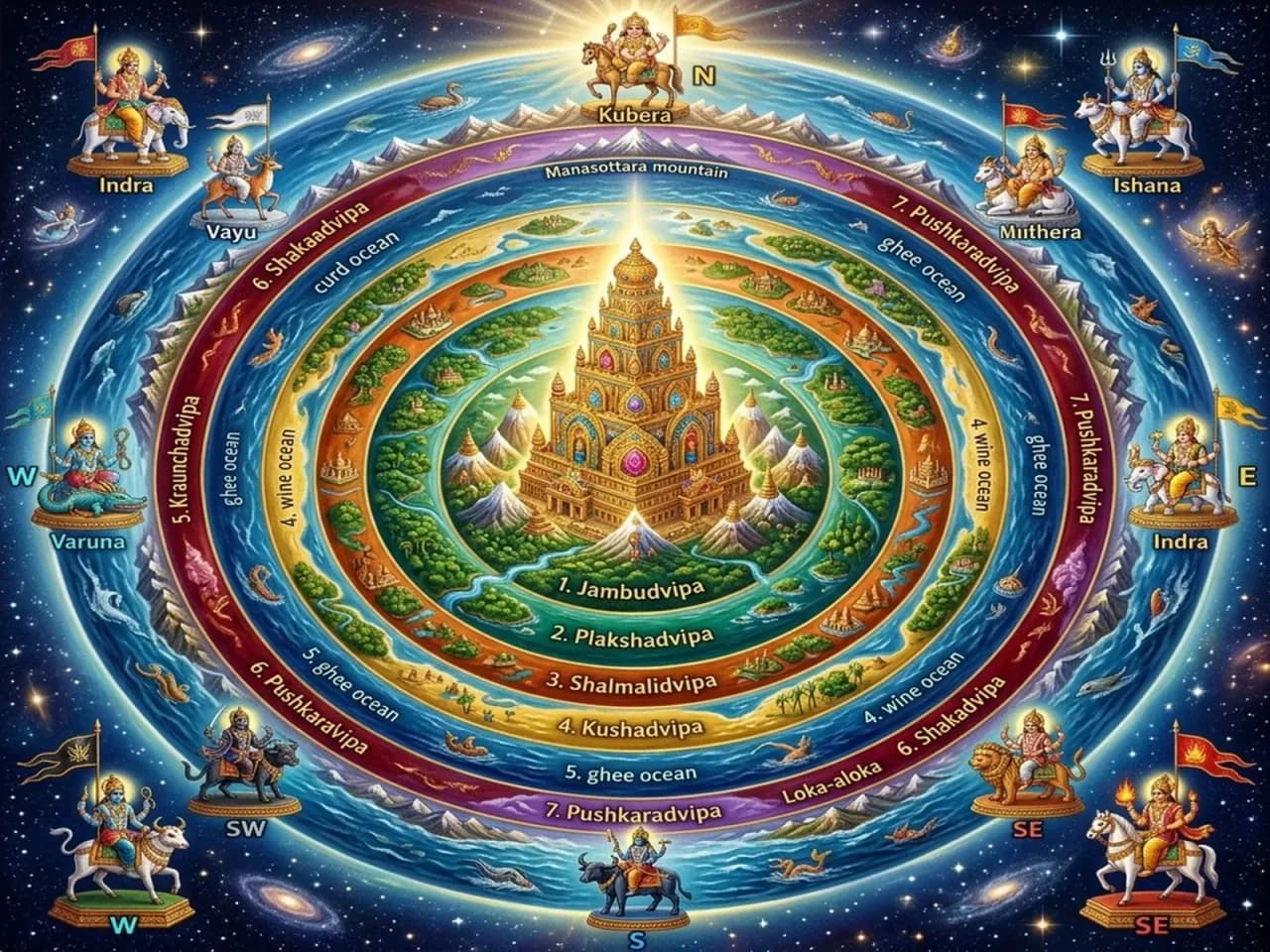
The Vishnu Purana, Bhagavata Skandha 5, and Devi Bhagavata describe the cosmic geography in elaborate detail. Modern readers encounter this both as a literal mythological map AND as a microcosmic key - the same architecture maps to the human spine (7 chakras = 7 upper lokas; spinal base = patalas). Below: 14 lokas, 7 dwipas with their 7 oceans, Mt. Meru, and the 8 dikpalakas guarding the 8 directions.
Inhabitants: Humans, animals, plants, minerals
The earth-plane. The world of karma - only here can new karma be created. Humans alone can ascend or descend from here.
Inhabitants: Pitris (ancestors), Yakshas, Gandharvas
The atmospheric plane. Realm of intermediate beings - those between human + deva. Pitri-yana (path of ancestors) reaches here.
Inhabitants: Devas, Indra, Apsaras
Heaven. Indra's court. Punya-merit takes one here for a temporary stay; once punya is exhausted, return to earth. NOT moksha - heaven is still in samsara.
Inhabitants: Bhrigu + other rishis who survive pralaya
Realm of great sages. Survives naimittika pralaya (the end-of-day-of-Brahma dissolution that destroys the lower 3 lokas).
Inhabitants: Devotees of Vishnu, Brahma's sons (Sanaka et al)
Realm of sublime devotees. Self-luminous beings.
Inhabitants: Vairagis (the totally renounced), Vaikhanasas
Realm of tapasvis. Beings of pure tapas.
Inhabitants: Brahma + the highest beings
Brahma's own realm. The highest manifest loka. From here, one either takes krama-mukti (gradual liberation) or returns to a new kalpa.
Inhabitants: Bala (son of Maya, asura)
First underworld below earth. Bala creates 3 kinds of women (svairini-self-willed, kamini-lustful, pumshchali-prostitute).
Inhabitants: Hara-Bhava (a form of Shiva), Bhavani
Second underworld. Shiva-Bhavani reside here.
Inhabitants: King Bali (with Vamana guarding the door)
Realm of King Bali. After Vamana stepped Bali to patala, Vishnu himself became the gatekeeper here.
Inhabitants: Maya (the architect-asura), other asuras
Realm of Maya - the asura architect. He built the assembly hall of Yudhishthira (in Mahabharata) and the puspaka-vimana.
Inhabitants: Kadru's sons - the snakes (Vasuki, Takshaka, etc)
Realm of the serpent-children of Kadru. Vasuki, who served as the churning-rope for Samudra Manthan, dwells here.
Inhabitants: Danavas, Daityas (asura clans)
Realm of the danava + daitya clans defeated by devas. Their natural habitat.
Inhabitants: Vasuki, the supreme naga, and on his hood - Adishesha bearing the earth
The lowest realm. Adishesha (the thousand-headed cosmic serpent) supports the entire cosmos from here. Vishnu reclines on Adishesha.
Jambu-dvīpa is where we live. It is the central and innermost of the 7 concentric continents, named after the Jambu (rose-apple) tree that grows near Mt. Meru. Bharata-varsha - the Indian subcontinent - is its southernmost division. It is the only karma-bhūmi in all of creation: the one place where souls can create karma, exhaust it, and advance toward liberation. Every Sankalpa you hear in a temple begins by naming this place.
Bhu-mandala (the earth-plane) is divided into 7 concentric dwipas (continents), each defined by a characteristic tree, and each surrounded by an ocean of a different substance (salt, sugarcane juice, wine, ghee, curd, milk, sweet water). Jambu-dwipa is the central one - Bharatavarsha is its southern part, and the ONLY karma-bhumi (where humans can create karma; all other dwipas are bhoga-bhumi, lands of enjoyment only).
| № | Dwipa | Vegetation | Surrounding ocean | Meaning |
|---|---|---|---|---|
| 1 | Jambu-dwipa · जम्बू द्वीप | Jambu (rose-apple) | Lavana (salt water) | The continent of the rose-apple tree. Centred on Mt. Meru. Bharatavarsha (India) is the southern part of Jambu-dwipa. The ONLY dwipa where humans can perform karma - hence called "Karma-bhumi". Other dwipas are bhoga-bhumi (lands of enjoyment only). |
| 2 | Plaksha-dwipa · प्लक्ष द्वीप | Plaksha (Indian fig) | Ikshu (sugarcane juice) | The continent of the fig tree. Surrounded by sugarcane-juice ocean. |
| 3 | Shalmali-dwipa · शाल्मलि द्वीप | Shalmali (silk-cotton) | Sura (wine) | The continent of the silk-cotton tree. |
| 4 | Kusha-dwipa · कुश द्वीप | Kusha (sacred grass) | Sarpi (ghee) | The continent of kusha-grass. Surrounded by an ocean of ghee. |
| 5 | Krauncha-dwipa · क्रौञ्च द्वीप | Krauncha tree | Dadhi (curd) | The continent of the krauncha tree. |
| 6 | Shaka-dwipa · शाक द्वीप | Shaka (teak / sometimes identified with vegetables) | Kshira (milk) | The continent of teak. Surrounded by milk-ocean - the ksheera-sagara where Vishnu reclines on Adishesha. |
| 7 | Pushkara-dwipa · पुष्कर द्वीप | Pushkara (lotus) | Svadu (sweet water) | The outermost continent. Surrounded by a freshwater ocean. Beyond it - Loka-loka-parvata (the boundary mountain), then darkness, then the cosmic egg shell. |
Jambu-dvīpa is divided into 9 varshas (continental divisions). Ilāvṛta-varsha surrounds Mt. Meru at the center. Four varshas lie N/S/E/W of it; four more frame those. Bharata-varsha is the only karma-bhūmi - where humans can create new karma and work toward liberation. All other 8 are bhoga-bhūmi (enjoyment realms). Click any card to expand.
रम्यक वर्ष
Ramyakas - serene, long-lived beings
उत्तर कुरु वर्ष
Uttara-kurus - 10,000-year lifespans, free of sorrow and disease
हिरण्मय वर्ष
Beings of golden luminosity
केतुमाल वर्ष
Kāmadeva rules; Lakṣmī resides; beings of unsurpassed beauty
इलावृत वर्ष
Śiva (the only male permitted), Durgā's śaktis, divine women
भद्राश्व वर्ष
Bhadrāśravas and their celestial clan
किंपुरुष वर्ष
Kimpuruṣas (horse-headed divine beings); Hanumān in eternal Rāma-bhakti
भारत वर्ष
Humans - the ONLY beings who can create new karma
हरि वर्ष
Beings of golden hue with all desires naturally fulfilled at birth
Grid arranged geographically: N (top) → S (bottom), W (left) → E (right), with Ilāvṛta-varsha at center. Source: Bhāgavata Purāṇa 5.16–18, Viṣṇu Purāṇa 2.2.
Bharata-varsha itself is sub-divided by its mountain ranges (Mahendra, Malaya, Sahya, Śuktimat, Ṛkṣa, Vindhya, Pāriyātra) into 9 khaṇḍas (regional divisions). The khaṇḍa is the most specific location identifier in a Sankalpa. In the Sankalpa generator below, your Indian state automatically maps to the correct khaṇḍa. Source: Viṣṇu Purāṇa 2.3.6-7.
General Bharata / all of India
North India - the Gaṅgā-Yamunā corridor
Northeast India + Bengal delta
Eastern coastal India - Oḍra coast
Central India - Vindhya-Deccan transition belt
Deep South India + Laṅkā
West India - Sindhu valley and desert regions
Northwest frontier - Gandhāra (Afghanistan-Pakistan border)
West coastal India - Varuṇa's maritime zone
A Sankalpa names your cosmic position, the exact moment, your identity, and your intent. Generate yours below. All panchang data is computed automatically from today's date. Identity fields (name, gotra, deity, intent) are optional - the Sankalpa remains valid even if left blank.
The cosmic axis. A mountain at the centre of Jambu-dwipa, 84,000 yojanas tall (1 yojana = ~12 km, so ~1 million km - astronomically beyond our solar-system altitude). All four quarters of Bhu-mandala radiate from it. Brahma's palace sits at its summit.
Interpretation - Scholars + sadhus read Mt. Meru cosmographically (a literal world-mountain) AND microcosmically (the spine of the human body, with the chakras as its 7 levels + Sahasrara at the summit). The Sri Yantra is also identified with Mt. Meru in some tantras.
Indra · इन्द्र
Mount: Airavata (white elephant)
Weapon: Vajra (thunderbolt)
Agni · अग्नि
Mount: Ram
Weapon: Shakti (spear)
Yama · यम
Mount: Buffalo
Weapon: Danda (rod)
Nirruti / Rakshasa · निऋति
Mount: Lion / corpse
Weapon: Sword
Varuna · वरुण
Mount: Makara (sea-creature)
Weapon: Pasha (noose)
Vayu · वायु
Mount: Deer / antelope
Weapon: Banner + goad
Kubera · कुबेर
Mount: Naravahana (man-mount) / horse
Weapon: Gada (mace)
Ishana (Shiva) · ईशान
Mount: Nandi (bull)
Weapon: Trishul (trident)