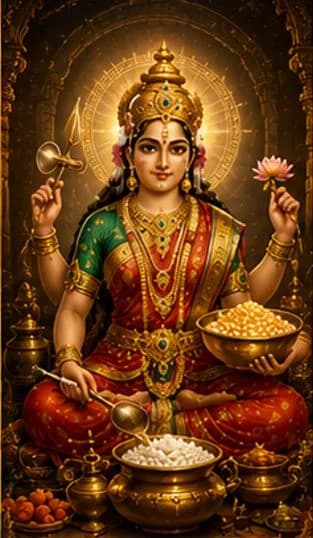
Annapurneshwari of Kashi · काशी अन्नपूर्णेश्वरी
Her supreme form as queen of Varanasi, enshrined beside Vishvanatha; the meal-bestowing tableau in which Shiva begs her alms belongs to this aspect.
The goddess of anna (food, grain, and nourishment) who sustains all living beings and bestows both bodily sustenance and the spiritual wealth of jnana and vairagya.
Who Annapurna is
Annapurna is a benevolent form of Parvati, consort of Shiva, enshrined as the queen (rajni) of Kashi alongside Vishvanatha, the king of the city. Her name joins anna ("food, grain") and purna ("full, complete"): she is "she who is replete with food," the cosmic feeder from whose hand even Shiva accepts alms. She is counted among the gentle (saumya) forms of the Devi and is invoked wherever food is cooked, offered, and shared.
What Annapurna embodies
Annapurna embodies anna-brahman - the Upanishadic teaching (Taittiriya Upanishad) that food is itself a form of Brahman, the ground from which beings arise, by which they live, and into which they return. She personifies the principle that sustenance is not maya to be dismissed but the very grace by which the formless sustains the embodied. As Shakti in her nourishing aspect, she is the active power (kriya-shakti) of the Divine that translates the abstract sustaining of the cosmos into the concrete giving of the daily meal.
The central narrative, elaborated in the Kashi Khanda of the Skanda Purana and echoed in the Devi Bhagavata, tells that Shiva once declared to Parvati that the material world, food included, is mere maya. To reveal the dignity of nourishment, the Devi withdrew her sustaining power and vanished; the three worlds were seized by famine, the seasons failed, and gods, sages, and men languished without offering or food. Moved by compassion she manifested at Kashi as Annapurna, setting up her kitchen and distributing food to all; Shiva himself came before her bearing a kapala (begging bowl) and received alms from her hand, acknowledging that anna is the grace through which even the ascetic body endures. A second strand, prominent in the Linga Purana, frames the episode around Shiva begging food for his ganas and dependents when no food could be had, Parvati appearing as Annapurna to feed them at the door. Her Himalayan parentage as daughter of Himavat further links her to the peak Annapurna named in her honour.
When: Eternal (anadi) as the nourishing Shakti of the Devi; her principal manifestation and enshrinement is set at Kashi within the present age.
Parents
As a form of Parvati, daughter of Himavat (king of the Himalayas) and Mena/Menavati.
Consort
Shiva, worshipped at Kashi as Vishvanatha / Vishweshwar; in the Annapurna episode he is the bhikshu (mendicant) who receives her alms.
Children
As Parvati: Ganesha and Kartikeya (Skanda).
Siblings
Ganga and (in Parvati's lineage) Mainaka.
Vahana (mount)
Generally depicted enthroned (simhasana) rather than upon a mount; the lion of Parvati/Durga is associated with her wider Shakti identity.
Annapurna is envisioned as a youthful, gracious goddess of reddish-golden (aruna) complexion with a moon-like face, seated upon a throne and crowned, often with a crescent adorning her head. In the common four-armed form she holds a jewelled vessel (ratna-patra) brimming with cooked food, anna or payasa, and a golden serving ladle (darvi); her remaining hands show the abhaya (fearlessness) and varada (boon-granting) mudras. Beside her Shiva frequently stands as the mendicant, kapala in hand, receiving alms - the defining tableau of the deity. She is richly ornamented and radiant, the very image of plenty and maternal grace.
Her supreme form as queen of Varanasi, enshrined beside Vishvanatha; the meal-bestowing tableau in which Shiva begs her alms belongs to this aspect.
The South Indian form, seated in padmasana holding shankha, chakra, sri-chakra and the gada/anna-patra; venerated as the feeding mother of Karnataka, her temple famed for ceaseless annadana.
"The food-giver"; the Bengali devotional form eulogised in Bharatchandra Ray's Annada-mangala, worshipped especially in the eastern Shakta tradition.
Her tantric form within the Sri-Vidya / Shakta corpus, associated with the Annapurna mantra-shastra and dhyana that identify her nourishing power with the Sri-Chakra Devi.
When Shiva dismissed food as illusion, Parvati withdrew as Annapurna and the worlds starved; even the gods found no offering and the rituals ceased. Out of mercy she revealed her kitchen at Kashi and fed all who came. Shiva approached with his begging bowl and accepted her alms, conceding that anna is the sustaining grace of the embodied - the lesson that gives Kashi its standing as the place where none should go hungry.
The Skanda Purana relates that Vedavyasa, denied alms in Kashi, raised his hand to curse the city that it lack wealth, food, and liberation. Annapurna herself appeared as a householder woman and fed him, dissolving his anger. Humbled, Vyasa was asked by Shiva to leave the city, and the episode became a charter for Kashi's renown as the abode of Annapurna where food is never refused.
The closing verse of the Annapurna Stotra dramatises Shiva as supplicant before his own consort: "Annapurne sadapurne... bhiksham dehi cha Parvati" - "O ever-full Annapurna, beloved of Shankara, grant me alms for the sake of jnana and vairagya." The food she gives is thus twofold: the bread that sustains the body and the wisdom-detachment that liberates the soul.
अन्नपूर्णे सदापूर्णे शङ्करप्राणवल्लभे । ज्ञानवैराग्यसिद्ध्यर्थं भिक्षां देहि च पार्वति ॥
annapūrṇe sadāpūrṇe śaṅkara-prāṇa-vallabhe | jñāna-vairāgya-siddhyarthaṁ bhikṣāṁ dehi ca pārvati ||
The principal verse, the heart of the Annapurna Stotra attributed to Adi Shankaracharya: "O Annapurna, ever-full, beloved of Shankara's life-breath; for the attainment of knowledge and dispassion, grant me alms, O Parvati." Recited before meals and in daily worship of the goddess.
माता च पार्वती देवी पिता देवो महेश्वरः । बान्धवाः शिवभक्ताश्च स्वदेशो भुवनत्रयम् ॥
mātā ca pārvatī devī pitā devo maheśvaraḥ | bāndhavāḥ śiva-bhaktāśca svadeśo bhuvana-trayam ||
The benedictory closing verse of the same stotra, declaring spiritual kinship: "Mother is Parvati Devi, father is Lord Maheshvara, my kinsmen are the devotees of Shiva, and my homeland is the three worlds." Chanted as the seal of Annapurna worship.
Annapurna is worshipped above all through annadana - the giving of food - held to be among the highest acts of dharma, together with keeping the kitchen pure and reciting a blessing over food before eating. Ritual offerings (naivedya) feature cooked rice, kheer/payasa, grains, fruit, kumkuma, turmeric, lamp, and incense; in Maharashtrian and other households small images of Annapurna are honoured with offerings of uncooked rice and grain. Her favourite offering is freshly cooked food shared with others, the meal itself being returned to her as prasada.
The teaching
Annapurna teaches that nourishment is sacred and that to feed another is to worship the Divine - anna-brahman, food as a form of Brahman. The image of Shiva begging alms from his own consort overturns the false hierarchy that exalts renunciation over sustenance: even the supreme ascetic depends on the giving hand of the Mother, and the food that fills the body is asked precisely for the sake of jnana and vairagya. To eat with gratitude, to waste nothing, and to ensure no one nearby goes hungry is, in her tradition, both the simplest service and a complete spiritual path.