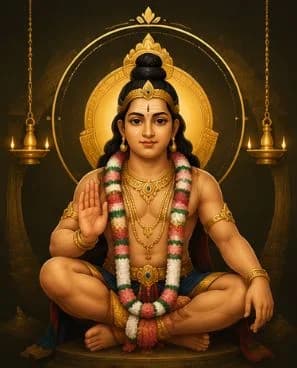
Dharmashāsta · धर्मशास्ता
The eternal, pan-Indian aspect - the lord who upholds dharma; worshipped widely across Kerala and Tamil Nadu, frequently with the consorts Pūrṇā and Puṣkalā.
Dharma, righteous warriorhood, brahmacharya (celibate asceticism), and protection of devotees on the inner pilgrimage to Self-realisation.
Who Ayyappa is
Ayyappa is the Hariharaputra - the son born of Hari (Vishnu in the Mohini form) and Hara (Shiva) - worshipped pre-eminently as the celibate warrior-ascetic enshrined at Sabarimala in Kerala. He is identified with the ancient deity Dharmashāsta (also called Ārya/Śāsta), the lord who "rules" (śās) and upholds dharma. In his most famous earthly life he is Manikanṭha, the foundling prince of Pandalam, who slew the demoness Mahishi and then ascended the Sabari hill as a yogi.
What Ayyappa embodies
He embodies the reconciliation of the two great streams of the Sanatana tradition - Shaiva and Vaishnava - as a single tattva: Harihara-aikya, the non-difference of Vishnu and Shiva. As Dharmashāsta he is the indwelling principle of dharma that governs and guards the cosmos, the jagad-guru-rūpa who chastises adharma. For the pilgrim he personifies the jīva's disciplined ascent (the forty-one-day vratam) from worldliness through tapas to the tattvamasi - the great Upanishadic identity revealed at the sanctum door.
The principal Puranic account (associated with the Brahmāṇḍa and Skanda Purāṇa traditions): after the asura Mahisha was slain by the Goddess, his sister Mahishī performed tapas and won from Brahmā a boon that she could be killed only by a child born of Shiva and Vishnu - a union she believed impossible. To resolve this and to recover the amrita, Vishnu took the enchanting Mohinī form; from the union of Hara and Hari-as-Mohinī was born Hariharaputra / Dharmashāsta, destined to destroy Mahishī. A second strand, popular in the Mohinī-Bhasmāsura narrative, places the Mohinī episode at the destruction of Bhasmāsura. The beloved sthala-purāṇa of Sabarimala continues the story on earth: the divine child, bearing a bell around his neck (hence Maṇikanṭha), is found on the banks of the Pampā and raised by the childless Rāja of Pandalam; he later fetches a tigress's milk, reveals his divinity, vanquishes Mahishī, and asks that a shrine be built at Sabarimala where the arrow he shot landed.
When: Anādi as the eternal Dharmashāsta tattva; his principal earthly manifestation as Manikanṭha of Pandalam is placed by tradition in a historical past localised to medieval Kerala.
Parents
Shiva (Hara) and Vishnu in the Mohinī form (Hari); hence Hariharaputra.
Consort
Worshipped as Naiṣṭhika Brahmachārī (perpetual celibate) at Sabarimala; in his Śāsta aspect elsewhere (especially Tamil Nadu) he is shown with two consorts, Pūrṇā and Puṣkalā, and a son Satyaka.
Children
Satyaka (in the householder Śāsta tradition); none in the Sabarimala brahmachārī aspect.
Siblings
Reckoned a brother-figure to Skanda/Murugan and Gaṇeśa as a son of Shiva.
Vahana (mount)
A tiger (vyāghra); also depicted mounted on a horse or an elephant in Śāsta iconography.
Classically golden- or dark-complexioned and youthful, seated in a yogic posture (the utkaṭikāsana / vīrāsana) with a band of cloth - the yoga-paṭṭa - tied around the waist and drawn-up knees, signifying contained tapas. The right hand is held in chin-mudrā or abhaya; he wears a jewelled bell (maṇi) on a chain at the throat, recalling Maṇikanṭha. Bedecked in flower garlands and often armed with bow and arrow, he is serene yet warrior-like; in the Śāsta form he may appear with consorts, mounted on a tiger, horse, or elephant.
The eternal, pan-Indian aspect - the lord who upholds dharma; worshipped widely across Kerala and Tamil Nadu, frequently with the consorts Pūrṇā and Puṣkalā.
The theological essence - son of Hari and Hara, the living embodiment of Harihara-aikya (the unity of Vishnu and Shiva).
The foundling prince of Pandalam who bore a bell at his throat, slew Mahishī, and revealed his godhood - the central narrative of the Sabarimala tradition.
The hill-lord of Sabarimala in perpetual brahmacharya, seated in yoga before the eighteen sacred steps (patinettām paṭi).
Lord of the bhūta-gaṇas (spirit-hosts) and guardian deity; the name invoked in his Gāyatrī and in tantric Śāsta worship.
Granted near-invincibility by Brahmā - vulnerable only to a son of Shiva and Vishnu - the demoness Mahishī terrorised the worlds. Vishnu assumed the Mohinī form and from his union with Shiva was born Dharmashāsta. Grown to manhood as the Pandalam prince, he met Mahishī in battle on the banks of the Aḻutā, struck her down, and freed her from a curse, whereupon she rose as a celestial maiden.
Raised by the childless Rāja of Pandalam, the boy Maṇikanṭha was sent into the forest to fetch tigress's milk as a cure for the queen - a ruse by a scheming minister to be rid of the heir. He returned riding a tigress amid a host of forest beasts, revealing himself as divine; renouncing the throne, he asked that a temple be raised where his arrow fell, and merged into the deity at Sabarimala.
Pilgrims who keep the forty-one-day vratam - wearing the mālā, observing celibacy and austerity, and bearing the irumuḍi bundle on the head - alone may climb the patinettām paṭi, the eighteen holy steps, to the sanctum. Above the doorway shines the mahāvākya 'Tat tvam asi' (That thou art): the ascent dramatises the soul's journey, and the darshan of Ayyappa is the recognition of one's own divine Self.
स्वामिये शरणम् अय्यप्प
Svāmiye śaranam Ayyappa
The universal śaranaghosha (call of surrender) chanted ceaselessly by pilgrims on the Sabarimala vratam; an utterance of total refuge at the feet of the Swāmi.
ॐ भूतनाथाय विद्महे महादेवाय धीमहि तन्नो शास्ता प्रचोदयात्
Oṃ Bhūtanāthāya vidmahe Mahādevāya dhīmahi tanno Śāsta prachodayāt
The Śāsta / Ayyappa Gāyatrī, invoking Bhūtanātha-Mahādeva and praying that Śāsta impel the intellect; used in formal upāsanā.
Worshipped through the disciplined forty-one-day Maṇḍala vratam: donning the tulsī or rudrāksha mālā, observing strict celibacy, austerity and sattvic living, and carrying the two-pouched irumuḍi on the head for the climb of the eighteen steps. Devotees address one another and the Lord alike as 'Swāmi,' chanting 'Svāmiye śaranam Ayyappa.' Favoured offerings are the aravaṇa pāyasam and appam prasāda, ghee (in the coconut offered at the sanctum), tulsī and flower garlands, and the singing of the Harivarāsanam at the nightly closing of the shrine.
The teaching
Ayyappa teaches the harmony of all paths - the literal Harihara-aikya proclaiming that Shiva and Vishnu, and by extension all sectarian divisions, are one Reality. His brahmacharya and warrior austerity model the conquest of the senses as the precondition for the vision of God. Above all, the Sabarimala pilgrimage is an enacted Vedānta: through equality (all pilgrims are 'Swāmi,' caste and rank set aside), tapas, and surrender, the seeker climbs to the threshold where 'Tat tvam asi' reveals the deity sought without to be the Self abiding within.