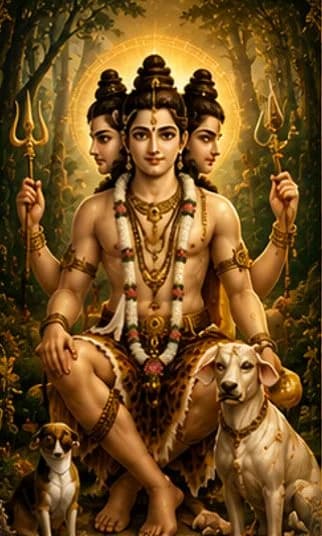
Avadhuta · अवधूत
The naked, ecstatic sage who has cast off all conditioning - the ideal of the Avadhuta Gita and Jivanmukti; the source-form of the entire Datta tradition.
The triune Guru-principle: bestower of self-knowledge (jnana), renunciation (vairagya), and yogic liberation as the conjoined power of creation, preservation, and dissolution.
Who Dattatreya is
Dattatreya is the combined incarnation of the Trimurti - Brahma, Vishnu, and Shiva - born as the son of the rishi Atri and the supremely chaste Anasuya. He is revered as the Adi-Guru of the Avadhuta lineage, the wandering naked sage absorbed in Brahman who teaches by his very presence. Because he is "given" (datta) by the gods themselves, he is approached above all as Guru rather than as a sectarian deity.
What Dattatreya embodies
He embodies the non-dual reality (Parabrahman) in which the three cosmic functions are one undivided principle; his three faces declare that creation, sustenance, and dissolution arise from a single Self. As Avadhuta he is the tattva of pure consciousness that has "shaken off" (ava-dhū) all bonds of body, varna, ashrama, and convention. He thus stands for the supreme Guru-tattva - the grace through which the bound jiva recognises its identity with that one Self.
In the Markandeya Purana account, Atri and Anasuya undertook severe tapas for a son equal to the gods; pleased, Brahma, Vishnu, and Shiva each granted a portion of themselves, and were born to Anasuya as Soma (Chandra, from Brahma), Dattatreya (from Vishnu), and Durvasa (from Shiva). A widely told variant centres on Anasuya's pativrata-test: the three gods, prompted to test her chastity, came as guests demanding to be fed while she was unclothed; by her power she turned them into infants and nursed them, and as a boon they merged and were reborn as her single three-headed child, 'given' (datta) to her - hence Dattatreya. Devotional tradition treats Dattatreya himself as the full amsha of Vishnu, while the broader Datta-cult venerates the one three-headed Guru as the integral Trimurti.
When: Anadi (beginningless) as the eternal Guru-tattva; his principal manifestation is placed in the early lineage of the Puranic age, and he reappears across the yugas as guru to Kartavirya, Parashurama, Alarka, Yadu, and Prahlada.
Parents
Father: Rishi Atri (one of the Saptarshi); Mother: Anasuya, daughter of Kardama and Devahuti, paragon of pativrata-dharma
Consort
None in mainstream tradition - he is the celibate Avadhuta and Yogiraj; later Tantric/Datta-sampradaya texts associate the consort-power Anaghalakshmi with him in the Anagha-vrata
Children
None (renunciate); his 'progeny' is his disciplic lineage (the Avadhuta-parampara)
Siblings
Chandra (Soma, amsha of Brahma) and the sage Durvasa (amsha of Shiva); Dattatreya being the amsha of Vishnu
Vahana (mount)
No formal mount; iconographically attended by four dogs (the four Vedas) and a cow (Kamadhenu / Mother Earth) standing behind him
Most commonly shown with three heads (Brahma, Vishnu, Shiva) and six arms, as a radiant ascetic seated or standing by an audumbara (fig) tree near a river or sacred fire. The six hands hold the emblems of the Trimurti - japamala and kamandalu (Brahma), shankha and chakra (Vishnu), trishula and damaru (Shiva). Four dogs at his feet represent the four Vedas (and, in another reading, the four states of consciousness) and a wish-fulfilling cow stands behind him as Mother Earth; he is digambara (sky-clad) or clad as a simple jata-dhari monk, smeared with bhasma. Older medieval images sometimes depict a single-headed, four-armed form.
The naked, ecstatic sage who has cast off all conditioning - the ideal of the Avadhuta Gita and Jivanmukti; the source-form of the entire Datta tradition.
The three-headed, six-armed icon worshipped in temples, displaying the integrated power of Brahma, Vishnu, and Shiva as one Guru.
First historical avatar of the Datta-sampradaya at Pithapuram (Andhra), foundational to the Gurucharitra tradition.
Second great avatar (c. 14th–15th c.), associated with Karanja, Audumbar, Narasobawadi, and Ganagapur; central figure of the Sri Guru Charitra.
The yogic teacher-form invoked as Smartrugami - who appears the moment a devotee remembers him; later extended in devotee-tradition to Swami Samarth of Akkalkot and Sai Baba of Shirdi.
In the Bhagavata Purana (Skandha XI, the Uddhava-Gita section), Krishna recounts how the boy-Avadhuta Dattatreya instructed King Yadu. Asked the source of his blissful wisdom, Dattatreya named twenty-four gurus drawn from nature - earth, air, sky, water, fire, moon, sun, python, ocean, moth, bee, elephant, deer, fish, the courtesan Pingala, a child, an arrow-maker, a serpent, a spider, and more. Each taught one virtue (forbearance, non-attachment, contentment, single-pointedness), illustrating that the whole world is the open book of a discerning seeker.
Dattatreya granted the Haihaya king Kartavirya Arjuna a thousand arms and invincible sovereignty (Mahabharata and the Puranas), making him a model of dharmic rule who later fell through pride. In the same lineage Dattatreya is honoured as guru of Parashurama, to whom - in Shrividya tradition - he imparted the secret Tripura-rahasya and the path of the Devi.
In the Markandeya Purana, the troubled king Alarka, sent by his mother Madalasa, receives from Dattatreya the yoga of detachment that frees him from his enemies within and without. The non-dual essence of his realization is crystallised in the Avadhuta Gita, traditionally his discourse, which proclaims the actionless, ever-free nature of the Self beyond all distinctions.
ॐ द्रां दत्तात्रेयाय नमः
oṃ drāṃ dattātreyāya namaḥ
The principal Datta mula-mantra; 'draṃ' is his bija. Japa is traditionally done facing the audumbara tree, on a rudraksha or sphatika mala, for protection, jnana, and the removal of obstacles.
ॐ दत्तात्रेयाय विद्महे अवधूताय धीमहि तन्नो दत्तः प्रचोदयात्
oṃ dattātreyāya vidmahe avadhūtāya dhīmahi | tanno dattaḥ pracodayāt
The Dattatreya Gayatri; many lineages read the central line as 'atriputrāya dhīmahi' ('on the son of Atri we meditate'). The simple invocation 'Shri Gurudev Datta' (श्री गुरुदेव दत्त) is the universal Datta-nama-japa.
Worshipped foremost as Sadguru through nama-japa ("Shri Gurudev Datta"), the Datta-bija mantra, and recitation of the Sri Guru Charitra (a 7-day or 3-day parayana), the Datta Stotra, Karunatripadi, and Datta Bavani. He is invoked under the audumbara (cluster-fig) tree, which is held to be his perpetual abode, and Thursday (Guruvar) is his special day. Favourite offerings are simple and sattvic - bhasma/vibhuti, kumkum, fresh flowers, fruit, and madhukari (mendicant's gathered food) reflecting his Avadhuta nature; lighting a lamp at the audumbara and feeding dogs are cherished acts of his seva.
The teaching
Dattatreya's teaching is that the Self is ever-free and that the entire creation is a teacher to the awakened eye: liberation comes not by renouncing the world outwardly but by inwardly "shaking off" identification with body and ego (the Avadhuta state). Through the parable of the twenty-four gurus he dissolves the boundary between scripture and life, and through his three-in-one form he reveals that creation, preservation, and dissolution - and all sectarian divisions - rest on one non-dual reality. To remember the Guru sincerely is itself the path, for Smartrugami Datta comes the instant he is called.