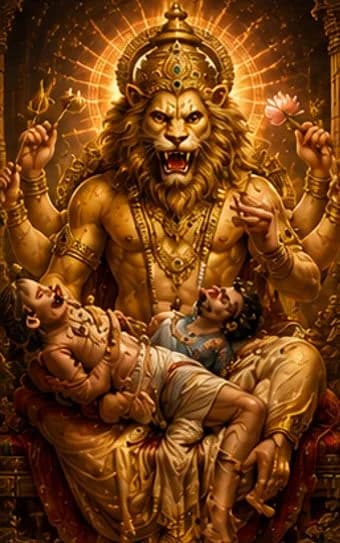
Ugra-Narasimha · उग्रनरसिंह
The terrible, wrathful form caught in the act of slaying Hiraṇyakaśipu; also called Sphaṭika or Vīra-Narasimha, radiating destructive fury.
Fierce divine protection of devotees and the destruction of evil and seemingly invincible adharma.
Who Narasimha is
Narasimha is the fourth avatāra of Viṣṇu, half-man and half-lion, who incarnated to slay the asura king Hiraṇyakaśipu and rescue his child-devotee Prahlāda. He is counted among the daśāvatāra and is the supreme refuge (śaraṇya) for those in unbearable danger. As Narahari he unites the human (nara) and the lion (hari/siṃha), embodying ferocity wholly subordinated to compassion for the bhakta.
What Narasimha embodies
Narasimha embodies the tattva that the Divine transcends every category and limit: he is the answer to the "impossible" boon, appearing where logic says God cannot. He represents ugra-śakti - terrifying divine power - bound to bhakta-vātsalya, the protective love for the devotee, so that wrath itself becomes grace. He is the principle that adharma, however cleverly fortified, is torn apart at the threshold where it presumes to exclude God.
Hiraṇyakaśipu, brother of the slain Hiraṇyākṣa, performed terrible tapas and won from Brahmā a boon that he die neither by day nor night, neither inside nor outside, on neither earth nor sky, by neither man nor beast nor weapon, by neither deva, asura nor any created being. Made effectively immortal, he persecuted his own son Prahlāda for worshipping Viṣṇu. When the boy declared God present even in a pillar, Hiraṇyakaśipu struck it, and Viṣṇu burst forth as Narasimha at twilight (neither day nor night), on the threshold of the hall (neither in nor out), placed the asura on his lap (neither earth nor sky), and tore him with his claws (no weapon), being himself neither wholly man nor beast - fulfilling every clause while voiding the boon. The principal account is in the Bhāgavata Purāṇa (Canto 7); the Viṣṇu, Matsya, Kūrma, Padma, and Liṅga Purāṇas give variants. A major Śaiva variant holds that after the slaying Narasimha's wrath was uncontainable and Śiva manifested as Śarabha (or sent Vīrabhadra) to pacify him - a tradition Vaiṣṇavas counter with the Gaṇḍabheruṇḍa form; another strand makes Prahlāda himself the one whose stuti finally calms the Lord.
When: Anādi as Viṣṇu's eternal avatāra; his principal manifestation is placed in the Satya (Kṛta) Yuga, the first of the world-ages.
Parents
As an avatāra, an aṃśa of Viṣṇu himself; he is unborn (aja) and self-manifest (svayambhū), emerging from the pillar rather than from a womb.
Consort
Lakṣmī, who as Narasimhī / Lakṣmī-Narasimha sits enthroned with him in his benign aspect; in some Andhra and Tamil temple traditions a local consort Cencu-Lakṣmī (Chenchu Lakshmi) is honoured.
Children
None in the principal narrative; the rescued bhakta Prahlāda stands in the place of a beloved son.
Siblings
Shares the avatāra-lineage of Viṣṇu's ten descents (Matsya, Kūrma, Varāha precede him; he is the fourth).
Vahana (mount)
None in his fierce theophany; Viṣṇu's mount Garuḍa attends the Lord, and Narasimha is more often shown enthroned or standing than mounted.
Depicted with a leonine head and mane and a powerful human torso, usually golden-tawny or fiery in complexion, with blazing eyes, bared fangs, and an extended tongue. Commonly four-armed (sometimes eight or more), bearing the śaṅkha (conch) and cakra (discus) while the lower hands disembowel Hiraṇyakaśipu, the asura sprawled across his thighs and entrails drawn out like a garland. In the fierce (ugra) icon he is shown at the broken pillar and threshold; in the benign (saumya) icon he sits in yoga-bandha with Lakṣmī, or in padmāsana with a yoga-paṭṭa band, hands in abhaya and varada, serene and crowned.
The terrible, wrathful form caught in the act of slaying Hiraṇyakaśipu; also called Sphaṭika or Vīra-Narasimha, radiating destructive fury.
The serene yogic form seated in meditation with a yoga-paṭṭa binding his knees, hands at rest - the Lord after wrath has subsided, master of yoga.
The auspicious form with Goddess Lakṣmī seated on his left lap, embodying grace, prosperity, and the pacified compassionate Lord widely worshipped in homes and temples.
A two-headed (or fierce bird-faced) hyper-wrathful manifestation said to overpower Śiva's Śarabha; emblematic in Karnataka iconography and royal heraldry.
The set of nine Narasimha forms (Jvālā, Ahobila, Mālola, Krodha, Kāraṃja, Bhārgava, Yogānanda, Kṣatravaṭa, Pāvana) enshrined across the Ahobilam kṣetra in Andhra Pradesh.
Granted near-invincibility by Brahmā, Hiraṇyakaśipu demanded universal worship, but his son Prahlāda's heart never wavered from Viṣṇu. The asura subjected the boy to poison, serpents, fire, and being hurled from cliffs, yet each time Viṣṇu preserved him unharmed. Prahlāda's unshakable bhakti, declaring Hari present everywhere, set the stage for the Lord's appearance.
Enraged, Hiraṇyakaśipu demanded whether Viṣṇu was in the very pillar of his hall, and smote it. At dusk Narasimha exploded forth, seized the asura, carried him to the doorway's threshold, laid him across his thighs, and rent him with his claws - satisfying every condition of the boon while annulling it. Thus the seemingly impossible death was accomplished, and the worlds were freed from tyranny.
After the slaying, Narasimha's ugra-rūpa was so fearsome that even the devas, Lakṣmī, and Brahmā dared not approach. The child Prahlāda alone came forward, bowed without fear, and offered the Prahlāda-stuti; touched by the boy's love, the Lord calmed, placed his hand on Prahlāda's head in blessing, and granted him fearless devotion. This episode is the source of Narasimha's renown as the swift, fierce protector of those who take refuge.
उग्रं वीरं महाविष्णुं ज्वलन्तं सर्वतोमुखम् । नृसिंहं भीषणं भद्रं मृत्युमृत्युं नमाम्यहम् ॥
ugraṃ vīraṃ mahāviṣṇuṃ jvalantaṃ sarvato mukham | nṛsiṃhaṃ bhīṣaṇaṃ bhadraṃ mṛtyumṛtyuṃ namāmyaham ||
The famed Narasimha Gāyatrī / praṇāma verse from the Bhāgavata-related stotra corpus; invoked for protection and the conquest of fear and death ('death of death'). Widely recited daily and at saṃkaṭa (crisis).
ॐ नमो भगवते नरसिंहाय
oṃ namo bhagavate narasiṃhāya
The principal Narasimha mūla-mantra in the namo-bhagavate form; a complete devotional invocation used in japa and upāsanā for refuge and removal of obstacles.
Worshipped for protection from enemies, black magic, grave danger, and untimely death, and for fearless devotion; Narasimha upāsanā is especially associated with the kavaca and the recitation of his stotras. Favoured offerings include panaka (jaggery-and-pepper water, the signature naivedya at Mangalagiri), cooling substances such as sandal paste, butter, and milk to soothe his fierce heat, and tulasī, coconut, and pepper-rasam preparations. Devotees recite the Narasimha Kavaca (attributed to Prahlāda), the Lakṣmī-Narasimha Karāvalamba Stotra of Ādi Śaṅkara, and the Divya Prabandham verses, often facing the temple at dusk.
The teaching
Narasimha teaches that no fortress of ego or evil - however cleverly it bargains with fate - can exclude the Divine, who is present even in a pillar and will burst forth at the appointed threshold. He shows that God's wrath and God's love are one reality: the same claws that destroy the tyrant cradle the devotee. The narrative exalts ananya-bhakti: a child's pure surrender outweighs cosmic power, and the Lord arrives precisely at the limit of human helplessness, tearing apart the impossible for those who take refuge.