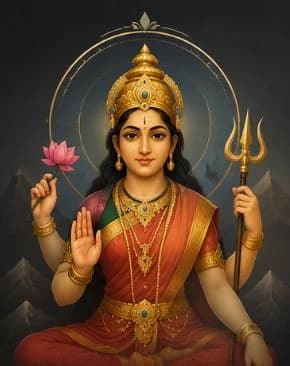
Gauri · गौरी
The golden, fair, pure form won through penance; the auspicious goddess of marriage and marital felicity, invoked by women for a good husband and a long, happy union (Gauri-puja, Hartalika, Gangaur).
Goddess of the benign, married, fertile aspect of Shakti - divine power, devotion (bhakti), love, marital harmony, motherhood, and ascetic resolve (tapas).
Who Parvati is
Parvati is the Mother Goddess in her gentle (saumya) form: the daughter of Himavan, lord of the Himalaya, and the consort of Shiva. She is the reincarnation of Sati, reborn expressly to win Shiva back to householder life; through her are born Ganesha and Kartikeya. As Uma, Gauri, and Ambika she is the most widely beloved face of the Devi, worshipped as the ideal of devotion, wifely virtue, and motherly grace.
What Parvati embodies
Parvati embodies Shakti - the dynamic, creative energy without which Shiva (pure consciousness) is inert; the maxim "Shivah Shaktya yukto" expresses that the two are inseparable. She is Prakriti to Shiva's Purusha, the active principle that animates and sustains the cosmos, and the personal, approachable form of the one supreme Mahadevi. In the Shakta vision her benign form (Parvati/Gauri) and her fierce forms (Durga, Kali) are a single power in different moods, the whole of manifest reality being her play.
Parvati is universally the rebirth of Sati, Shiva's first wife, who yielded up her body at Daksha's sacrifice after her father insulted Shiva. The standard Puranic account (Shiva Purana, Devi Bhagavata, Skanda Purana) has Sati reborn as the daughter of Himavan (king of the mountains) and his queen Mena/Menavati, named Parvati ('she of the mountain'). To win the grief-stricken, meditating Shiva she undertakes extraordinary tapas in the Himalaya - austerities so severe she even gives up leaves, earning the name Aparna ('leafless') - after Kama's attempt to rouse Shiva fails and he is burnt to ash. A second strand of tradition (Kena Upanishad) presents her as Uma Haimavati, the eternal wisdom-goddess who appears to the proud Devas to reveal the supreme Brahman, an identity that predates and underlies the Puranic biography. A further well-known motif is that her dark complexion is shed (by Shiva's jest about it) when she performs penance to become golden - thus Gauri, 'the fair one.'
When: Anadi (beginningless and eternal) as Mahadevi/Adi Shakti; her principal saguna manifestation as Parvati follows Sati's self-immolation and is narrated across the Puranic age.
Parents
Himavan (Parvataraja, king of the Himalaya) and Mena (Menavati); as Sati she was daughter of Daksha Prajapati.
Consort
Shiva (Mahadeva), with whom she forms the half-male-half-female Ardhanarishvara.
Children
Ganesha and Kartikeya (Skanda/Murugan); in some traditions also the goddess Ashokasundari and Andhaka.
Siblings
Ganga (in many accounts a sister); Mainaka, the mountain.
Vahana (mount)
The lion (simha) or tiger, shared with her form as Durga.
Depicted as a serene, beautiful woman of golden or fair complexion (Gauri), usually two-armed when shown beside Shiva, often holding a blue lotus (nilotpala) and a mirror or making varada and abhaya mudras. She is richly adorned as a married woman (saubhagya) - vermilion, mangala-sutra, fine ornaments - and is shown seated with Shiva on Kailasa, or with the infant Skanda on her lap (Somaskanda), or fused as the left half of Ardhanarishvara. In fuller Shakta forms she bears weapons and many arms and rides a lion.
The golden, fair, pure form won through penance; the auspicious goddess of marriage and marital felicity, invoked by women for a good husband and a long, happy union (Gauri-puja, Hartalika, Gangaur).
Parvati as the Mother who feeds the worlds, holding the rice-vessel and ladle; she is said to give alms to Shiva himself as the divine mendicant. Her chief seat is Kashi (Varanasi).
The supreme, transcendent beauty of the Sri Vidya tradition, foremost of the Dasha Mahavidyas; enthroned in Srichakra and praised in the Lalita Sahasranama. Identified with Kamakshi of Kanchi.
Her warrior emergence as the unconquerable slayer of Mahishasura, celebrated in the Devi Mahatmya; the bridge between her benign and fierce natures, worshipped at Navaratri.
The fish-eyed queen-goddess of Madurai, born to a Pandya king, who rules and bears arms in her own right before her celestial wedding to Shiva as Sundareshvara.
When the Devas, needing a son of Shiva to defeat Taraka, sent Kama to strike the meditating Shiva with desire for Parvati, Shiva opened his third eye and reduced Kama to ash. Undeterred, Parvati renounced ease and performed terrible austerities in the mountains, standing through heat and cold and at last giving up even fallen leaves (Aparna). Shiva, testing her, came disguised as a young ascetic to disparage himself, but her devotion never wavered, and he revealed himself and accepted her as his bride. This narrative is told at length in the Shiva Purana and immortalised in Kalidasa's Kumarasambhava.
Wishing for a guardian of her own while she bathed, Parvati fashioned a boy from the turmeric paste (or sandal/clay) of her body and gave him life, setting him at the door. When the returning Shiva was barred by this unknown youth, a battle followed in which the boy's head was severed; to console the grieving Parvati, Shiva restored him to life with the head of an elephant. Thus Ganesha became the foremost son and the lord of beginnings, born wholly of the Mother.
In the Kena Upanishad, after the Devas grew proud of a victory truly won by Brahman, a mysterious Yaksha confounded Agni and Vayu, who could neither burn a blade of grass nor move it. When Indra approached, the figure vanished and in its place stood Uma Haimavati, the resplendent goddess, who taught him that the power was Brahman. Here Parvati appears as the very embodiment of higher wisdom (brahma-vidya), the one who reveals the Absolute to the gods.
ॐ पार्वत्यै नमः
Om Parvatyai Namah
The simplest principal invocation - 'Salutations to Parvati.' Suited to daily japa and worship for her grace, strength, and marital and domestic harmony.
ॐ पार्वत्यै च विद्महे शिवप्रियायै धीमहि । तन्नो दुर्गिः प्रचोदयात् ॥
Om Parvatyai cha vidmahe Shivapriyayai dhimahi | Tanno Durgih prachodayat ||
The Parvati Gayatri: 'We know Parvati, we meditate on the beloved of Shiva; may that Durga impel us.' A widely chanted dhyana-mantra; a closely parallel form reads 'Om Katyayanyai vidmahe Kanyakumaryai dhimahi, tanno Durgih prachodayat.'
Parvati is worshipped through Gauri-puja and the sixteen upacharas, with married women especially keeping vratas (Teej, Gauri Vrata, Mangala Gauri on Tuesdays of Shravana) for the well-being of husband and family. She is offered red flowers and the red lotus, vermilion (kumkum) and turmeric, bilva and the symbols of saubhagya (bangles, sindoor, mangala-sutra), sweets, and coconut; her stutis include the Devi Mahatmya, Lalita Sahasranama, Soundarya Lahari, and the Annapurna Stotra. Couples invoke her with Shiva for marital concord, and she is honoured wherever Shiva is worshipped, the two being inseparable.
The teaching
Parvati teaches that devotion and disciplined resolve (tapas) can win the highest, and that the divine is approached not only through renunciation but through love, marriage, and householder duty made sacred. As Shakti inseparable from Shiva, she reveals that power and consciousness, the active and the still, the world and the Absolute, are one reality - and as Uma Haimavati she is herself the wisdom that unveils Brahman. She models the integration of fierce strength and gentle grace, showing the seeker that the same Mother who slays demons also nourishes and forgives.