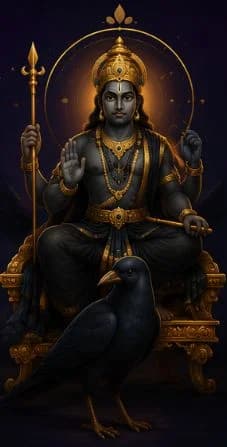
Shanaishchara · शनैश्चर
The primary cosmic form - 'the slow-mover', Saturn pacing the zodiac roughly two and a half years per sign, the deliberate hand of karmic time.
Saturn (the graha), karma and its just requital, time, longevity, hardship, discipline, and the testing of the soul.
Who Shani (Shani Dev) is
Shani is the divine personification of the planet Saturn (Śani-graha) and one of the Navagraha. He is the son of Surya (the Sun) by Chhaya, elder kin of Yama Dharmaraja, and the cosmic judge who returns to every being the exact fruit of its thoughts, words, and deeds. Though feared as the sternest of the grahas - slow, dark, and unsparing - he is in essence Nyayadhisha, the impartial dispenser of dharma who afflicts only to purify.
What Shani (Shani Dev) embodies
Shani embodies the tattva of karmaphala-dharma: the inexorable law by which every action ripens into a corresponding result, in its own slow time. He is Kala in its aspect of patient, grinding inevitability - the principle that strips away ego, pride, and attachment through limitation, delay, loss, and labour. As Saturn he governs the boundaries of mortal life (longevity, old age, decay) and the discipline (tapas, vairagya) by which the soul is matured. He is therefore not a god of evil but the great teacher of detachment, justice, and humility.
Shani is the son of Surya and Chhaya ('Shadow'). When Surya's first consort Samjna (Saranyu) could not bear his blaze, she left her shadow-double Chhaya in her place; from Surya and Chhaya was born Shani (with Yama and Yami/the Yamuna as related offspring of Surya). Chhaya's intense penance to Shiva while pregnant - fasting in the open sun - is one traditional explanation for Shani's dark complexion. A widely told variant holds that Surya rejected the dark infant and mocked Chhaya, whereupon Shani's wrathful gaze eclipsed the Sun and stopped his chariot until Shiva reconciled them; another tradition traces Shani's destructive dr̥ṣṭi to a curse from his neglected wife, who decreed that whomever he looked upon directly would be ruined. Shani is also counted among the eleven Rudras in some Puranic enumerations.
When: Anadi (beginningless) as a cosmic principle; as a graha he is eternal, presiding ceaselessly over the wheel of karma across all yugas.
Parents
Surya (Sun) and Chhaya (the shadow-form of Samjna/Saranyu)
Consort
Shani's wife (variously Manda / Damini / Jyeshtha-Dhamini in regional tradition; in some accounts Neela)
Children
Generally regarded as without prominent issue; named offspring are rare in the Puranas
Siblings
Yama (Dharmaraja) and Yami (Yamuna); Tapati and Savarni Manu; by Surya's other consort, the Ashvins and Vaivasvata Manu
Vahana (mount)
The crow (kaka); also depicted on a vulture/raven, a buffalo, or an iron chariot drawn by eight black horses
Shani is shown with a dark (krishna-varna), blue-black complexion, lame or limping (whence Mandagati, 'slow-gaited'), clad in deep blue or black and adorned with sapphire (nilamani) and dark-blue flowers. He is typically four-armed, bearing a danda (rod/sceptre of punishment), an arrow and bow, an axe (parashu) or trident (trishula), with the remaining hand in varada (boon-giving). He is seated or mounted upon his crow, or upon a vulture, buffalo, or an iron chariot yoked to eight black steeds; his lowered, sidelong gaze (signifying the dreaded Shani-drishti) and his iron ornaments are characteristic.
The primary cosmic form - 'the slow-mover', Saturn pacing the zodiac roughly two and a half years per sign, the deliberate hand of karmic time.
Shani as one of the nine grahas worshipped in the Navagraha mandala, presiding over the west and over Saturdays, dispensing the results of past deeds.
Esoteric tradition names seven forms/hues of Shani (Pingala, Krishna, Babhru, Roudrantaka, Aurva, Mahakaya, etc.), each governing a different mode of his influence.
Shani as the supreme magistrate of dharma, wielding the danda - the just, incorruptible judge who afflicts the guilty and shelters the upright.
In bhakti tradition, freed or befriended by Hanuman, Shani vows to spare Hanuman's devotees; hence oil offered to Hanuman on Saturdays and Shani's benevolent aspect toward the devout.
Astrologers warned King Dasharatha of Ayodhya that Shani was about to pierce the 'cart' of Rohini (Rohini-Shakata-Bheda), an omen portending a twelve-year drought dreaded by gods and demons alike. Rather than submit, the Ikshvaku king rode his chariot to the celestial sphere and confronted Shani with a hymn of praise, the Dasharatha-krita Shani Stotra (preserved in the Brahmanda Purana). Moved by his courage and devotion, Shani granted the boon that he would never again rend the Rohini-cart, and declared that whoever recites this stotra would be shielded from his malefic influence.
When Parvati's newborn son was presented to the assembled gods, Shani - cursed so that his direct gaze destroys whatever it falls upon - kept his eyes lowered. Pressed by the proud mother to look upon the child, he glanced, and at once the infant's head was severed and consumed. Vishnu then fetched the head of an elephant (Gajasura) and restored the boy as Gajanana, Ganapati - a tale (told in Brahmavaivarta and allied traditions) that explains both Ganesha's elephant head and the gravity of Shani's drishti.
When Shani, in his pride of power, sought to cast his Sade-Sati upon Hanuman, the vanara seized him - in popular versions crushing him beneath his weight or binding him with his tail while leaping to Lanka. In agony Shani begged release and asked for oil to soothe his hurts; freed, he vowed never to trouble Hanuman's devotees. From this comes the custom of offering oil (tila-taila) to Hanuman on Saturdays as a remedy against Shani's afflictions.
ॐ नीलाञ्जनसमाभासं रविपुत्रं यमाग्रजम् । छायामार्तण्डसम्भूतं तं नमामि शनैश्चरम् ॥
Om nilanjana-samabhasam ravi-putram yamagrajam | chhaya-martanda-sambhutam tam namami shanaishcharam ||
The Shani verse of the Navagraha Stotra - the universally chanted invocation: 'Lustrous like blue collyrium, son of the Sun, elder kin of Yama, born of Chhaya and Martanda - to that Shanaishchara I bow.' The standard daily prayer to Saturn.
ॐ शं शनैश्चराय नमः
Om sham shanaishcharaya namah
The principal Shani mula/beeja mantra, recited (often 23,000 times in purashcharana, or japa on Saturdays facing west) for relief during Sade-Sati and Shani dasha. A common variant is 'Om praam preem praum sah shanaishcharaya namah.'
Shani is propitiated chiefly on Saturdays and during Sade-Sati (his seven-and-a-half-year transit over the moon-sign) and Dhaiyya, through taila-abhisheka (bathing the image in sesame or mustard oil), lighting lamps of til-oil, recitation of the Dasharatha Shani Stotra, Shani Chalisa, Shani Ashtottara, and the Navagraha mantras, and dana (charity) to the needy. Favoured offerings are black or blue articles: black sesame (til) and urad dal, mustard oil, blue/black cloth and flowers, iron, horseshoe-iron, neelam (sapphire), and oil-lamps; service to the poor, the lame, the aged, and crows (his vahana) is held especially dear to him.
The teaching
Shani teaches that the universe is morally exact: nothing is escaped, only deferred, and every soul reaps precisely what it has sown, in its appointed time. His hardships - delay, loss, limitation, humbling - are not punishment but tapas, the slow fire that burns away pride, greed, and attachment and ripens vairagya and dharma. To the upright, the patient, the truthful, and the charitable he is the gentlest of friends; to the arrogant he is the severe but just teacher. The deeper instruction of Shani is surrender to rita - to accept the fruit of one's karma with equanimity, and through discipline and righteous action, to grow free.