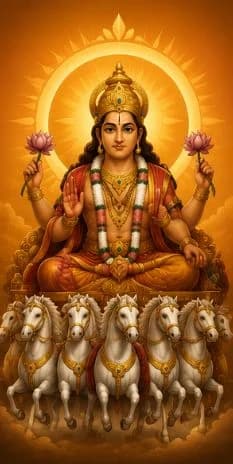
Savitṛ · सवितृ
The Sun as the impeller and vivifier - the unseen power that 'sets in motion'; the deity addressed by the Gāyatrī (Sāvitrī) of RV 3.62.10, emphasising spiritual illumination over the physical orb.
The visible Sun - source of life, light, time, health and vision, and the supreme deity of the Saura sampradāya.
Who Surya is
Sūrya is the Sun-god, the one Āditya among the twelve who is worshipped as the perceptible (pratyakṣa) form of the Divine - "the only God one can actually see." Son of Kaśyapa and Aditi, he traverses the sky in a single-wheeled chariot drawn by seven horses and driven by the legless Aruṇa. As Savitṛ he is the inner light invoked by the Gāyatrī, and as Vivasvān he is progenitor of the Solar Dynasty (Sūryavaṃśa) and father of Manu, Yama and the Yamunā.
What Surya embodies
Sūrya embodies the principle of prakāśa - self-luminous consciousness that dispels darkness without and ignorance within - and is identified in the Upaniṣads with the brahman dwelling in the solar orb (Chāndogya, Īśa). He is the cosmic timekeeper whose motion ordains the ṛtu, the ayanas and the year, and the sustaining ātman of all that lives, since prāṇa itself is said to rise with the dawn. In the trimūrti correspondence he is sṛṣṭi at dawn, sthiti at noon and saṃhāra at dusk - Brahmā, Viṣṇu and Rudra in one disc.
The principal Purāṇic account (Mārkaṇḍeya, Viṣṇu, Bhāgavata) makes Sūrya the son of the sage Kaśyapa and Aditi, eldest and most radiant of the twelve Ādityas; when the Devas were oppressed by the Asuras, Aditi performed the Āditya-vrata and the Sun consented to be born of her to vanquish them. A widely cited variant explains his epithet Mārtāṇḍa ('born of a dead/cosmic egg, aṇḍa'): the embryo was at one point lifeless or, in the Ṛgvedic hymn (RV 10.72), Aditi cast out the eighth son Mārtāṇḍa whom the gods then brought forth to live and die in the world. A third, distinct strand identifies him with Vivasvān, husband of Saraṇyū (Saṃjñā), daughter of the divine artisan Tvaṣṭṛ/Viśvakarman.
When: Eternal in essence (anādi), being the Vedic Sun praised from the Ṛgveda onward; his iconic Purāṇic and Saura-cult form crystallised in the epic–Purāṇic age.
Parents
Kaśyapa (father) and Aditi (mother); hence Āditya, 'son of Aditi'.
Consort
Saṃjñā (Saraṇyū), daughter of Viśvakarman/Tvaṣṭṛ, and her shadow Chāyā; also named are Rājñī, Prabhā and Niṣubhā in various Purāṇas.
Children
By Saṃjñā: Vaivasvata Manu, Yama and the Yamunā, and the Aśvins (born when both were in equine form). By Chāyā: Śani (Saturn), Sāvarṇi Manu, Tapatī and Viṣṭi. Karṇa of the Mahābhārata and Sugrīva of the Rāmāyaṇa are also his sons; Revanta is counted among his offspring.
Siblings
The other Ādityas (sons of Aditi) - including Indra, Varuṇa, Mitra, Bhaga, Aryaman, Aṃśa, Dhātṛ, Tvaṣṭṛ, Pūṣan, Vivasvān and Viṣṇu in the Vāmana incarnation, the lists varying by text.
Vahana (mount)
A chariot (ratha) of one wheel drawn by seven horses - the seven chandas/metres or the colours of light - charioteered by Aruṇa, the dawn; he has no separate mount.
Sūrya is depicted of red-gold or copper complexion, lotus-eyed, robed in red, blazing with a thousand rays and crowned, seated or standing erect in a chariot. He holds a full-blown lotus (padma) in each of his two principal hands - the only deity shown grasping flowers that bloom at his own touch. North-Indian and especially the distinctive 'Maga/Śāka-dvīpī' Sūrya wears boots (udīcyaveṣa) and a waist-girdle (avyaṅga), attended by Daṇḍī and Piṅgala, and flanked by the archer-consorts Uṣā and Pratyūṣā loosing arrows at the dark; the seven horses and one-wheeled chariot driven by the thighless Aruṇa are constant emblems.
The Sun as the impeller and vivifier - the unseen power that 'sets in motion'; the deity addressed by the Gāyatrī (Sāvitrī) of RV 3.62.10, emphasising spiritual illumination over the physical orb.
The Sun as ancestor: husband of Saṃjñā and father of Vaivasvata Manu, founder of the present manvantara and of the Sūryavaṃśa, the solar lineage of Ikṣvāku, Rāma and the Raghus.
The primordial Āditya 'born of the (dead) egg', the eighth son of Aditi cast forth and revived - the cosmogonic aspect that issues forth and withdraws creation.
The Sun adored as a form of Viṣṇu/Nārāyaṇa, the supreme Brahman seated in the solar orb (the haṃsa of the Īśopaniṣad); the focus of much Vaiṣṇava–Saura devotion.
The twelve solar forms - one for each month (e.g. Dhātṛ, Mitra, Aryaman, Pūṣan, Tvaṣṭṛ, Savitṛ, Bhaga, Vivasvān, Aṃśa, Varuṇa, Indra, Viṣṇu) - through whom the Sun governs the year.
Unable to bear Sūrya's blazing heat, his wife Saṃjñā left her shadow-double Chāyā in her place and fled, taking the form of a mare in the northern lands. When the deception came to light, Saṃjñā's father Viśvakarman set Sūrya upon his lathe and pared away an eighth of his effulgence to a bearable radiance; from the shorn brilliance were forged the discus of Viṣṇu, the trident of Śiva and the weapons of the gods. Sūrya, taking the form of a stallion, rejoined her, and of that union were born the twin physician-gods, the Aśvins, and Revanta.
In the Yuddha-Kāṇḍa of Vālmīki's Rāmāyaṇa (6.105), as a weary Rāma faces Rāvaṇa, the sage Agastya appears and imparts the Āditya-hṛdaya, the 'Heart of the Sun', extolling Sūrya as the soul of all the gods and the cause of creation, sustenance and dissolution. Rāma sips water, recites it thrice facing the Sun, and rises filled with vigour to slay Rāvaṇa - establishing the hymn as the foremost Saura stotra.
In boyhood Hanumān leapt skyward mistaking the rising Sun for a ripe fruit, and was struck down by Indra's vajra - yet later Sūrya accepted him as pupil, teaching the Vedas and grammar even while wheeling unceasingly across the sky. As guru-dakṣiṇā the Sun asked him to aid his son Sugrīva, binding Hanumān to the service that would unfold in the Rāmāyaṇa.
ॐ भूर्भुवः स्वः । तत्सवितुर्वरेण्यं भर्गो देवस्य धीमहि । धियो यो नः प्रचोदयात् ॥
oṃ bhūr bhuvaḥ svaḥ | tat savitur vareṇyaṃ bhargo devasya dhīmahi | dhiyo yo naḥ pracodayāt ||
The Sāvitrī or Gāyatrī Mantra (Ṛgveda 3.62.10, ṛṣi Viśvāmitra), the supreme Vedic prayer to Savitṛ for illumination of the intellect - recited daily at the three sandhyās and the heart of Sūrya-upāsanā.
ॐ ह्रां ह्रीं ह्रौं सः सूर्याय नमः
oṃ hrāṃ hrīṃ hrauṃ saḥ sūryāya namaḥ
The Navagraha bīja-mantra of Sūrya, used in graha-śānti, the Āditya-hṛdaya tradition and Sunday/Ratha-saptamī worship; a simpler form is 'oṃ sūryāya namaḥ' / 'oṃ ghṛṇiḥ sūryāya namaḥ'.
Worshipped above all through arghya - water offered to the rising Sun with cupped hands at the morning sandhyā - alongside Sūrya-namaskāra, the Gāyatrī and Āditya-hṛdaya, and circumambulation. Sunday and Ratha Saptamī are his special days; devotees fast, wear and offer red - red flowers (especially japā/hibiscus and lotus and arka), rakta-candana (red sandal), wheat and jaggery - and light the lamp facing east. Chhaṭh devotees stand in water to give arghya at dawn and dusk, the purest folk form of his upāsanā.
The teaching
Sūrya teaches that the same light shines impartially on all and is never stained by what it falls upon - the model of the liberated soul, luminous, detached and ceaselessly giving. To greet the Sun is to honour the indwelling self (the ātman in the solar orb of the Īśa and Chāndogya Upaniṣads), so that outer light becomes a discipline for kindling inner light; thus the Gāyatrī prays not merely for radiance but that 'he may impel our thoughts.' His daily, unfailing rounds make him the very emblem of ṛta - duty performed without lapse - and of the dispelling of tamas by jñāna.