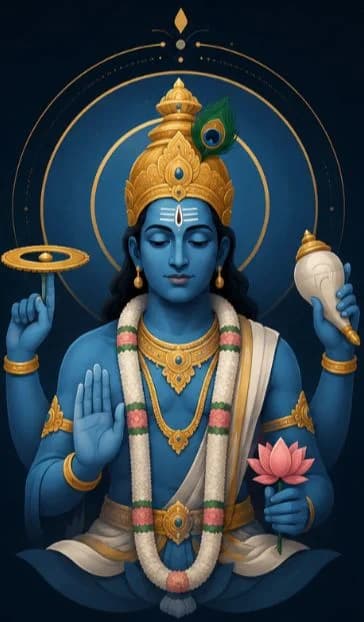
Dashavatara
The ten descents - Matsya, Kurma, Varaha, Narasimha, Vamana, Parashurama, Rama, Krishna, Buddha, Kalki.
The preserver and sustainer of the cosmos; the indwelling order (dharma) that holds creation together.
Who Vishnu is
Vishnu is the preserver of the Trimurti - the all-pervading (the root vish means “to pervade”) who maintains cosmic order and descends as avataras (Rama, Krishna, and the Dashavatara) whenever dharma declines. Reclining on the serpent Ananta upon the ocean of milk, he dreams the universe into being; Brahma is born from the lotus of his navel.
What Vishnu embodies
He is sustaining grace and dharma embodied - the principle that preserves, protects, and restores balance. For the Vaishnava traditions he is Parabrahman, the supreme person (Purushottama), of whom all other deities are aspects or servants.
Vishnu is eternal (Sanatana), unborn as the supreme Narayana resting on the causal waters. He is not created but creates: from his navel-lotus Brahma arises to fashion the worlds. He “takes birth” only by his own will, as avataras within time, to rescue dharma - never by karmic necessity.
When: Eternal (Narayana); manifests across the yugas through the Dashavatara.
Consort
Lakshmi (Shri) - fortune and abundance, ever at his side.
Children
Brahma (from his navel-lotus); Kamadeva in some accounts.
Vahana (mount)
Garuda - the eagle (the Vedas, swiftness of the liberated soul); Ananta-Shesha as his couch.
Dark-blue/sky-hued, four-armed, bearing the conch (Panchajanya - primordial sound), discus (Sudarshana Chakra - the wheel of time/dharma), mace (Kaumodaki - power) and lotus (Padma - purity); the Kaustubha gem and Shrivatsa mark on his chest, yellow silks (pitambara), reclining on Shesha or standing with Lakshmi.
The ten descents - Matsya, Kurma, Varaha, Narasimha, Vamana, Parashurama, Rama, Krishna, Buddha, Kalki.
The supreme cosmic form reclining on Ananta upon the ocean of milk.
The Kali-yuga refuge at Tirumala - the most-visited form today.
The abstract wooden form of Puri, worshipped with Balabhadra and Subhadra.
The universal form revealed to Arjuna in Bhagavad Gita 11.
Between dissolutions Vishnu sleeps the yoga-nidra on the thousand-hooded Shesha amid the milk-ocean; when a new cycle dawns, a lotus rises from his navel bearing Brahma, who begins creation anew.
When the elephant-king Gajendra, seized by a crocodile, cried out in total surrender holding up a lotus, Vishnu flew on Garuda to free him - the archetype of grace answering helpless devotion (sharanagati).
On the Kurukshetra field Vishnu, as Krishna, showed Arjuna his universal form - all worlds, gods, and time itself blazing within one body - the vision that grounds the Bhagavad Gita’s teaching of surrender.
ॐ नमो नारायणाय
Om Namo Narayanaya
The Ashtakshara - eight-syllable heart-mantra of Vaishnavism.
ॐ नमो भगवते वासुदेवाय
Om Namo Bhagavate Vasudevaya
The Dvadashakshara - twelve-syllable mantra of surrender.
Worshipped with tulsi leaves (dear to him above all), the Vishnu Sahasranama, salagrama-shila, and the Dvadashakshara. Ekadashi fasting is kept in his honour; the conch, lotus, and yellow flowers mark his rites.
The teaching
The universe is held by an order that protects the good and restores balance - and grace descends whenever we truly surrender. Vishnu teaches sharanagati: do your dharma, hold to tulsi-pure devotion, and let the Preserver carry the rest.