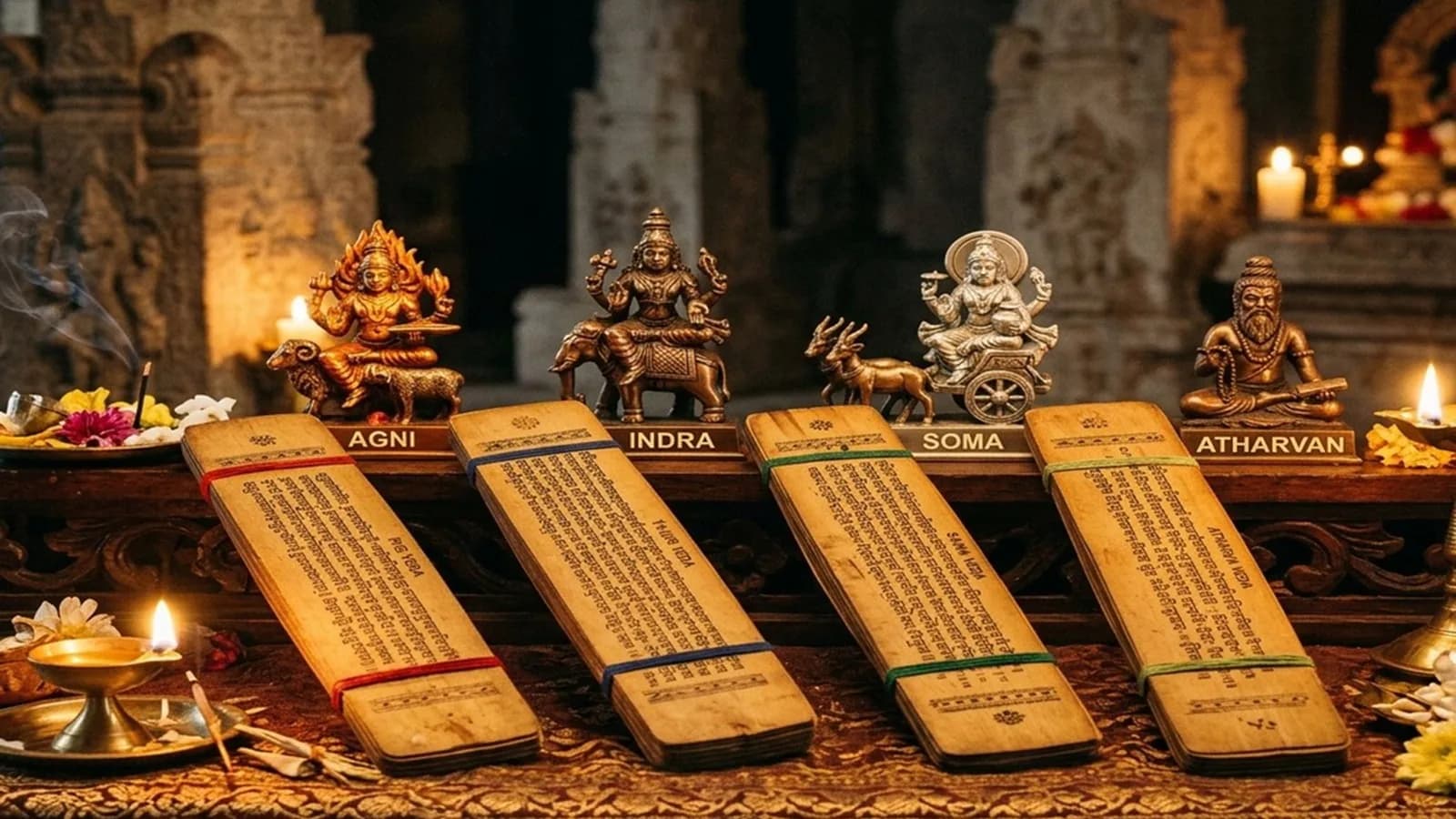
The sixth Vedanga. Kalpa= “procedure, method, way of doing” - the “how-to” of the Veda. Each major Veda-shakha (recension-branch) developed a complete kalpa-sutra cycle containing four classes: Shrauta Sutras (Vedic public yajnas), Grihya Sutras (domestic samskaras), Dharma Sutras (ethics + law), and - most remarkably - Shulba Sutras (geometry for altar construction; the foundation of Indian mathematics).
What is a kalpa-sutra cycle?
A complete kalpa-sutra is a four-part cycle attached to a specific Veda-shakha. For example, the Apastamba cycle (Krishna Yajur Veda, Taittiriya shakha) consists of: the Apastamba Shrauta Sutra (24 prashnas covering the great public yajnas), the Apastamba Grihya Sutra (covering home rituals), the Apastamba Dharma Sutra (covering ethics + law), and the Apastamba Shulba Sutra (covering altar geometry).
A practising brahmana family follows one complete kalpa-sutra - typically the one associated with the family’s Veda-shakha lineage. So a Tamil Smarta Iyer (Yajur Vedi, Taittiriya shakha, Apastamba sutra) performs every life-cycle ritual according to the Apastamba Grihya Sutra; a Maharashtrian Konkanastha (Yajur Vedi, Vajasaneyi shakha, Katyayana sutra) performs them according to the Paraskara (associated with Katyayana lineage); and so on. This is why two families that look identically “Hindu” from the outside may follow visibly different ritual procedures.
Scope - The most elaborate of the four classes. Covers the 21 public Vedic sacrifices: 7 paka-yajnas (smaller cooked-offering rites), 7 havir-yajnas (clarified-butter and grain rites), and 7 soma-yajnas (the great pressed-juice sacrifices including Agnihotra, Agnistoma, Atyagnistoma, Vajapeya, Rajasuya, Ashvamedha, Sautramani). Each rite is broken into thousands of micro-procedures: the layout of the altar, the timing of each oblation, the precise wording of each mantra, the role of each priest (hota, adhvaryu, udgata, brahma).
Examples - Apastamba Shrauta Sutra (Krishna Yajur Veda; 24 prashnas + 6 paribhasha-prashnas). Baudhayana Shrauta Sutra (oldest extant). Ashvalayana Shrauta Sutra (Rig Veda; 12 adhyayas). Katyayana Shrauta Sutra (Shukla Yajur Veda).
Modern continuation - Performance of the great Shrauta yajnas is now rare but living - the Athirathram (oldest continuous Soma yajna in the world, last performed at Panjal, Kerala in 1975 and 2011) is documented in Frits Staal’s Agni: The Vedic Ritual of the Fire Altar. Several Veda-pathshalas (Sringeri, Kanchi, Pune) maintain Shrauta priests.
Scope - The most actively used class today. Codifies all domestic rituals: the daily aupasana (morning + evening household fire), the panchamahayajnas (five daily duties - brahma-yajna, deva-yajna, pitri-yajna, bhuta-yajna, manushya-yajna), the samskaras (16 life-cycle rituals from garbhadhana to antyeshti), vivaha (marriage), sthala-grihapravesha (house-warming), shraddha (ancestor-offerings), and vrata observances.
Examples - Apastamba Grihya Sutra. Ashvalayana Grihya Sutra. Paraskara Grihya Sutra (Shukla Yajur Veda). Sankhayana Grihya Sutra. Gobhila Grihya Sutra (Sama Veda). Hiranyakeshin Grihya Sutra. Bodhayana Grihya Sutra.
Modern continuation - Every Hindu samskara performed today - namakarana, upanayana, vivaha, antyeshti - follows a specific Grihya Sutra of the family’s parent Veda-shakha. Most South Indian Smarta brahmanas use Apastamba; Sri Vaishnavas use Bodhayana; North Indian Rig Vedi families use Ashvalayana; Shukla Yajur Vedi families use Paraskara.
Scope - The shortest and oldest of the four classes - the precursor to the later Dharma Shastras. Covers: the four ashramas, varna-dharma duties, the eight kinds of marriage, the duties of brahmacharya, householder dharma, ascetic dharma, the king’s dharma, courts of justice, prayaschitta (expiations), food laws, contact rules.
Examples - Apastamba Dharma Sutra (oldest extant - ~600-300 BCE). Baudhayana Dharma Sutra. Vasishtha Dharma Sutra (this Vasishtha is later, not the Saptarshi). Gautama Dharma Sutra (oldest of all, per most scholars). These four are the source-texts of the Hindu ashrama-system.
Modern continuation - The classical Dharma Sutras were expanded into the 18 Dharma Shastras (Manu, Yajnavalkya, Parashara, etc) - see the Dharma Shastras page for the developed corpus. Modern Hindu personal law (the Hindu Code Bills 1955-56) descends through this lineage.
Scope - The most surprising of the four classes - pure geometry and mathematics. Composed to specify the precise construction of Vedic altars (vedi) using only a measuring rope (shulba) and pegs. The altars had to be constructed in specific shapes (chayana - falcon-shaped, turtle-shaped, etc) with exact area-equivalence to a square. Solving these construction problems forced the Shulba authors to discover and formalise: the Pythagoras theorem, the square root of 2, methods for squaring the circle, transforming triangles to squares of equal area, and more.
Examples - Baudhayana Shulba Sutra (the oldest; ~800 BCE; contains the first known statement of the Pythagoras theorem at sutra 1.12: “dirgha-chaturasrasya akshnaya rajjuh parshva-mani tiryag-mani cha yat prthag bhute kurutas tad ubhayam karoti”). Apastamba Shulba Sutra. Manava Shulba Sutra. Katyayana Shulba Sutra.
Modern continuation - Indian mathematics begins here. The Shulba theorems pre-date Pythagoras (~570-495 BCE) by several centuries. Modern temple Vastu (the geometric layout of temple complexes) and Vedic altar reconstructions still consult the Shulba Sutras.
The kalpa-sutra cycles bear the names of their compiler-acharyas. Each was associated with a specific Veda-shakha; today, a modern brahmana family’s kalpa-sutra lineage typically reflects its historical Vedic affiliation.
Works - Apastamba Shrauta Sutra, Apastamba Grihya Sutra, Apastamba Dharma Sutra, Apastamba Shulba Sutra (a complete kalpa-sutra cycle).
Significance - The most-followed kalpa-sutra in South India. The complete Apastamba corpus is structured into 30 prashnas - first 24 cover Shrauta, prashnas 25-26 are Grihya, 27 is Dharma, 28 is the mantra-collection, 29 is Shulba, 30 is a paribhasha-section.
Modern following - Most South Indian Smarta brahmanas. Tamil + Kannada + Telugu Smarta lineages predominantly Apastamba-shakha.
Works - Baudhayana Shrauta Sutra, Baudhayana Grihya Sutra, Baudhayana Dharma Sutra, Baudhayana Shulba Sutra.
Significance - Author of the oldest Shulba Sutra. The first to formally state the Pythagoras theorem (Baudhayana Shulba 1.12). His grihya sutra is the foundation of Sri Vaishnava ritual practice. Probably the oldest of the kalpa-sutra authors (~800-600 BCE).
Modern following - Sri Vaishnava brahmanas (Iyengars + Tamil Acharya families). Some Andhra and Karnataka brahmana families.
Works - Ashvalayana Shrauta Sutra (12 adhyayas), Ashvalayana Grihya Sutra (4 adhyayas).
Significance - The foremost kalpa-sutra of the Rig Veda. Sankhayana wrote a parallel set for the Bashkala shakha. Ashvalayana’s Grihya Sutra is the textual basis for the upanayana, vivaha, and antyeshti procedures of most Rig Vedi families.
Modern following - Most North Indian Rig Vedi brahmanas. Maharashtrian Deshastha Rig Vedi families.
Works - Katyayana Shrauta Sutra (26 adhyayas), Katyayana Shulba Sutra. The Paraskara Grihya Sutra (Shukla Yajur Veda) is sometimes attached to Katyayana’s lineage.
Significance - The foremost kalpa-sutra of the Shukla Yajur Veda. Katyayana Shrauta is the most precise and detailed of all Shrauta Sutras - every soma sacrifice is laid out in step-by-step procedure. Katyayana also authored the famous Varttika commentary on Panini’s Ashtadhyayi.
Modern following - North Indian Shukla Yajur Vedi (Madhyandina + Kanva) brahmanas. Many Maharashtra Konkanastha + Saraswat families.
Works - Manava Shrauta Sutra, Manava Grihya Sutra, Manava Shulba Sutra.
Significance - Author for the Maitrayaniya shakha (a Krishna Yajur Veda branch now mostly extinct). The Manava Shulba Sutra is one of the most mathematically sophisticated; it independently derives and formalises area-preservation transformations.
Modern following - A small remnant Maitrayaniya community in Maharashtra + Gujarat. The Manava texts are studied for their mathematical content even outside this community.
Works - Hiranyakeshin Shrauta Sutra (27 prashnas), Hiranyakeshin Grihya Sutra, Hiranyakeshin Dharma Sutra.
Significance - A parallel kalpa-sutra to Apastamba for the Taittiriya shakha. Some scholars consider Hiranyakeshin to be a near-identical recension of Apastamba with minor variations. Hiranyakeshin sometimes followed by South Indian families who differ slightly from Apastamba lineages.
Modern following - Some Telugu + Tamil brahmana families. Smaller following than Apastamba.
Works - Sankhayana Shrauta Sutra, Sankhayana Grihya Sutra, Sankhayana Aranyaka.
Significance - The Rig Vedic counterpart of Ashvalayana, but for the Bashkala shakha rather than the Shakala. Less widely followed today but still active.
Modern following - Some Maharashtra + Karnataka + Goa Rig Vedi families.
Works - Drahyayana Shrauta Sutra, Drahyayana Grihya Sutra (sometimes attached as Khadira Grihya Sutra).
Significance - The principal Sama Veda kalpa-sutra. Sama Veda brahmanas are now rare. Latyayana is the parallel author. Drahyayana’s Shrauta details the proper recitation of the Sama-gana during a yajna.
Modern following - A handful of Sama Veda families in Tamil Nadu, Kerala, Karnataka, and Maharashtra.
The Shulba Sutras are the most surprising part of the kalpa-sutra corpus. Composed to specify how to construct Vedic altars (vedi) using a rope (shulba) and pegs, they end up containing the first known formal statements of geometric theorems - five centuries or more before similar results appear in Greek mathematics.
“Dirgha-chaturasrasya akshnaya rajjuh parshva-mani tiryag-mani cha yat prthag bhute kurutas tad ubhayam karoti”
Statement - The diagonal-rope of a rectangle produces an area equal to the sum of the areas produced by the side-rope and the width-rope independently.
Modern equivalent - a² + b² = c² (Pythagoras theorem, stated by Pythagoras ~5th c BCE; Baudhayana ~ 800 BCE).
Baudhayana lists the rope-lengths (3, 4, 5), (5, 12, 13), (8, 15, 17), (7, 24, 25), (12, 35, 37) as valid altar-corner constructions.
Statement - These specific integer Pythagorean triples produce exact right-angle corners using only a rope with knots.
Modern equivalent - These are exactly the famous Pythagorean triples taught in modern algebra.
“Pramanam tritiyena vardhayet, tat chaturthena atmachatustrimsonena” - “Increase the measure by its third, and that third by its own fourth less the thirty-fourth part of that fourth”.
Statement - √2 ≈ 1 + 1/3 + 1/(3·4) - 1/(3·4·34) = 1.4142156... (accurate to 5 decimal places).
Modern equivalent - Modern value: 1.41421356... - Baudhayana’s value differs only in the 6th decimal place.
Methods to construct a square whose area equals that of a given circle, using only rope and pegs.
Statement - The construction implies a value of π ≈ 3.0883 (less accurate than Greek values, but still a working approximation for altar-area calculation).
Modern equivalent - Modern π ≈ 3.14159. Baudhayana’s value is rough; later Indian astronomers (Aryabhata, Madhava) gave far better approximations.
Procedure to transform any rectangle into a square of equal area, and vice versa.
Statement - Take a rectangle a × b. Cut off a square a × a from one end. Place the remaining strip (a × (b-a)) on the side. Compute the new square’s side from the resulting gnomon-shape using Pythagoras.
Modern equivalent - This is geometric algebra - solving x² = a·b for x. Equivalent to the geometric mean construction.
Family identifies its shakha
Every brahmana family identifies its parent Veda + shakha at the upanayana - e.g. “Yajurveda, Taittiriya shakha, Apastamba sutra, Bharadvaja gotra, Angirasa pravara”. This identification is recited at every major samskara.
Purohita follows that sutra
The family’s purohita (officiating priest) reads from the Grihya Sutra of the same shakha. The mantras chanted, the sequence of oblations, the timing of each step - all are specified by the family’s parent sutra. This is why a marriage performed by a Tamil Apastamba priest looks different from one performed by a Maharashtrian Katyayana priest, even when both are entirely “Hindu”.
The continuity guarantee
Because the kalpa-sutra is a fixed text, the ritual procedure has not drifted in 2,500+ years. A modern Apastamba namakarana is procedurally indistinguishable from one performed in the 4th century BCE. This continuity is what gives Hindu samskaras their archetypal weight.
Vastu + Shilpa Shastra
Vastu Shastra (temple + house architecture) and Shilpa Shastra (sculpture + iconography) inherit their geometric foundations from the Shulba Sutras. The square mandala used in temple ground-plans and the geometric proportions of murti-sculpting are direct descendants.
Dharma Shastras expansion
The Dharma Sutras’ brief code-statements were expanded into the great Dharma Shastras (Manu, Yajnavalkya, etc). These in turn became the source-texts of Anglo-Hindu jurisprudence (1772-1947) and partially survive in modern Hindu personal law (the Hindu Code Bills 1955-56).
Shrauta yajnas - living rare
The great public Shrauta yajnas are now rare but not extinct. The Athirathram at Panjal (Kerala) has been performed several times in the past century - documented by Frits Staal in his magnum opus Agni. Several Veda-pathshalas actively maintain the Shrauta priest tradition (hota, adhvaryu, udgata, brahma).
Read further - See Samskaras for the 16 life-cycle rituals codified in the Grihya Sutras, Dharma Shastras for the expanded code-corpus that descends from the Dharma Sutras, Vedangas hub for the six-anga overview, and the four Vedas for the shruti corpus the kalpa-sutras serve. Standard editions: G. Buhler’s English translations in the Sacred Books of the East (vols 2, 14, 30 for Apastamba, Vasishtha, Baudhayana Dharma Sutras), Frits Staal’s Agni: The Vedic Ritual of the Fire Altar (2 vols, 1983), and the Pune critical editions of the Shulba Sutras by S. N. Sen + A. K. Bag (1983).