1
Avahana
आवाहन · Invocation
Mentally invite the deity to take residence in the murti or yantra. Hand gesture: avahana mudra (palms cupped, drawing inward).
Three closely-related topics on one page. The 16 upacharas are the standard sequence of any formal Hindu puja. Panchayatana pujais Adi Shankara's five-deity householder arrangement that lets a single home altar accommodate multiple sectarian traditions. And the yantra-mantra-tantra triad is the technical vocabulary that describes how the worship works.
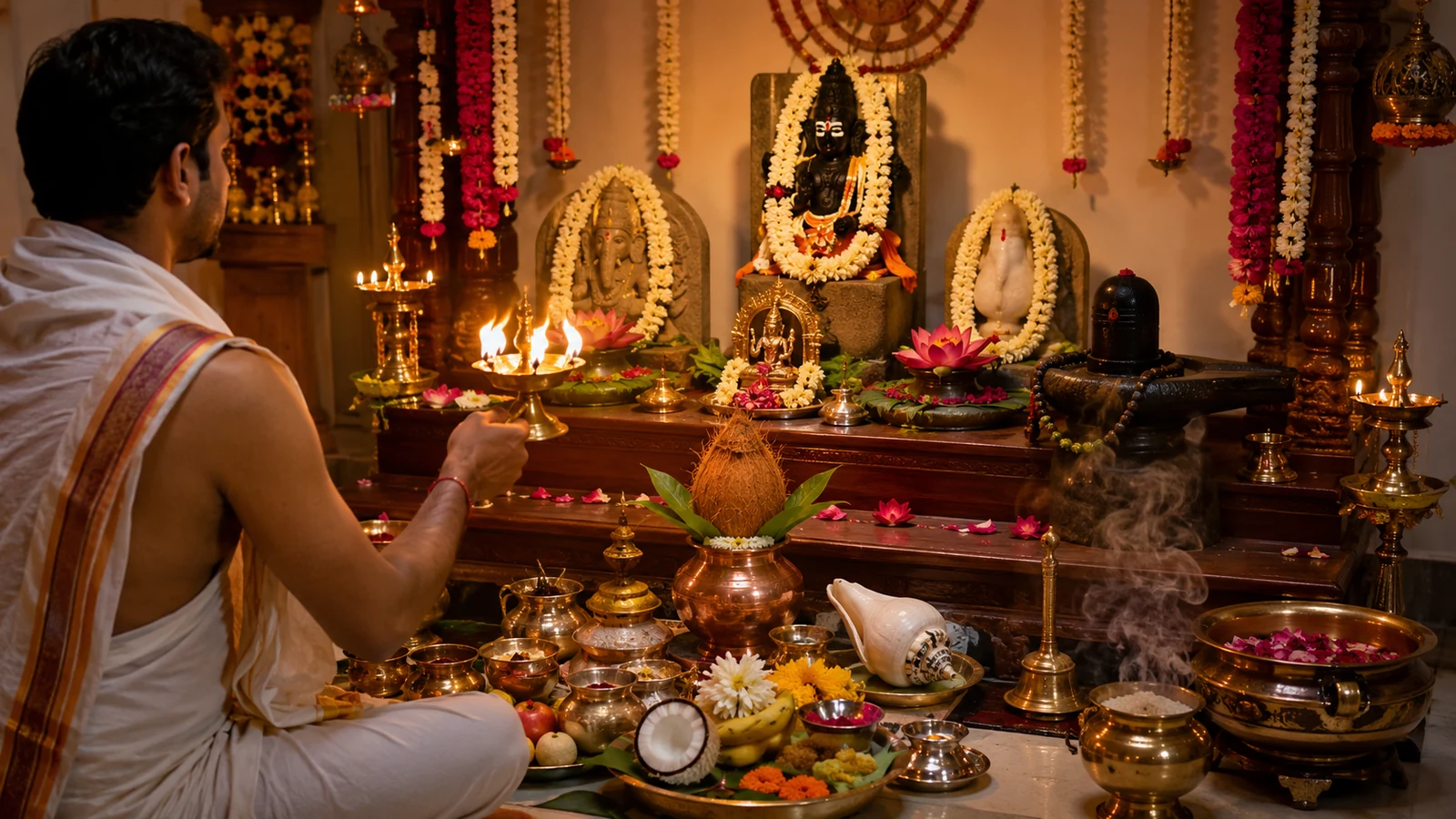
Shodasha-upachara (sixteen services). The puja is structured as the welcoming and care of an honoured guest. You invite, seat, wash, refresh, dress, decorate, feed, and finally release the deity from their formal stay. Two abbreviated versions are common: Pancha-upachara(5: gandha, pushpa, dhupa, deepa, naivedya) for daily home worship, and Dasha-upachara(10: invocation through pradakshina, skipping snana, vastra, yajnopavita, tamboola, achamana, padya).
आवाहन · Invocation
Mentally invite the deity to take residence in the murti or yantra. Hand gesture: avahana mudra (palms cupped, drawing inward).
आसन · Offering of seat
Offer a flower or pinch of akshata as a seat. The deity is now seated as an honoured guest.
पाद्य · Water for washing the feet
A small spoon of water. The deity is treated as if just having walked in from a journey.
अर्घ्य · Water for hands
Water offered to wash the hands of the guest.
आचमन · Water for sipping
A sip of water for refreshment.
स्नान · Bath
Bathe the murti - water, milk, curd, ghee, honey, sugar (panchamrita), then water again. For metal/stone images. For paper/cloth images, just sprinkle water.
वस्त्र · Cloth offering
A small piece of new cloth - symbolic clothing for the deity.
यज्ञोपवीत · Sacred thread
Offer the sacred thread (for male deities) or appropriate ornament.
गन्ध · Sandalwood paste
Apply sandal paste to the feet and forehead of the murti.
अक्षत · Unbroken rice
Offer unbroken rice grains coloured with turmeric or kumkum. Symbol of completeness.
पुष्प · Flowers
Offer flowers - preferably fresh, locally grown, of the colour the deity prefers (red for Devi, white for Shiva, yellow for Vishnu).
धूप · Incense
Wave incense (agarbatti or dhoop) in three clockwise circles in front of the deity.
दीप · Lamp
Light a ghee or oil lamp and wave it in the same clockwise circles. Represents the deity revealing itself with its own light.
नैवेद्य · Food offering
Offer cooked food - fruit, sweets, full meal - covered with a plate, with water sprinkled around. The deity partakes of the essence (sukshma); the food returns as prasad.
ताम्बूल · Betel leaf and nut
Offer paan and supari, the traditional after-meal mouth refresher in India.
प्रदक्षिण नमस्कार · Circumambulation and prostration
Circle the murti clockwise (one to seven times depending on the deity), then prostrate. Conclude with the dakshina (offering to the priest, or any token to your chosen cause) and visarjana (mentally requesting the deity to return).
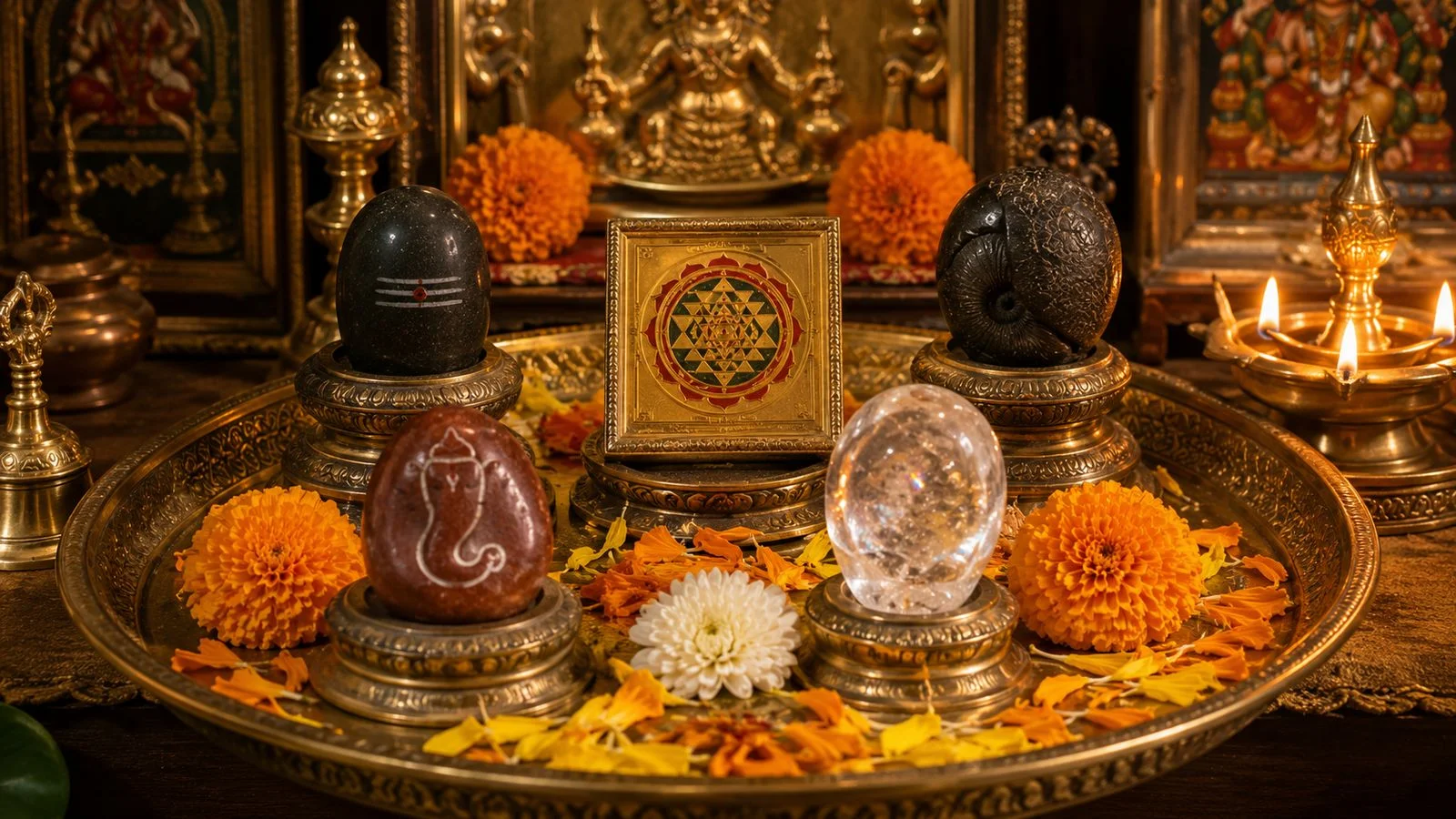
In the early 9th century, Adi Shankara found Hindu households split into competing sects - Shaivas, Vaishnavas, Shaktas, Sauras (sun-worshippers), and Ganapatyas (Ganesha-worshippers) - each insisting their chosen deity was supreme and worshipping the others was illegitimate. His response was the Panchayatana: a single altar arrangement where all five deities are present, the household's preferred ishta-devata at the centre and the other four around it. It became the dominant Smarta household worship and remains so today.
Each deity is represented not by an image but by a specific natural shila (sacred stone) - a tradition Shankara drew from older Pancharatra and Shaiva practice. This makes the altar portable, theologically minimalist, and acceptable to every sect.
The household's preferred deity sits at the centre; the other four rotate around. Vaishnava, Shakta, Saura, and Ganapatya households each have their own arrangement with their chosen deity centred.
Centre
Represented by: Banalinga (river-rounded stone) from the Narmada
The principle of consciousness as it dissolves all forms. Shaivite households place Shiva at the centre.
Centre or NE
Represented by: Saligrama (ammonite fossil) from the Gandaki river
The principle of consciousness as it sustains all forms. Vaishnava households place Vishnu at the centre.
NW
Represented by: Svarna-rekha shila (gold-lined stone) - or any sacred yantra
The principle of dynamic energy (shakti). Smarta and Shakta households place Devi at the centre.
SW
Represented by: Sona-bhadra shila (red-streaked stone) from the Sona river
The principle of beginnings and obstacle-removal. Always invoked first regardless of the household tradition.
SE
Represented by: Sphatika (clear quartz) - symbol of the sun
The principle of the visible source of life. Saura households place Surya at the centre.
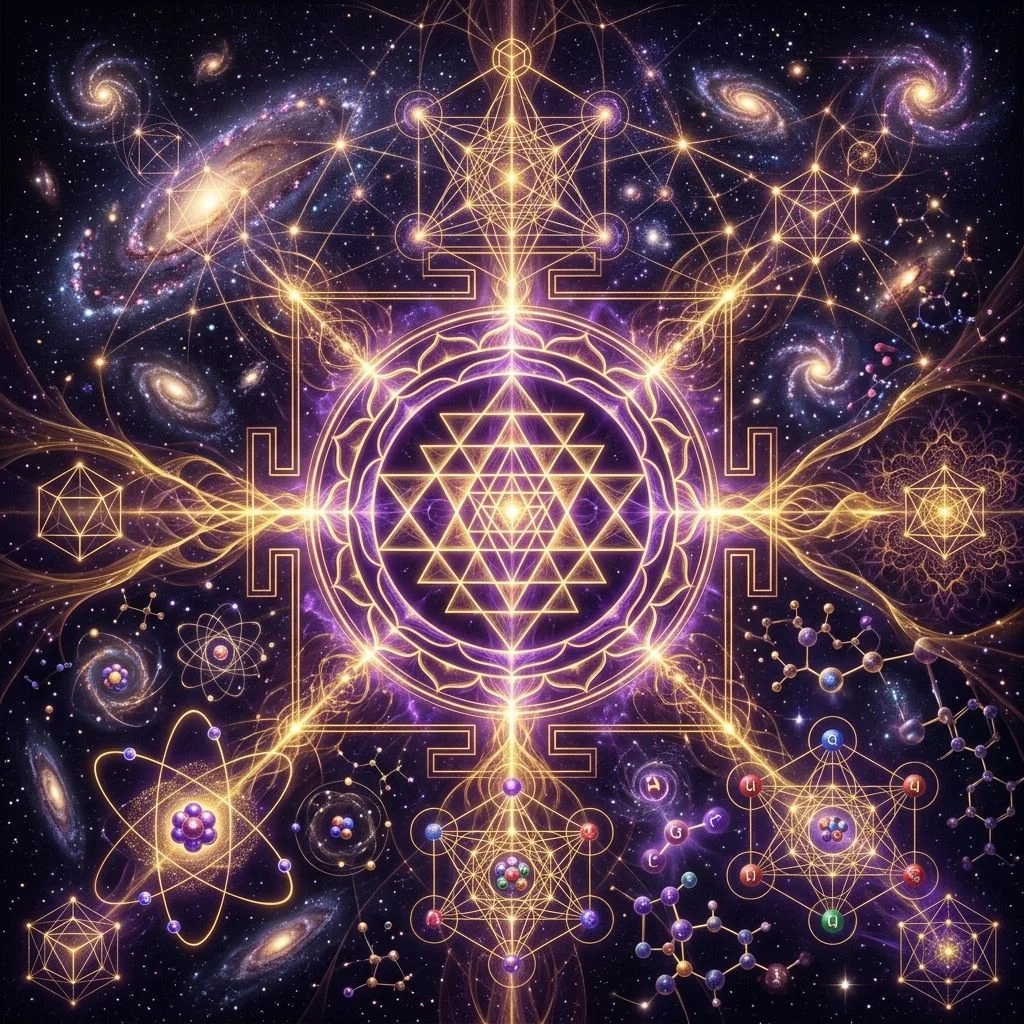
These three Sanskrit words are often used loosely (and sometimes sensationally) outside the tradition. Inside it, each names a specific class of practice with a long history and a clear definition. Understanding the distinction is the first step in approaching any school of Hindu ritual seriously.
Mantras are the oldest of the three. Vedic mantras (Gayatri, Mahamrityunjaya, Purusha Sukta) are considered eternal sounds heard by the rishis, not composed. Tantric and Pauranic mantras (Om Namah Shivaya, Hare Krishna, Om Mani Padme Hum) are later compositions but use the same logic - repeated sound shaping consciousness. Bija mantras (Lam, Vam, Ram, Yam, Ham, Om) are single seed-syllables that activate specific chakras or deities. Practice modes are Vaikhari (audible), Upamshu (whispered), and Manasika (purely mental); manasika is held to be the most powerful.
Where it is followed: All schools. Vedanta and Smarta households centre on the Gayatri. Sri Vaishnava on Ashtakshari (Om Namo Narayanaya). Madhwa Vaishnava on Dvadashakshari (Om Namo Bhagavate Vasudevaya). Shaiva on Panchakshari (Om Namah Shivaya). Shakta on the Lalita Sahasranama. Gaudiya on the Maha Mantra.
A yantra is a precise geometric drawing - usually involving triangles, circles, lotus petals, and a central bindu (point) - that is treated as a body of the deity, equivalent to a murti. The most famous is the Sri Yantra (Sri Chakra), nine interlocking triangles forming 43 smaller triangles around a central bindu, representing the cosmic union of Shiva (downward triangles) and Shakti (upward triangles). Yantras are consecrated by mantra (the yantra without mantra is held to be inert) and worshipped with the same 16 upacharas as a murti. Drawn correctly on copper, silver, or gold, or simply on bhurja patra (birch bark) for portable use.
Where it is followed: Primarily Shakta (Sri Vidya tradition). Also used in Shaiva tantra, Vaishnava Pancharatra (Sudarshana Yantra), and Saura traditions (Surya Yantra). Smarta households often keep a Sri Yantra at home. Each major deity has its own yantra.
The word tantra means “loom” or “system” - a tantra is a structured body of practice. There are three principal classes: Shaiva tantra (Kashmir Shaivism, Shaiva Siddhanta, Nath sampradaya), Shakta tantra (Sri Vidya, Kalikula, Dasha Mahavidya worship), and Vaishnava tantra (Pancharatra Agama). Tantra is misrepresented in Western popular culture as primarily about sexuality; in fact, sexual practices are a small specialised branch within only some of the “left-hand” tantric schools. Mainstream tantric practice is daily worship, mantra repetition, yantra meditation, and meditation on the deity-as-self. Most South Indian temple worship - Pancharatra, Vaikhanasa, Shaiva Agamas - is technically tantric in origin.
Where it is followed: Shaiva tantra (Kashmir, Shaiva Siddhanta, Nath, Aghori), Shakta tantra (Sri Vidya in the south, Kalikula in the east, Mahavidyas across the country), Vaishnava tantra (Pancharatra in Sri Vaishnava temples, Vaikhanasa in temples of Tirupati and other ancient Vishnu shrines), and the Shabar tantra of folk practice.
Commission online
Have a traditional 16-upachara puja performed at a verified temple.
Select deity, scale, and date. Priest performs with full vidhi. Photographic proof returned.
One tap helps us learn what to improve. Add a note if you would like to see something specific on this page.
Anonymous votes are stored against a per-session ID; signed-in votes link to your profile. We use this only to decide what to add or improve. We never share or sell this data.