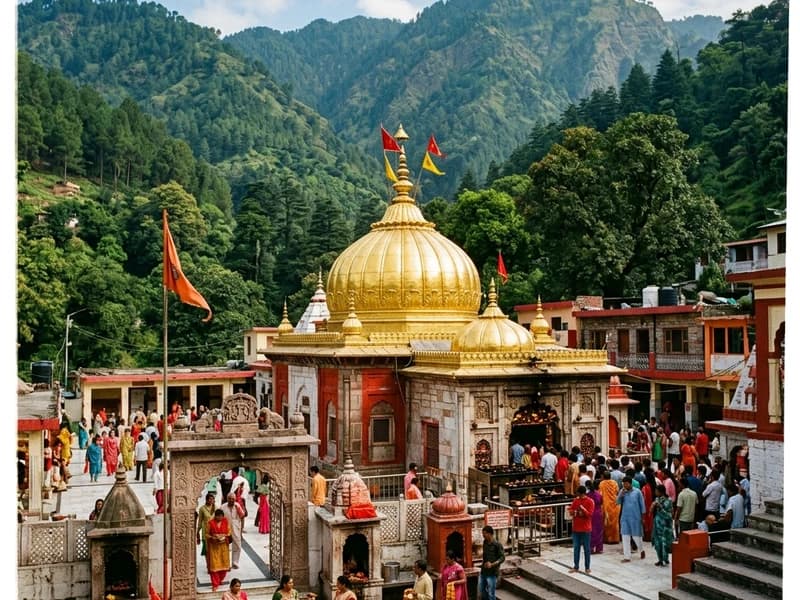
शक्तिपीठ — seats where the Earth herself became Devi
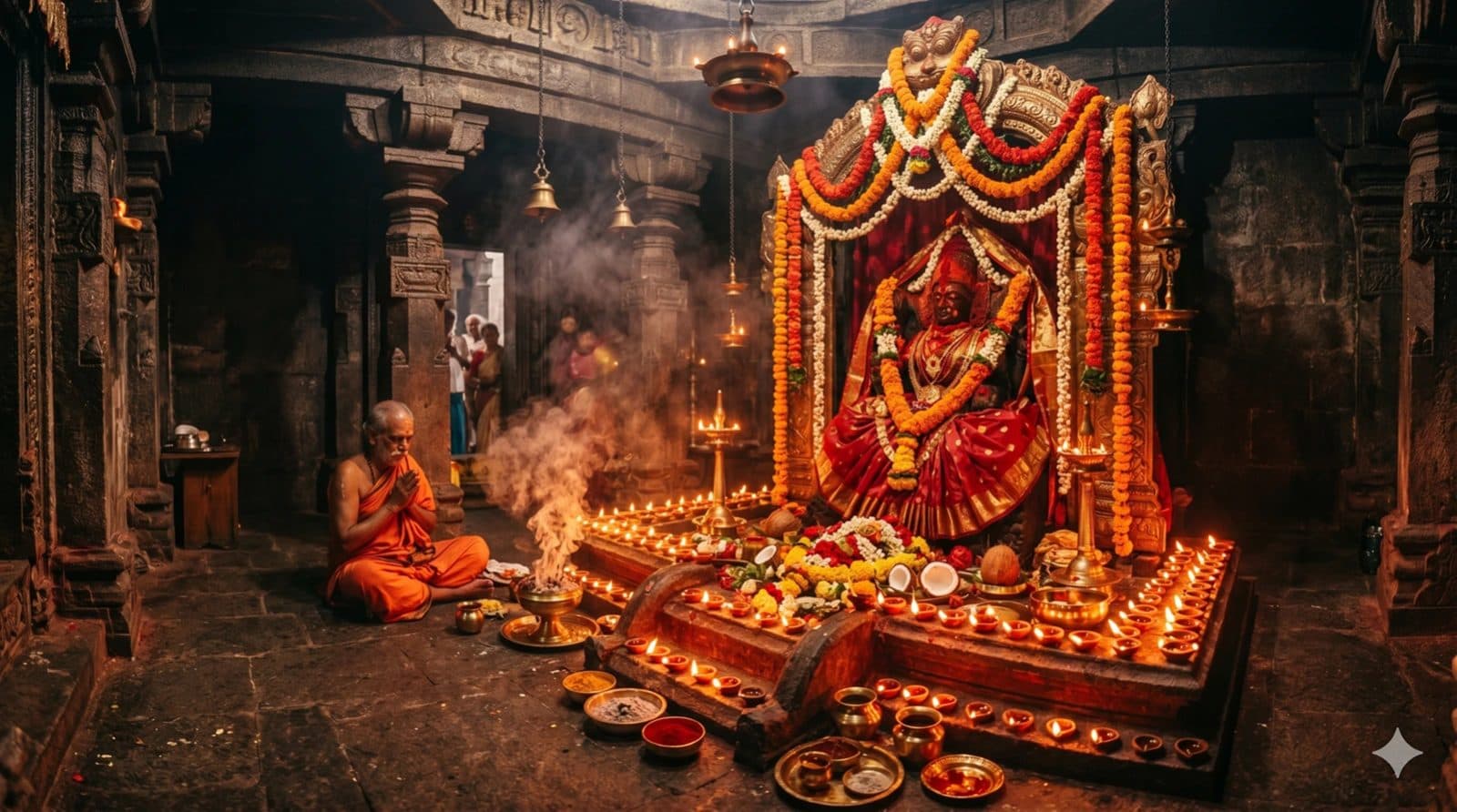
When Sati’s body was severed by Vishnu’s Sudarshana Chakra as Shiva carried her in grief, each part that fell to Earth charged that ground with her power forever. These are the Shakti Peethas — sacred power-seats of the Goddess, each presided over by a unique form of Devi and her Bhairava (Shiva).
Wherever a part of Satī's body fell, that place became a sacred seat of power — a Shakti Peetha — charged with Devi's presence for eternity.
Devi Bhagavata Purana 7.30; Pithanirnaya text
Note on the count:Different texts enumerate 51, 64, or 108 Shakti Peethas. The Pithanirnaya text (the most cited) gives 51. The Devi Bhagavata Purana lists 108. Below are the major canonical pithas — each an active, living temple where Devi’s presence is experienced directly, not as history but as now.
1
Kamakhyaकामाख्या
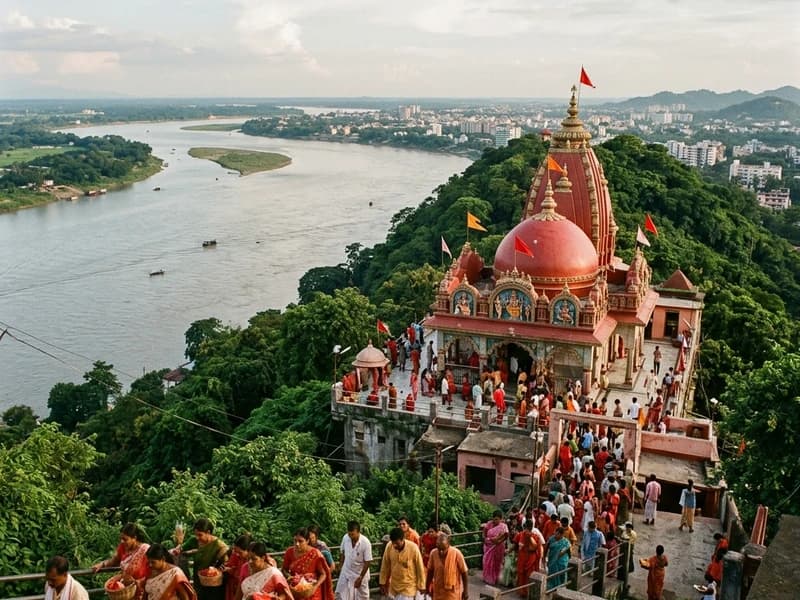
Nilachal hill, Guwahati, Assam (overlooking the Brahmaputra)
Deity: Kamakhya — the yoni (generative organ) of Sati. NO image of the goddess — only a natural rock-cleft with a spring that turns red each year.
Legend: Sati's yoni fell on Nilachal when Vishnu's chakra dismembered her corpse. The site became the most powerful tantric peetha. Naraka — son of Vishnu (Varaha) + Bhudevi — became Kamakhya's first king; ruled Kamarupa from here.
Yoni-peetha — the SOURCE of all Shakti, considered THE most powerful of the 51. Tantric supreme. Annual Ambubachi Mela (Jun, Ashadha) — the goddess is believed to menstruate; temple closes 3 days, prasad is a piece of red cloth from the menstruation. Wholly unique in Hinduism.
Grant: Grants the ultimate desire (kama). All tantric siddhis. Restores fertility, removes feminine afflictions (PCOS, infertility, menstrual irregularity). Activates the kundalini at root.
💡 During Ambubachi the temple closes 3 days then reopens — crowds extreme. Bali (animal-sacrifice) is still practiced — vegetarians may find this jarring. Climb 100 steps OR drive up.
2
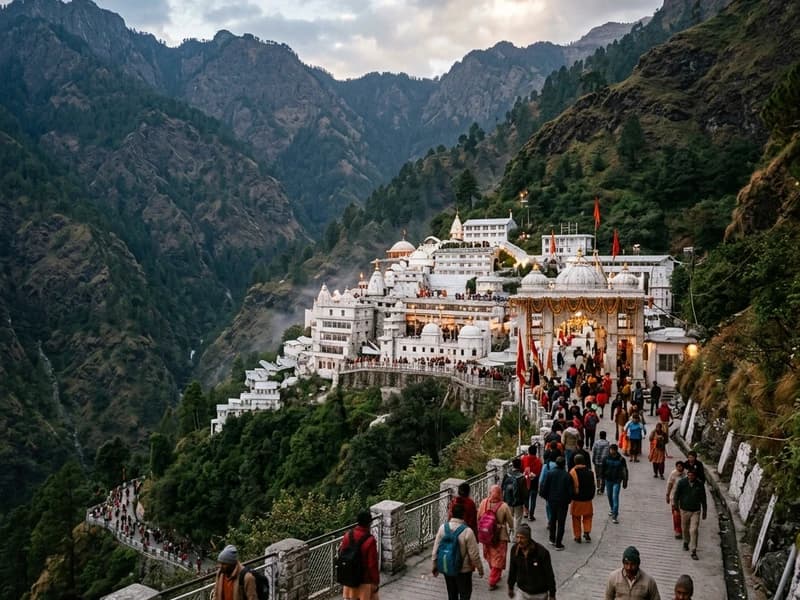
Vaishno Deviवैष्णो देवी
Trikuta hills, Reasi district, Jammu & Kashmir (5300 ft, 13 km trek from Katra)
Deity: Vaishno Devi — the combined form of Maha-Kali, Maha-Lakshmi, Maha-Saraswati. THREE PINDIS (natural rock-formations) in a sanctum cave — no anthropomorphic image.
Legend: Vaishnavi, a girl born in southern India, was a great Vishnu-devotee. She did tapas in the Trikuta cave for 9 months while the asura Bhairon Nath (a tantric who pursued her) waited outside. Vaishnavi entered the cave; Bhairon found her, was beheaded by her sword, his head flying to a nearby peak (Bhairon temple, 2 km further). His last prayer redeemed him — Vaishnavi blessed him: 'My pilgrimage is incomplete without darshan of Bhairon'.
One of the most-visited Hindu shrines (~8 million pilgrims/year). Trek of 13 km from Katra to the bhavan; another 2 km to Bhairon temple. Cave is the ORIGINAL sanctum — a narrow tunnel with the 3 pindis at the end. New cave opened in 1977 for crowds.
Grant: Vaishnavi's pure-Sattvic shakti grants 4 ashramas of dharma: fulfilment of right-desire, dharma, artha, kama, and eventual moksha. Vegetarian-only — no animal-sacrifice.
Navratri (Mar-Apr Chaitra + Sep-Oct Sharad). Diwali. Birthday of the goddess (Ashwin Shukla Pratipada).
💡 Online RFID yatra-parchi mandatory (free). Ardhkuwari + Bhairon temple are CRITICAL — most pilgrims skip Bhairon, making yatra technically incomplete. Pony / helicopter to Sanjichat available.
3
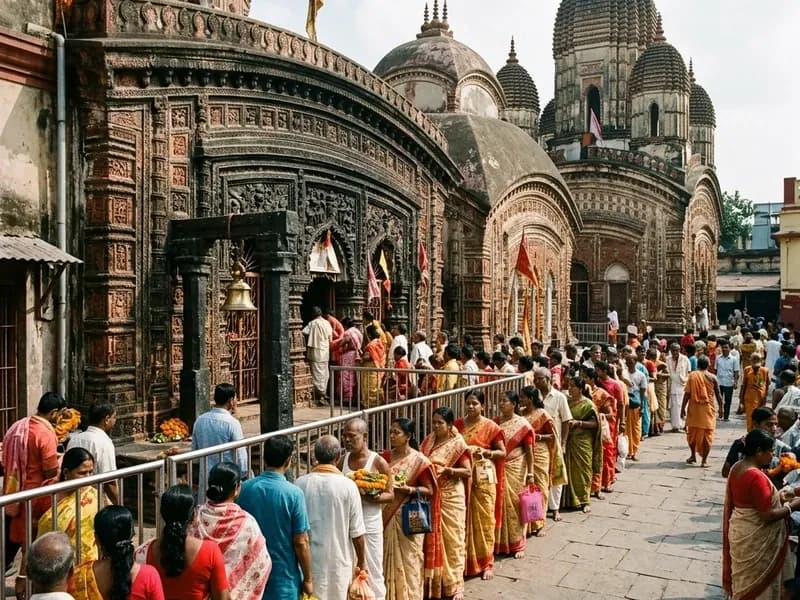
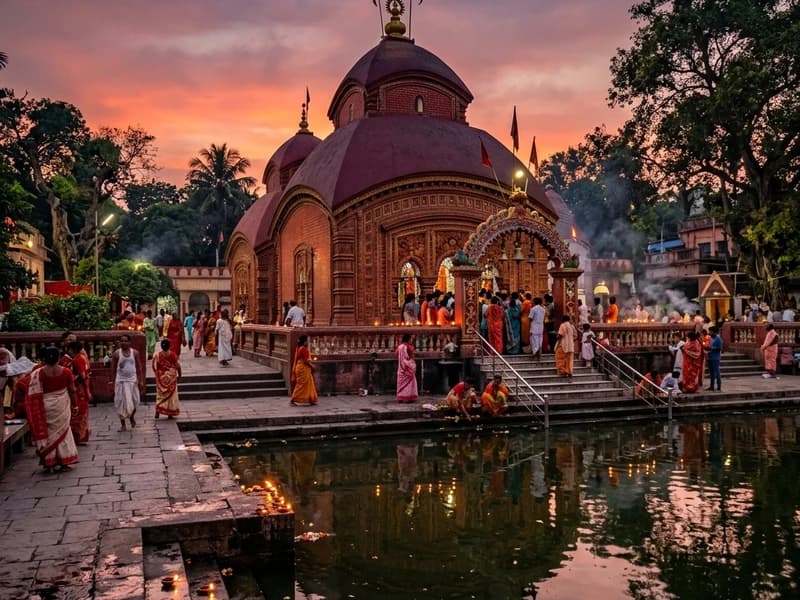
Kalighatकालीघाट
Kalighat, Kolkata, West Bengal (on the Adi Ganga / Tolly's Nala — original Ganga course)
Deity: Kalika — Kali in a stone face with 3 red enamel eyes, gold tongue, 4 silver arms. Sati's right-toes fell here.
Legend: Sati's right small-toe (some say all 4 toes of right foot) fell at this site. The name 'Calcutta' is itself derived from 'Kalikata' — Kali's habitation. The current temple is c. 1809 (rebuilt over a much older shrine).
One of the 51 Shakti Peethas + one of the 4 Adi-Shakti Peethas (with Bimala-Puri, Tara-Tarapith, Dakshina-Kalighat — per Bengal-Tantra). Ramakrishna Paramahamsa worshipped at Dakshineshwar Kali (across the river) — same Kali-bhakti tradition. Annual blood-sacrifice on Kali Puja.
Grant: Removes mahapaap (mortal sins). Grants protection from black-magic + abhichara. Kali consumes negative karma directly.
Kali Puja (Oct-Nov, Kartik Amavasya — same night as Diwali). Snana Yatra. Charak Puja (Apr).
💡 Crowd is intense; queue 2-4 hours on amavasya. Goat-sacrifice still happens daily (carcasses sold as prasad). Combine with Dakshineshwar (Ramakrishna's temple, 30 km north).
4
Tarapithतारापीठ
Birbhum district, West Bengal (on the Dwarka river)
Deity: Tara — the 2nd of the Dasha-Mahavidyas, a fierce blue-skinned form. Sati's eye-balls fell here (per one tradition).
Legend: Sage Vasishtha (per local tradition) installed the deity. The site became a Tantric seat (siddha-pith). Most famously associated with Bamakhepa (1837-1911) — the 'mad saint' who lived at the cremation-ground here, the original Aghori-saint of Bengal, mentor of generations of Tantric sadhakas.
One of the 51 Shakti Peethas. The supreme Tara-peetha in India. Adjacent cremation-ground (Maha-shmashana) is open + active — sadhakas practice shava-sadhana here. Bamakhepa's samadhi is steps from the temple.
Grant: Tara grants 'Tarini' (one-who-saves) — instant rescue from desperate situations. Grants powers of speech (vak-siddhi), removal of obstacles in spiritual practice.
💡 Tantric site — not a 'pleasant family pilgrimage'. Cremation ground is uncomfortable for the uninitiated. Bamakhepa's samadhi is the inner pilgrimage. Bali (sacrifice) is daily.
Deity: Jwala — 9 eternal-burning natural flames (no image, no idol). Sati's tongue fell here.
Legend: Sati's tongue fell at Jwalamukhi. The flames have burned UNINTERRUPTED for millennia (the site is over a natural-gas fissure — geologically a non-volcanic gas vent). When Akbar (1500s) tried to extinguish the flames with diverted water, the flames re-emerged elsewhere.
One of 51 Shakti Peethas. Unique — the deity is fire itself, no image. The 9 flames are named after the 9 Durgas (Mahakali, Annapurna, Chandi, Hinglaj, Vindhyavasini, Maha-Lakshmi, Saraswati, Ambika, Anjana). Akbar's failed extinguishment is recorded.
Grant: Burns away all impurities — the goddess as transformative fire (tapa). Grants instant fulfilment of vows offered into the flames.
Navratri (both Chaitra + Sharad). Jwala Jayanti.
💡 Combine with Chamunda Devi (60 km) + Bajreshwari (Kangra fort, 30 km) + Chintapurni (95 km) — the Himachal Devi-circuit. All 4 Peethas in 2-3 days.
6
Naina Deviनैना देवी
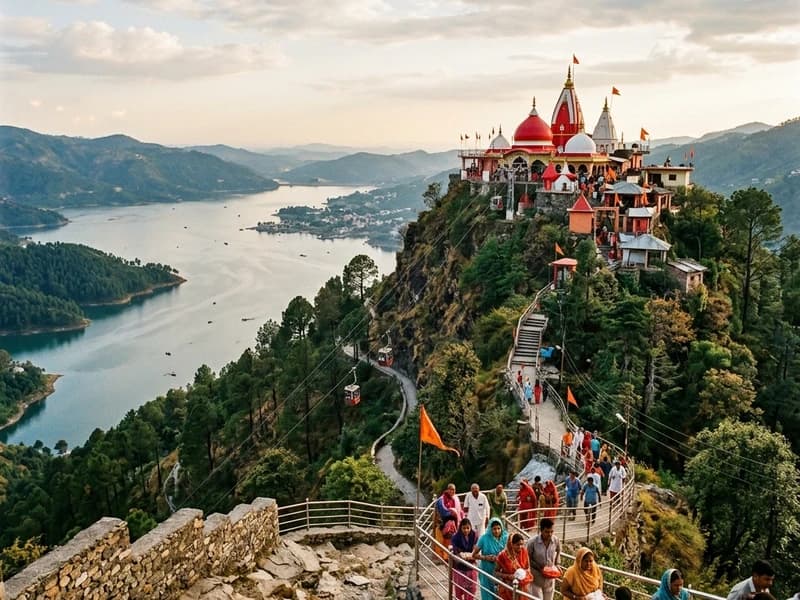
Bilaspur district, Himachal Pradesh (on Naina-Devi hill, 1100 m, overlooking Govind Sagar)
Deity: Naina Devi — Sati's eyes (naina) fell here. Stone-image of the goddess with eye-emphasis.
Legend: When Sati's eyes fell, the goddess manifested. Discovered by a cowherd Naina (or by Guru Gobind Singh who is said to have done puja here before the Battle of Anandpur). The Sikh-Hindu syncretism is notable — Guru Gobind Singh is said to have invoked Shakti here.
One of 51 Shakti Peethas + part of the Himachal Devi-circuit. 5-km trolley/cable-car from base. Bhakra Dam visible from temple.
💡 Cable-car shortens climb. Combine with Chintapurni (35 km).
7
Chamundeshwariचामुण्डेश्वरी
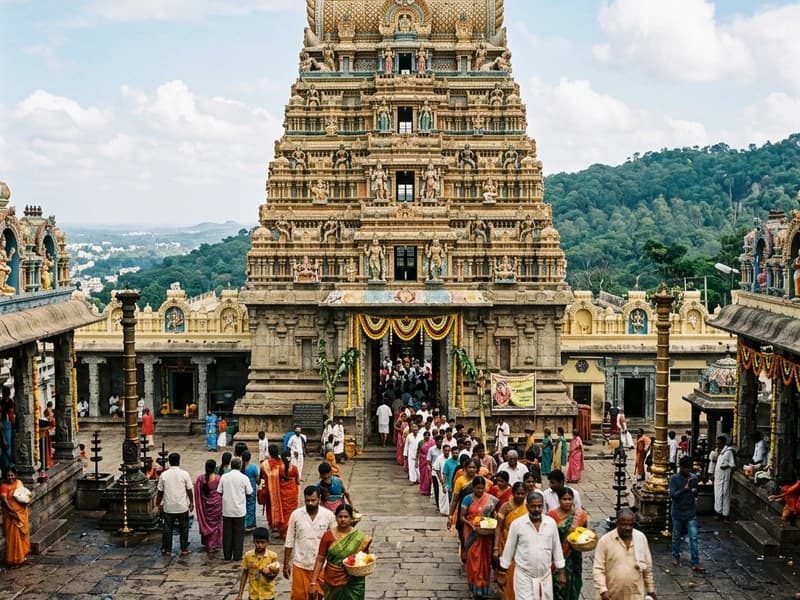
Chamundi Hills (1000 m), Mysuru, Karnataka
Deity: Chamunda — Devi who slew Chanda + Munda + Mahishasura. Sati's hair (per one tradition) fell here.
Legend: Per Devi Mahatmya, the goddess took the form of Chamunda to slay the asuras Chanda + Munda (commanders of Shumbha). She then defeated Mahishasura (the buffalo-demon) on Chamundi hill. Mahisha's statue stands at the foot of the hill.
One of 18 Maha-Shakti-Peethas. Kuladevi of the Mysuru Wadiyars (since 14th c). Annual Mysuru Dasara (Vijayadashami) — government-sponsored, 10-day royal celebration with elephant procession; Chamundeshwari is the centre.
💡 1008 steps up Chamundi Hill or drive. The Nandi (Shiva's bull) at step 800 is one of the largest monolithic Nandis in India (4.8 m). Combine with Mysore Palace.
8
Bhadrakali (Itkhori)भद्रकाली
Itkhori village, Chatra district, Jharkhand (on the Mahane river)
Deity: Bhadrakali — fierce form of Devi. Sati's anus / lower-back (some sources) fell here.
Legend: Sati's body-part fell here; goddess manifested as Bhadrakali. The site also has Buddhist + Jain stupas (the Mahane river-bank) — a rare tri-dharmic pilgrimage. Buddha is said to have visited.
One of the 51 Shakti Peethas. Sangam of Hindu, Buddhist, Jain. The 1000-piece Bhadrakali sahasra-shivalinga (a single basalt-stone with 1008 carved miniature lingas) is unique. Recently excavated archaeological site.
Grant: Bhadrakali = 'Auspicious Kali'. Grants Bhadra (auspiciousness) — turns sin into punya, danger into safety. Restores karma-balance.
Navratri. Bhadra Purnima (Bhadrapada Purnima).
💡 Remote location (5 hr from Ranchi). Combine with Hazaribagh tiger reserve. Most pilgrims unaware — uncrowded.
9
Bhramaramba (Srisailam)भ्रमराम्बा
Srisailam, Nallamala hills, Andhra Pradesh (same complex as Mallikarjuna Jyotirlinga)
Deity: Bhramaramba — Devi as 'mother of bees'. Sati's neck fell here.
Legend: An asura Arunasura received the boon: 'cannot be killed by any 2-legged or 4-legged being'. Devi took the form of Bhramari (6-legged bee-swarm) — millions of black-bees attacked + killed him. She remained as Bhramaramba on Srisailam.
One of 18 Maha-Shakti-Peethas + RARE pairing with a Jyotirlinga (Mallikarjuna) in one complex. Considered the supreme combined darshan in India (Linga + Yoni).
Maha Shivaratri (with Mallikarjuna). Bhramaramba Devi Brahmotsavam (Dasara).
💡 Inside the same Mallikarjuna prakaram — easy to do both. Sparsha-darshan paid-ticket available.
10
Mahalakshmi (Kolhapur)महालक्ष्मी
Kolhapur, Maharashtra (Karaveer, on banks of Panchaganga river)
Deity: Mahalakshmi (Ambabai) — black-stone murti, 3 ft, with shri-yantra carved into her crown. Sati's 3 eyes (per local) fell here.
Legend: Devi Mahalakshmi chose Karaveer (Kolhapur) as her permanent residence — she 'left' Vaikuntha to bless earth here. The original temple is c. 7th c (Chalukya); reconstructed c. 9th c (Shilahara). Twice a year (Jan 31 + Nov 9, approximately), sun-rays fall directly on the deity's face at sunset — Kiranotsav.
One of 18 Maha-Shakti-Peethas. The South-Indian + Maharashtrian Lakshmi-peetha (rare — most Shakti-peethas are Kali/Durga). Kiranotsav (sun-on-face phenomenon) is engineered — temple precisely aligned.
Legend: Sage Kardama's widow Anubhuti did tapas on Yamunachal; the asura Kukur attacked her. Devi appeared as Bhavani — slew Kukur. She remained on the hill. Famously, Shivaji Maharaj (Chhatrapati Shivaji, 1630-1680) was a devotee — Bhavani is the Bhonsale kuladevi. The sword 'Bhavani Talwar' was given to him by the goddess herself (legend).
One of 18 Maha-Shakti-Peethas. Kuladevi of Shivaji + the Marathas. Bhavani Talwar (kept at Tuljapur, also in London — disputed). Unique 'Manik-Prabhu Daivat' tradition.
Grant: Grants kshatriya-shakti — courage in just war, victory over corruption. The 'sword-mother'. Protects the dharma-warriors.
Navaratri (Sharad + Chaitra — 9 days of decorations). Shivaji Jayanti.
💡 Sparsha-darshan permitted. The original Manik Chowk (where Shivaji received the Talwar) is shown. Marathi-speaking guides essential.
12
Mookambikaमूकाम्बिका
Kollur, Udupi district, Karnataka (on Sauparnika river, foothills of Kodachadri)
Deity: Mookambika — Devi who silenced Mookasura. Jyotirlinga + 3-line gold-line on the linga (Brahma + Vishnu + Maheshwara).
Legend: An asura named Kumhasura did tapas to Brahma. About to receive the boon of immortality, he was struck dumb (mooka) by Devi at the request of the devas. He still attacked the gods, in his dumb form — hence 'Mookasura'. Devi slew him + remained at Kollur. Adi Shankara, during his digvijaya, sought to take Devi back with him to Sringeri — she agreed on condition he not turn back; he did at Kollur, so she remained.
Combined Devi (above) + a swayambhu linga (below) in one shrine — Ardha-nareeshwara-type. The supreme Devi-shrine of coastal Karnataka. Saraswati's seat (devotees do akshara-abhyasa here — children's first letter writing).
Grant: Restores speech (Mookambika = silencer-of-Mooka → grants Vak). The supreme deity for children with speech-delay, autism, deaf-mutism. Also Vidya (knowledge) — students do their first writing here.
Navaratri (Sharad). Vidyarambham (Vijayadashami — first letter ceremony for children).
💡 Vidyarambham slot must be booked. Kodachadri trek (40 km) is the Adi Shankara meditation cave. Sauparnika river-bath is a tirtha.
13
Vindhyavasiniविन्ध्यवासिनी
Vindhyachal, Mirzapur district, Uttar Pradesh (on the banks of the Ganga, Vindhya hills)
Deity: Vindhyavasini — 'She who dwells on the Vindhyas'. Manifests in 3 simultaneous forms — Vindhyavasini (south), Ashtabhuja (west, 8-armed), Kalikhoh (east, in a cave) — pilgrims do trikona-parikrama of all 3.
Legend: When Kamsa killed the children of Devaki, Vishnu had Yogamaya (the daughter of Yashoda born the same night as Krishna) switched with Krishna. Kamsa tried to kill her — she flew up as a goddess + declared 'Your slayer is born elsewhere; I shall reside on the Vindhyas'. She became Vindhyavasini. The unique 3-form (Mahakali + Mahalakshmi + Mahasaraswati) is per Devi Mahatmya 11.
One of 51 Shakti Peethas. The ONLY peetha where Devi resides in 3 simultaneous physical-temple forms in a triangle (trikona) — pilgrims do 'trikona-parikrama' (5 km circuit).
Grant: Switches misfortune to fortune (as she switched with Krishna). Yogamaya — the power of cosmic-illusion to one's advantage. Protects children.
💡 Do the trikona-parikrama at dawn — the 3 temples form a 5-km triangle. Sub-zero in winter — carry warm clothes. Closest railhead: Mirzapur.
14
Hinglaj Mataहिंगलाज माता
Hingol National Park, Lasbela district, Balochistan, PAKISTAN (on the Hingol river, 12 km from Arabian Sea)
Deity: Hinglaj Devi — Sati's brahmarandhra (top-of-head / fontanelle) fell here. Natural rock-shrine in a cave.
Legend: Sati's brahmarandhra (the crown chakra opening) fell on the Hingol river-bank. The site became the WESTERNMOST Shakti Peetha. Even after partition (1947), the temple is maintained by the Pakistani Hindu community + a small Muslim community calls her 'Nani Mandir' / 'Bibi Nani'.
Westernmost of 51 Shakti Peethas. Despite being in Pakistan, ~250,000+ pilgrims (mostly Pakistani Hindus + Indian pilgrims with visa) attend the annual Hinglaj Yatra every year — making it the largest Hindu pilgrimage in Pakistan. The cave-shrine itself is unique.
Hinglaj Yatra (Apr — Chaitra Navaratri to Vaisakh).
💡 Requires Pakistan visa — apply 6+ months ahead via Pakistan High Commission. Most international pilgrims go in organised groups. The 250-km road from Karachi is now paved (was rough until 2010).
15
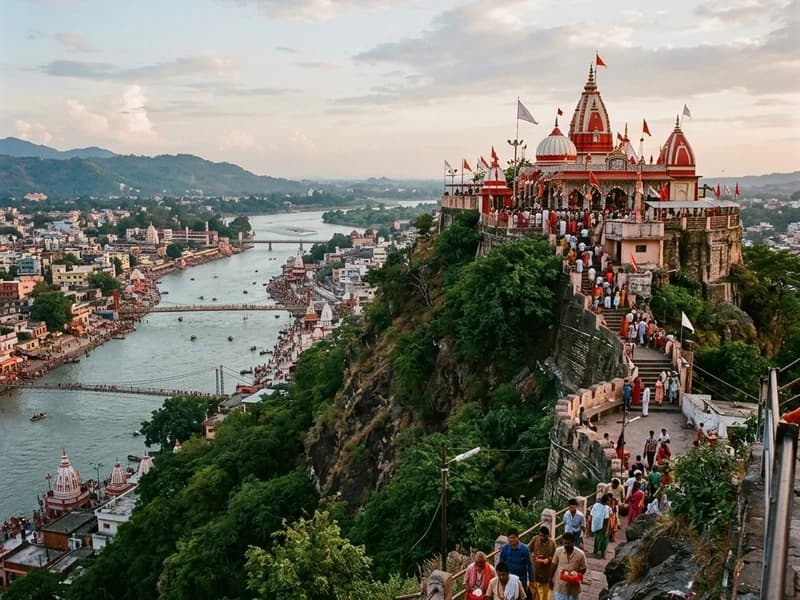
Manasa Devi (Haridwar)मनसा देवी
Bilwa Parvat, Haridwar, Uttarakhand (overlooking Har-ki-Pauri ghat on the Ganga)
Deity: Manasa Devi — daughter of sage Kashyapa, sister of the Nagas (serpent-deities), wife of sage Jaratkaru. 3-headed, 5-armed form.
Legend: Manasa was created from Kashyapa's mind (manas) to control the Nagas — she became their queen-protector. She married Jaratkaru + bore Astika — the rishi who saved the Nagas from Janamejaya's snake-sacrifice. She is invoked against snake-bite.
One of 51 Shakti Peethas (per some lists). Haridwar's top hill-shrine, reached by 2-cable-car (or 1.5 km climb). Wish-fulfilling tree (mannat-tree) inside complex — devotees tie red-threads.
Grant: Wish-fulfilment ('manasa' = wish). Protection from snake-bites. Removes Kalsarpa-dosha when paired with Trimbakeshwar.
💡 Cable-car ('Udan Khatola') is a 1.5-min ride. Combine with Chandi Devi (Neel Parvat, opposite hill, also Shakti Peetha) + Maya Devi (Haridwar's original Peetha — Sati's nabhi-heart-eye fell here, less crowded).
16
Chintapurniछिन्नमस्तिका / चिन्तपूर्णी
Una district, Himachal Pradesh (Chhinnamastika peeth — Sati's head fell here)
Deity: Chhinnamasta / Chintapurni — Devi who severed her own head. Pindi-form (head-stone) in shrine.
Legend: Once, Devi was bathing with her 2 yoginis (Dakini + Varnini) in the Mandakini. After bath, the yoginis became hungry + asked for food. Devi instantly severed her own head — 3 streams of blood gushed: one fed Dakini, one Varnini, the third Devi drank herself. The severed head spoke + blessed them. The body remained at this location.
One of 51 Shakti Peethas + one of the Dasha-Mahavidyas (Chhinnamasta — see /wisdom/dasha-mahavidyas). The shrine of the supreme self-sacrificing form.
Grant: Removes worries (chinta-purni = filler-of-worry-gap). Grants whatever is mentally requested. The deity who 'gives her head' will give anything.
💡 Combine with Jwala Devi (60 km) + Naina Devi (80 km) + Kangra (40 km) — the Himachal 4-Devi yatra. 3-4 days.
17
Bagalamukhi (Datia)बगलामुखी
Datia, Madhya Pradesh (also a smaller temple at Bankhandi, Kangra, HP)
Deity: Bagalamukhi — 8th of the Dasha-Mahavidyas, yellow-coloured paralysing Devi.
Legend: Pitambar / Bagala = 'crane-faced'. Stops the speech + action of one's enemies. Born at Saurashtra (per one tradition) from the lake of turmeric-water. The Datia temple was built by Bir Singh Deo (Bundela king, c. 1610) on Devi's direct command in a dream.
Not on the standard 51-list but considered a Maha-Vidya pith + 'shatru-stambhana' supreme. Bir Singh Deo's temple is the most famous; small temple at Bankhandi, Kangra, HP also revered.
💡 Yellow-cloth offerings + yellow flowers + turmeric paste. NO black clothing. Especially busy before elections.
18
Annapurna (Kashi)अन्नपूर्णा
Inside the Kashi Vishwanath complex, Varanasi, UP
Deity: Annapurna — Devi as the giver-of-food. Stands with golden ladle + bowl of khichdi. Sati's tongue / breast (varies by tradition) fell here.
Legend: Once Shiva, in a philosophical mood, told Parvati: 'Food is maya, illusion. Why eat?' Parvati was angered + disappeared. The world starved. Shiva himself begged for food. Parvati appeared as Annapurna at Kashi + fed Shiva from her own hand — Shiva ate humbly + acknowledged: 'Food is Brahman (annam brahma)'. She remained at Kashi.
Within Kashi Vishwanath complex — every Vishwanath-pilgrim also visits Annapurna. Annual Annakut (Dec-Jan, Margashirsha Purnima) is the most famous food-offering in Kashi.
Grant: Removes food-scarcity (anna-daridrya). Once Annapurna is invoked, the household never lacks food. Domestic prosperity, never-empty kitchen.
💡 Buy a single grain of the gold-coin prasadam (a tiny token-coin given by the temple, distributed Annakut day only) — believed to ensure annapurna's blessing on your kitchen for the year.
The origin story — Daksha Yajna & Sati’s sacrifice
King Daksha (Sati’s father, a prajapati) performed a grand yajna and deliberately excluded Shiva. Sati, unable to bear the insult to her husband, entered the yajna fire and died. Shiva, overwhelmed with grief, lifted her body and began wandering the universe. The three worlds fell into chaos as Shiva’s mourning threatened to dissolve creation. Vishnu, to restore order and release Shiva from attachment, sent his Sudarshana Chakra to sever Sati’s body. As each part fell, the earth absorbed her Shakti. At each of these sites, Bhairava (a wrathful form of Shiva) stands as guardian, and the presiding Devi holds a unique name reflecting the power that descended there. The Shaktis and the Bhairavas are always worshipped as a pair at each peetha.