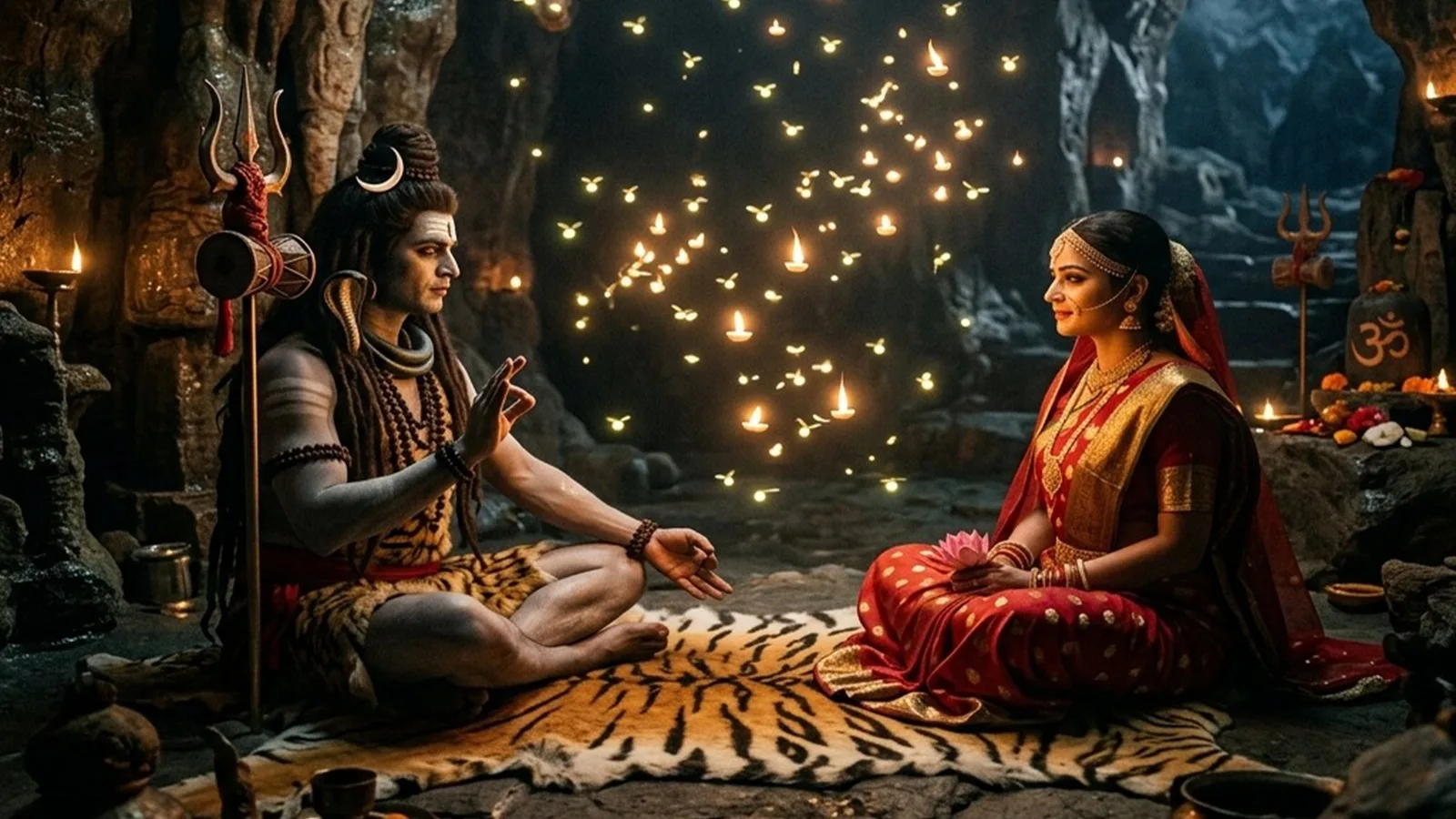
Two great streams of post-Vedic shastra. Tantra - the loom of Shiva-Shakti, 64 canonical texts across four regions, emphasising direct experience over revelation. Bhakti - the devotional path codified in the sutras of Narada + Shandilya, culminating in the 11-fold classification of love.
प्रश्न उल्लास
Parvati questions Shiva on liberation in kali-yuga - older sadhanas being impractical, what remains for the modern aspirant?
ब्रह्म-सृष्टि उल्लास
Exposition of the formless Brahman + the unfolding of creation through Shakti.
3Worship of Brahman (formless)
निर्गुण उपासना उल्लास
Upasana of nirguna Brahman - japa, dhyana, the Brahma-mantra.
4Worship of Shakti (with form)
आद्या काली उल्लास
Pooja-vidhi of Adya Kali - the Mother as concrete object of worship.
मन्त्र-विद्या उल्लास
Bija-mantras, their construction, purification, japa-vidhi, awakening.
6Placement of Mantras (nyasa)
न्यास उल्लास
Anga-nyasa, kara-nyasa, matrika-nyasa - installing mantras into the body.
आद्या स्तोत्र उल्लास
Stotras of the Mother - Adya-stotra, Karpuradi-stotra references, kavachas.
वर्णाश्रम-धर्म उल्लास
Rules of caste + stage of life adapted for kali-yuga - softer + more inclusive than orthodox smriti.
9Achara (Conduct) - 7 acharas
आचार उल्लास
The 7 acharas: veda, vaishnava, shaiva, dakshina, vama, siddhanta, kaula. Progressive ladders of practice.
धन-दाय उल्लास
Stridhana, partition, inheritance - a Tantric dharma-shastra code.
11Atonement (Prayashchitta)
प्रायश्चित्त उल्लास
Penances for transgressions - simplified for kali-yuga.
अन्त्येष्टि उल्लास
Death-rites, sapindi-karana, periods of impurity (ashauca). The Tantric funeral code.
प्रतिष्ठा उल्लास
Pratishtha-vidhi - installation of murtis, prana-pratishtha, temple consecration.
उपसंहार उल्लास
Summary, secrecy-clauses, blessings, fruits of study.
अथातो भक्तिं व्याख्यास्यामः॥
athato bhaktim vyakhyasyamah
Now, therefore, we shall expound bhakti.
Commentary - The classical sutra-opening - establishing bhakti as a subject worthy of independent exposition, alongside dharma-jijnasa + brahma-jijnasa.
1.2Bhakti is supreme love
सा त्वस्मिन् परम-प्रेम-रूपा॥
sa tu asmin parama-prema-rupa
It (bhakti) is verily of the form of supreme love directed to That (the Lord).
Commentary - The signature definition. Bhakti is not a method or technique - it is a state, the form of which is parama-prema (supreme love).
1.3Bhakti is immortal in form
अमृत-स्वरूपा च॥
amrita-svarupa cha
And it is of the form of immortality.
Commentary - Bhakti is not transient enjoyment - its nature is the deathless. Whoever attains it attains immortality (amritatva).
1.6What does NOT happen to the bhakta
नहि तस्मात् किं भवति॥
nahi tasmat kim bhavati
There is nothing further that needs to happen for one who has it.
Commentary - Once bhakti is established, no further attainment remains - for the bhakta, the goal IS the path. Reverses the karmic logic of "becoming".
अहैतुकी च॥
ahaituki cha
And it is causeless.
Commentary - True bhakti has no external cause + seeks no result. It is its own reason - unconditional, gratuitous love.
एकादशधा एव सा भवति॥
ekadasha-vidha eva sa bhavati
It (bhakti) becomes verily of eleven kinds.
Commentary - Foreshadows sutra 82 - the canonical 11-fold classification of bhakti expounded in chapter 5.
2.19Like the gopis of Vraj
यथा व्रज-गोपिकानाम्॥
yatha vraja-gopikanam
As (was the case) with the gopis of Vraj.
Commentary - The gold standard. The gopis' love for Krishna - total, embarrassing, public, irrational - is held up as the supreme exemplar of bhakti.
2.21Heart melts at Hari's name
यथोत्कलित-हरि-प्रेम॥
yatha utkalita-hari-prema
As in the heart-bursting love of Hari (in a true devotee).
Commentary - The signs of bhakti - choked voice, tears, horripilation, heart melting. Outer marks of the inner overflow.
2.25Bhakti excels karma + jnana
सा तु कर्म-ज्ञान-योगेभ्योऽप्यधिकतरा॥
sa tu karma-jnana-yogebhyo apy adhikatara
Bhakti, however, is superior to (the paths of) karma, jnana, + yoga.
Commentary - Narada's chosen position: bhakti is supreme because it culminates IN itself (svayam-phala-rupatvat), whereas the others are means.
2.26Bhakti is its own fruit
फल-रूपत्वात्॥
phala-rupatvat
Because it is of the form of the fruit itself.
Commentary - Karma + jnana + yoga all aim at something else. Bhakti IS the something else. The means + the end collapse into one.
2.27And because the Lord dislikes pride
ईश्वरस्याप्यभिमानि-द्वेषित्वात्॥
ishvarasyapi abhimani-dveshitvat
Because the Lord too is averse to the proud (and karma + jnana breed pride).
Commentary - Karma + jnana risk inflating the ego. Bhakti - by definition self-abnegating - is the path the Lord prefers.
3.34Even sin departs from the bhakta
तस्या ज्ञानमेव साधनमित्येके॥
tasya jnanam eva sadhanam ity eke
Some say (mere) knowledge is the means to it; others disagree.
Commentary - Narada records the schools-debate fairly - but his own position (later sutras) is that bhakti is svayam-sadhya, self-attained.
4.51Forms of bhakti differ by lineage
मुख्यतस्तु महत्कृपयैव भगवत्कृपा-लेशाद्वा॥
mukhyatas tu mahat-kripayaiva bhagavat-kripa-leshad va
Primarily, however, (bhakti arises) by the grace of the great (the saints) or by a particle of God's grace.
Commentary - Bhakti's primary source is grace - satsanga of the wise + the touch of bhagavat-kripa. Not self-effort alone.
4.54Guna-bhakti + raga-bhakti
गुण-माहात्म्यासक्ति-रूपासक्ति-पूजासक्त्यादि-रूपा॥
guna-mahatmyasakti-rupasakti-pujasakty-adi-rupa
(Bhakti) takes forms such as attachment to the glory of the Lord's qualities, to His form, to His worship, etc.
Commentary - Introduces the famous 11-fold classification. Bhakti diversifies according to what catches the devotee's heart - quality, form, worship, etc.
5.66Avoid the company of the worldly
त्यजेद् दुस्सङ्गं सर्वथा॥
tyajed dussangam sarvatha
One should renounce bad company entirely.
Commentary - Negative-prerequisite for bhakti. Company shapes consciousness. Bhakti withers in worldly chatter.
5.69Saints' company unfailingly elevates
महत्सङ्गस्तु दुर्लभोऽगम्योऽमोघश्च॥
mahat-sangas tu durlabho agamyo amoghash cha
Satsang (company of the great) is rare, hard to attain, but never fails.
Commentary - Three properties: rare, difficult, unfailing. The reverse-stamp of sangati-dosha - durjana-sanga is easy, easy, + always damaging.
गुण-माहात्म्यासक्ति-रूपासक्ति-पूजासक्ति-स्मरणासक्ति-दास्यासक्ति-सख्यासक्ति-वात्सल्यासक्ति-कान्तासक्त्यात्म-निवेदनासक्ति-तन्मयासक्ति-परमविरहासक्ति-रूपा एकधाप्येकादशधा भवति॥
guna-mahatmyasakti, rupasakti, pujasakti, smaranasakti, dasyasakti, sakhyasakti, vatsalyasakti, kantasakti, atma-nivedanasakti, tanmayasakti, parama-virahasakti rupa ekadhapy ekadasha-dha bhavati
(Bhakti) though one, becomes elevenfold: attachment to His glories, His form, His worship, His remembrance, servanthood, friendship, parental affection, sweet-love, self-surrender, immersion, + supreme-separation.
Commentary - THE canonical 11-stage classification. From guna-mahatmya (admiring God's glories) up to parama-viraha (the burning pain of separation - the gopi-bhava). The summit.
इत्येवं वदन्ति जन-जल्प-निर्भया एकमताः कुमार-व्यास-शुक-शाण्डिल्य-गर्ग-विष्णु-कौण्डिन्य-शेषोद्धवारुणि-बलि-हनूमद्-विभीषणादयो भक्त्याचार्याः॥
ity evam vadanti jana-jalpa-nirbhaya ekamatah kumara-vyasa-shuka-shandilya-garga-vishnu-kaundinya-sheshoddhavaruni-bali-hanumad-vibhishanadayo bhaktyacharyah
Thus declare, fearless of public-talk + unanimous, the great bhakti-acharyas - Kumara, Vyasa, Shuka, Shandilya, Garga, Vishnu, Kaundinya, Shesha, Uddhava, Aruni, Bali, Hanuman, Vibhishana, + others.
Commentary - The roll-call of authoritative bhakti-acharyas. Establishing the para-bhakti view as consensus across lineages. Notice Shandilya is among them.
य इदं नारद-प्रोक्तं शिवानुशासनं विश्वसिति श्रद्धत्ते स भक्तिमान् भवति। सः प्रेष्ठं लभते सः प्रेष्ठं लभते इति॥
ya idam narada-proktam shivanushasanam vishvasiti shraddhatte sa bhaktiman bhavati. sah preshtham labhate sah preshtham labhate iti
Whoever believes + has faith in this teaching of Shiva spoken by Narada becomes possessed of bhakti, attains the dearest (the Lord), attains the dearest.
Commentary - Phala-shruti (fruits-of-hearing). The double-repetition "sa preshtham labhate sa preshtham labhate" is emphatic - yes, definitely attains.
№ 1Guna-mahatmya-asakti · गुण-माहात्म्यासक्ति
Attachment to hearing of the Lord's glories + qualities.
Exemplar - Hearing the Bhagavata-katha + being moved.
№ 2Rupa-asakti · रूपासक्ति
Attachment to the divine form - image, vision, idol.
Exemplar - Drawn to a particular murti or a darshan-experience.
№ 3Pooja-asakti · पूजासक्ति
Attachment to ritual worship - flowers, lamp, offerings.
Exemplar - The temple priest absorbed in archana.
№ 4Smarana-asakti · स्मरणासक्ति
Attachment to constant remembrance - japa, naam-smarana.
Exemplar - Mira Bai continuously chanting Govinda.
№ 5Dasya-asakti · दास्यासक्ति
Attachment in the mood of servant - Lord as master.
Exemplar - Hanuman to Rama. "Dasohum kosalendrasya."
№ 6Sakhya-asakti · सख्यासक्ति
Attachment in the mood of friend - Lord as buddy.
Exemplar - Arjuna to Krishna; Sudama to Krishna.
№ 7Vatsalya-asakti · वात्सल्यासक्ति
Attachment in the mood of parent - Lord as child.
Exemplar - Yashoda to Krishna; Kausalya to Rama.
№ 8Kanta-asakti / Madhurya-asakti · कान्तासक्ति
Attachment in the mood of beloved / lover - Lord as the beloved.
Exemplar - Radha to Krishna; the Vraja-gopis. Andal to Ranganatha.
№ 9Atma-nivedana-asakti · आत्म-निवेदनासक्ति
Total self-surrender - "I am Yours, do what You will."
Exemplar - Bali's gift to Vamana; Vibhishana's surrender to Rama.
№ 10Tanmaya-asakti · तन्मयासक्ति
Identification - losing the sense of separate self in the Lord.
Exemplar - Chaitanya in his moods; the deep absorption of Ramakrishna.
№ 11Parama-virahasakti · परम-विरहासक्ति
Supreme separation - the burning pain of distance from the Lord. The highest, paradoxically, is the most painful.
Exemplar - Radha in viraha after Krishna leaves Vrindavan. The dark night of the bhakti-saints. The summit.
अथातो भक्ति-जिज्ञासा॥
athato bhakti-jijnasa
Now, therefore, the inquiry into bhakti.
Commentary - Mirrors Vedanta-sutra 1.1.1 (athato brahma-jijnasa). Bhakti is established as worthy of independent shastraic inquiry alongside dharma + brahman.
1.1.2Bhakti is highest attachment to Ishvara
सा परानुरक्तिरीश्वरे॥
sa para-anuraktir Ishvare
It (bhakti) is the highest attachment (anurakti) directed to Ishvara.
Commentary - Shandilya's foundational definition. "Para-anurakti" - supreme + sustained inclination of the heart. Note: directed at Ishvara, not formless Brahman alone.
1.1.7Bhakti is not jnana, though it includes it
ज्ञानमिति चेन्न द्विषतोऽपि ज्ञान-सम्भवात्॥
jnanam iti chen na dvishato 'pi jnana-sambhavat
If it be said that (bhakti is) knowledge - no; for even one who hates the Lord may have knowledge of Him.
Commentary - Crucial argument. Kamsa + Shishupala KNEW Krishna - they had jnana - but had no bhakti. Therefore bhakti is not knowledge alone; it requires anurakti (loving attachment).
1.2.13Para-bhakti is moksha-rupa
मुख्यत्वमुभयोरीश्वरेच्छातः फलानुमेयम्॥
mukhyatvam ubhayor ishvarechchhatah phalanumeyam
The primacy of both (jnana + bhakti) follows from the Lord's will + is inferred from their fruits.
Commentary - Shandilya's careful Vedantic positioning - bhakti + jnana co-operate; neither is dispensable.
2.2.41Ekanta-bhakti - undivided devotion
एकान्ती न द्वेष्टि न दृह्यति॥
ekanti na dveshti na drihyati
The one-pointed devotee neither hates nor envies (any being).
Commentary - Ethical fruit of ekanta-bhakti. The devotee whose heart is wholly with the Lord has no room for hatred or jealousy - bhakti naturally produces non-enmity.
2.2.54Bhakti is independent of caste + condition
अनन्या-चिन्तनं भगवद्धर्म-नियतम्॥
ananya-chintanam bhagavad-dharma-niyatam
Undeviating contemplation (of the Lord) is the established law of devotion.
Commentary - Ananya - not other. The bhakta's mind admits no second. This is the criterion, not birth or scholarship.
3.3.86The 9-fold sadhana (navadha-bhakti)
श्रवण-कीर्तन-वन्दनादि गौणी-भक्तिः साधना॥
shravana-kirtana-vandanadi gauni-bhakti sadhana
Listening, singing, salutation + the rest - these are secondary bhakti, the sadhana.
Commentary - References the classical 9-fold sadhana (navadha-bhakti) of Bhagavata 7.5.23: shravana, kirtana, smarana, pada-sevana, archana, vandana, dasya, sakhya, atma-nivedana. Note: Shandilya calls these gauni (secondary) - para-bhakti (love itself) is primary.
3.3.91Bhakti for its own sake
तदर्पितेच्छा-मात्रः साधनापेक्षीति यावत्॥
tad-arpitechchha-matrah sadhana-apekshiti yavat
(One who has) only the wish to surrender to Him is dependent on sadhana to that extent.
Commentary - A subtle point: even the wish-to-surrender is a stage, requiring continued sadhana until para-bhakti dawns + the wish dissolves into the state.
3.3.97Bhakti is uncreated
ब्रह्म-काण्डं तु भक्तौ तज्जैरेव साधार्यात्॥
brahma-kandam tu bhaktau taj-jair eva sadharyat
The brahman-section (of shruti) supports bhakti, since those who arise from it (the bhaktas) share its nature.
Commentary - Vedantic grounding. The same Upanishadic texts that establish brahman also establish bhakti - bhakti is no innovation but the heart of shruti.
विद्यते हि तस्य नित्यता॥
vidyate hi tasya nityata
For its (bhakti's) eternal nature is established.
Commentary - Closing sutra. Bhakti is not a transient psychological mood - its eternal, non-perishable nature is shastraically established. The benediction.