Eighteen chapters. Seven hundred and one verses, all here in Devanagari, transliteration and plain English. Read straight through or jump to any chapter below.
All 701 verses available - chapter by chapter
Opening invocation · गीता ध्यानम्
पार्थाय प्रतिबोधितां भगवता नारायणेन स्वयं
व्यासेन ग्रथितां पुराणमुनिना मध्ये महाभारतम्।
अद्वैतामृतवर्षिणीं भगवतीमष्टादशाध्यायिनीं
अम्ब त्वामनुसन्दधामि भगवद्गीते भवद्वेषिणीम्॥
O Mother Bhagavad Gita, the destroyer of bondage - taught to Partha by Lord Narayana himself, compiled by the ancient sage Vyasa in the midst of the Mahabharata, raining the nectar of non-dual wisdom across eighteen chapters - I meditate on you.
What is the Bhagavad Gita?
The Bhagavad Gita - “the song of the divine” - sits inside the sixth book of the Mahabharata. On the morning the great battle is about to begin, the warrior Arjuna asks his charioteer Krishna to take him into the middle of the field so he can see both armies. There he sees relatives, teachers, friends arrayed on both sides. He puts down his bow and refuses to fight. The Gita is what Krishna says to him.
What begins as a battlefield counselling session becomes a complete philosophical text. Krishna draws from the Upanishads, the Samkhya tradition, the yoga schools. He reveals himself as the Divine itself. The teaching is universal - about duty, attachment, knowledge, action, devotion, death, and liberation. Eighteen chapters, seven hundred verses.
For two thousand years the Gita has been the most quoted, most translated and most lived text of Sanatana Dharma. Adi Shankara, Ramanuja, Madhva all wrote major commentaries on it. Tilak, Vivekananda, Aurobindo, Swami Chinmayananda did the same in modern times. It is short enough to read in six hours. It is deep enough to read for a lifetime.
The eighteen chapters
Each chapter is summarised in plain English with its signature shloka in Devanagari, transliteration and meaning.
1
Arjuna's Despair
अर्जुनविषादयोग · 47 verses
The crisis of conscience
On the field of Kurukshetra, Arjuna sees fathers, teachers and friends arrayed in both armies. His bow slips from his hand. The rest of the Gita is the answer to his collapse.
न च शक्नोम्यवस्थातुं भ्रमतीव च मे मनः।
निमित्तानि च पश्यामि विपरीतानि केशव॥
na ca śaknomy-avasthātuṃ bhramatīva ca me manaḥ, nimittāni ca paśyāmi viparītāni keśava.
- I cannot stand my ground; my mind whirls. I see only ill omens, O Keshava.
A practical chapter - sit erect, half-eyes closed, on a clean seat in a clean place. Eat moderately, sleep moderately, work moderately. The mind is fickle but can be tamed by abhyasa and vairagya.
Krishna distinguishes his lower (eight-fold) prakriti from his higher (jiva). All beings are born of these two. Among thousands, perhaps one strives for perfection.
The most direct path: offer a leaf, a flower, a fruit, a sip of water - with love, and Krishna accepts it. He becomes the friend of even the most wretched if they turn to him.
पत्रं पुष्पं फलं तोयं यो मे भक्त्या प्रयच्छति।
तदहं भक्त्युपहृतमश्नामि प्रयतात्मनः॥
patraṃ puṣpaṃ phalaṃ toyaṃ yo me bhaktyā prayacchati, tad-ahaṃ bhakty-upahṛtam-aśnāmi prayatātmanaḥ.
- Whoever offers Me a leaf, a flower, a fruit, water - with love, with a pure heart - I accept that offering of devotion.
Krishna names his manifestations - among rivers, the Ganga; among mountains, the Himalaya; among trees, the Ashvattha. Wherever there is splendour and power, He is the seed.
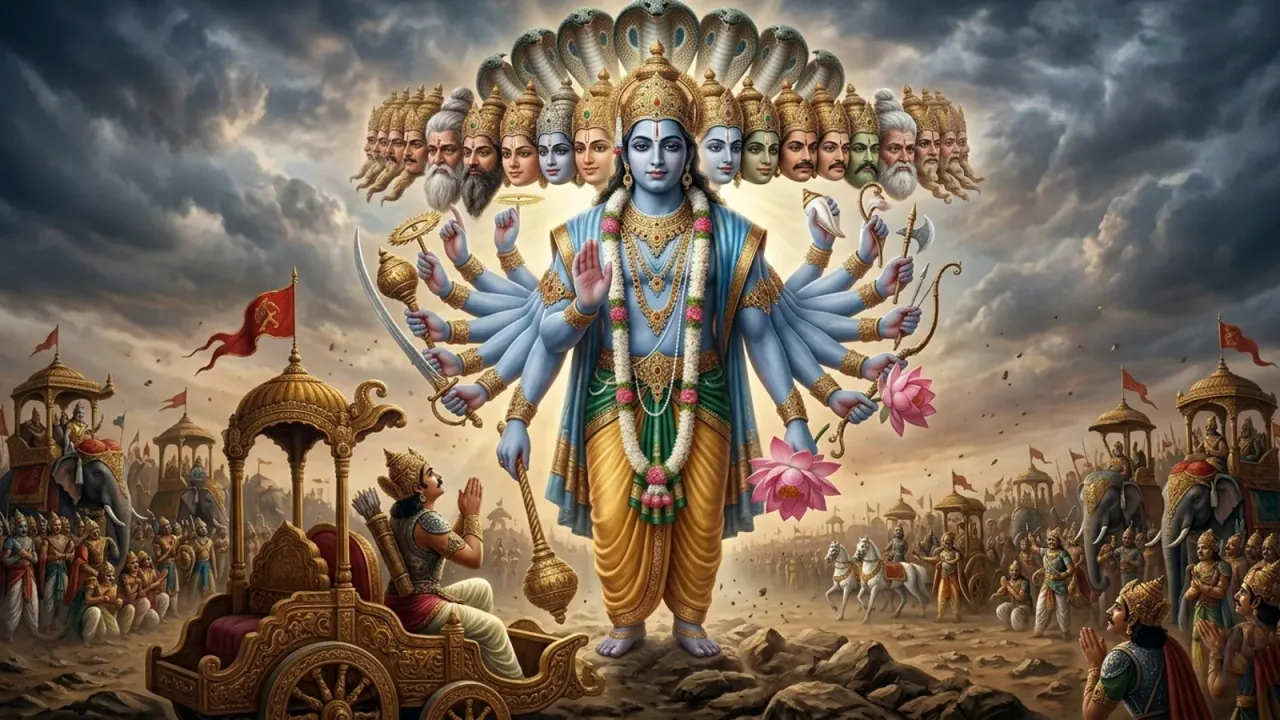
Arjuna asks to see Krishna's true cosmic form. Krishna grants divine sight. Arjuna sees the universe contained in Krishna's body - luminous, terrible, time itself devouring all worlds. He pleads to see the gentle four-armed form again.
Bhakti is supreme. The devotee who is friendly to all, free from possessiveness, even-minded in pleasure and pain, content, self-restrained, firm in resolve - that one is dear to Me.
adveṣṭā sarva-bhūtānāṃ maitraḥ karuṇa eva ca, nirmamo nirahaṅkāraḥ sama-duḥkha-sukhaḥ kṣamī.
- Without enmity to any being, friendly and compassionate, free of "mine," free of ego, equal in joy and sorrow, forgiving - such a devotee is dear to Me.
Sattva binds with light and joy, rajas with action and craving, tamas with darkness and sloth. Cultivate sattva. Then transcend even sattva to reach the eternal.
मां च योऽव्यभिचारेण भक्तियोगेन सेवते।
स गुणान् समतीत्यैतान् ब्रह्मभूयाय कल्पते॥
māṃ ca yo’vyabhicāreṇa bhakti-yogena sevate, sa guṇān samatītyaitān brahma-bhūyāya kalpate.
- Whoever serves Me with unwavering devotion goes beyond the three modes and is fit for absorption in Brahman.
The longest and concluding chapter. Sannyasa = renunciation of action; tyaga = renunciation of fruit. Krishna sums up all earlier teachings and ends with the supreme word: surrender all dharmas to Me - I will free you from all sin.
“Abandon all dharmas and take refuge in Me alone. I will liberate you from all sins. Do not grieve.”
- Bhagavad Gita 18.66 · the Charama Shloka, the supreme verse of surrender
Translations are paraphrastic to keep meaning accessible. For verbatim study consult Sankaracharya, Ramanuja, Madhva, or any modern scholarly edition. Detailed verse-by-verse commentary is available at trusted sources such as sacred-texts.com and Gita Supersite (IIT-K).