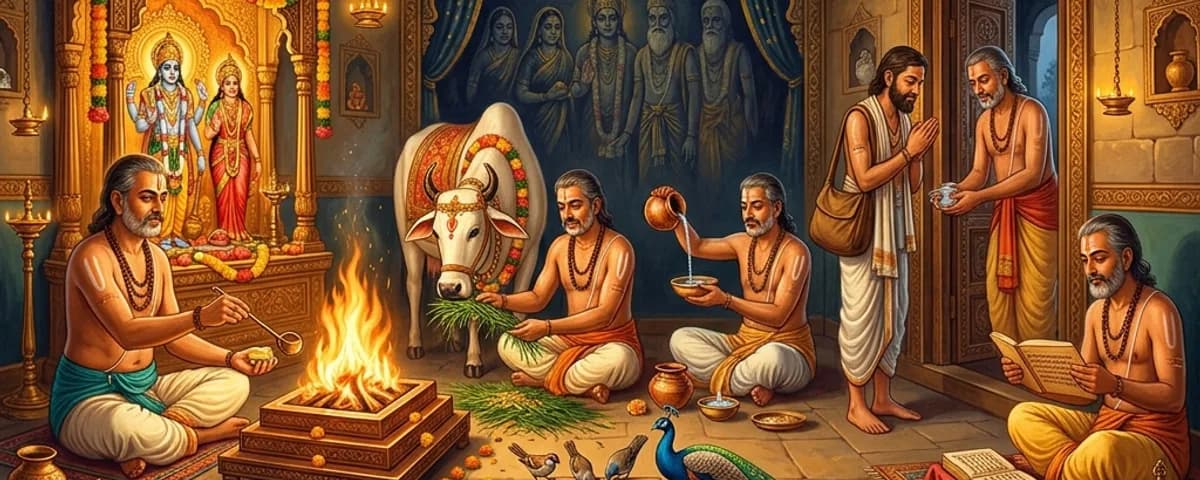
"Annam Brahma" - food is Brahman itself in edible form. What you eat shapes who you become. The Bhagavad Gita (17.7-10) classifies food into 3 gunas - sattvik, rajasik, tamasik. Daily naivedyam transforms a meal into prasadam (the deity\'s grace). Below: full food code, naivedyam rules, prasadam doctrine, ekadashi food restrictions, ahaara-niyama from Manu + Charaka, plus the panchamrita / panchagavya formulations.
आयुःसत्त्वबलारोग्य सुखप्रीतिविवर्धनाः।
रस्याः स्निग्धाः स्थिराः हृद्या आहाराः सात्त्विकप्रियाः॥
Foods that promote life, vitality, strength, health, happiness, and contentment - juicy, oleaginous, lasting, heart-pleasing - these are dear to the sattvik person.
Qualities - Increases life (ayuh), vitality (sattva), strength (bala), health (arogya), happiness (sukha), and contentment (priti). Juicy, oleaginous, substantial, agreeable.
Examples - Fresh fruits, milk, ghee, curd, whole grains (rice, wheat, barley), legumes (mung, urad, chana), vegetables (cooked), nuts (almonds, walnuts), honey. Foods cooked fresh - within 3 hours of preparation. Tulsi-laced.
Effect - Brings clarity to mind, peace to body, devotion in heart. The food of the brahmana + yogi + meditator.
कट्वम्ललवणात्युष्ण तीक्ष्णरूक्षविदाहिनः।
आहाराः राजसस्येष्टाः दुःखशोकामयप्रदाः॥
Foods that are bitter, sour, salty, excessively hot, pungent, dry, and burning - sought by the rajasik person - produce pain, grief, and disease.
Qualities - Bitter, sour, salty, very hot, pungent, dry, burning. Produces pain (duhkha), grief (shoka), disease (amaya).
Examples - Highly-spiced food, onion + garlic (considered rajasik), strong spices (chili, peppercorn excess), pickles, deep-fried items, very hot foods. Coffee + tea. Restaurant-spicy food. Meat (in some classifications).
Effect - Stimulates passion, ambition, restlessness, sexual energy. The food of the kshatriya + active householder. Excess leads to anger + craving.
यातयामं गतरसं पूति पर्युषितं च यत्।
उच्छिष्टमपि चामेध्यं भोजनं तामसप्रियम्॥
Food that is stale, tasteless, putrid, leftover, others' leftovers, and impure - is dear to the tamasik person.
Qualities - Stale, cold, tasteless, putrid, foul-smelling, refuse, impure.
Examples - Leftovers (older than 3 hours), reheated food, frozen + microwaved food, meat (in stricter classifications), fermented foods (in some readings), alcohol, intoxicants. Junk food. Tinned + canned + heavily preserved foods.
Effect - Dulls the mind, weighs down the body. Produces sleep, sloth, anger, depression. The food of the ignorant + addicted.
Naivedyam = offering food to the deity. The 6th of the 16 upacharas (after dhupa, dipa). All food prepared in the household kitchen must be offered to the deity FIRST - then it becomes prasadam (grace), and only then may humans eat.
Cleanliness
The cook must bathe before cooking + maintain shauca (purity). The kitchen + utensils must be ritually clean. Modern reality: at minimum, hands washed + mind composed.
Vegetarian only
Only sattvik vegetarian food is offered to deities (some local exceptions: Kali in Bengal accepts goat meat; Bhairava traditions accept other foods).
Onion + garlic excluded
These are rajasik / tamasik and should not be in naivedyam. Most temple kitchens (mathas) cook without onion + garlic.
Tulsi for Vishnu, Bilva for Shiva, Durva for Ganesha
The signature herb of the deity must be placed on the naivedyam plate.
Right hand only
Naivedyam is offered with the right hand using a flower / spoon. Never directly with fingers touching food.
Pranava Mantra
Recite "Om Pranaya Svaha, Om Apanaya Svaha, Om Vyanaya Svaha, Om Udanaya Svaha, Om Samanaya Svaha, Om Brahmane Svaha" while offering - invoking the 5 pranas + Brahman.
Wait period
Leave the offering before the deity for 10-15 minutes minimum. The deity's "essence" is absorbed during this time. Then offer + share as prasadam.
Tirupati Tirumala
Famous laddu prasadam. 4,00,000 laddus made daily. Receives GI tag - the only prasadam-product to have one.
Jagannath Puri
Mahaprasad - cooked in 752 earthen pots stacked on the same fire by the temple's 600 cooks. Once cooked, considered "abhojya" (free of all impurity) - even castes that normally do not share food may share Jagannath's prasad.
ISKCON Akshaya Patra
Mid-day meal program serving 2 million children daily across India - every meal first offered to Krishna, then served as prasadam.
Sikh Gurudwaras
Karah Prasad (semolina + flour + ghee + sugar) at every gurudwara - first offered to the Guru Granth Sahib, then distributed. Langar (community meal) is sister-tradition.
On Ekadashi (11th tithi of each fortnight, 24 times a year), strict food rules apply for Vaishnavas. The reason: legend says all the sins of the world hide in grains on Ekadashi, so abstaining from grains prevents intake of sin.
Eat facing east
Source: Manu Smriti, Apastamba grihya-sutra
Direction of the rising sun. Eats while facing east increases longevity + intelligence.
Wash hands + feet + face before eating
Source: Manu Smriti 2.56
Removing dust + impurity before introducing food into body. Modern hygiene corroborates.
Eat in silence (or chant)
Source: Bhagavad Gita 17 + Manu
No conversation during eating. If chanting - only Brahma-arpana mantra or Annapurna stotram.
Fill stomach 1/2 with food, 1/4 with water, 1/4 with air
Source: Charaka Samhita
Never eat until full. The stomach needs space for digestion (the agni-jathara to operate).
Avoid eating between meals
Source: Charaka Samhita
No snacking. Two meals a day (early lunch + early dinner) - what Charaka considers ideal for adult.
No food after sunset for the elderly + sadhu
Source: Charaka + grihya-sutras
Digestive agni weakens after sunset. Modern fasting research confirms beneficial for elderly. Sadhus practise strict no-food-after-sunset.
6 rasas (tastes) in every meal
Source: Charaka Samhita
Sweet, sour, salty, bitter, pungent, astringent - all 6 in one meal ensures complete nutrition + dosha balance. The traditional thali / sadya plates achieve this.
Brahma-arpana before first bite
Source: Bhagavad Gita 4.24
"Brahmarpanam Brahma havir, Brahmagnau Brahmana hutam, Brahmaiva tena gantavyam, Brahmakarmasamadhina" - offering of Brahman into Brahman - the very act of eating becomes a yajna.