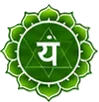
Compassion
The capacity to feel another person's suffering as if it were partially yours, without losing your own ground.
"Anahata" means "unstruck" - the sound that arises without two things hitting each other. The heart is where the felt unity behind apparent twoness becomes accessible.
Chest, at the level of the physical heart
Ishana Rudra and Kakini Shakti
Air (Vayu) · Touch
Heart, lungs, thymus, arms · Thymus
Love and acceptance when balanced; grief when blocked
Venus / Moon · Monday
Anahata sits at the heart and is the bridge between the lower three chakras (the body, the emotions, the will) and the upper three (speech, insight, transcendence). It is the meeting place. Whatever does not pass through here cannot rise; whatever the upper chakras do not connect to here cannot become wisdom.
The name itself is striking. "Anahata" means "unstruck sound" - the sound that arises without two objects colliding to produce it. Ordinary sound requires hammer and bell. The heart, when the chakra is open, hears the constant background hum of being itself, with no cause.
A modern person carries enormous accumulated grief in this chakra - losses we have not properly mourned, slights we have not fully forgiven, intimacies we have not fully accepted. Most heart-chakra practice in the contemporary West (and increasingly the East) is, before anything else, the slow work of letting that backlog out.
The capacity to feel another person's suffering as if it were partially yours, without losing your own ground.
Not only the high of new love but the steady warmth of long marriage, the love of a parent for a difficult child, the love of a teacher for a slow student.
The willingness to release a grudge - not because the other person was right, but because carrying it is more expensive than putting it down.
The felt experience of "we" - with family, community, all beings. The opposite of the loneliness epidemic.
Pranayama: Anuloma viloma - alternate nostril breathing. Balances Ida and Pingala, the lunar and solar channels that meet at the heart.
Cobra pose
Camel pose
Fish pose
Hands at the heart in prayer
Bridge pose
For five minutes a day, silently send well-wishes - first to yourself, then to a loved one, then to a neutral person, then to a difficult person, then to all beings. Modern psychology calls this LKM and finds measurable effects on cardiac coherence.
Below 20 seconds you barely register; above 20 seconds the body releases oxytocin. Anahata is responsive to actual touch.
Sit upright. Sleep on your back not curled. Carry less in your hands. Let the sternum face the world.
The single most direct heart-chakra practice in conversation. Most listening is rehearsal.
Singing - even just in the shower - vibrates the chest and breaks open held-in feeling.