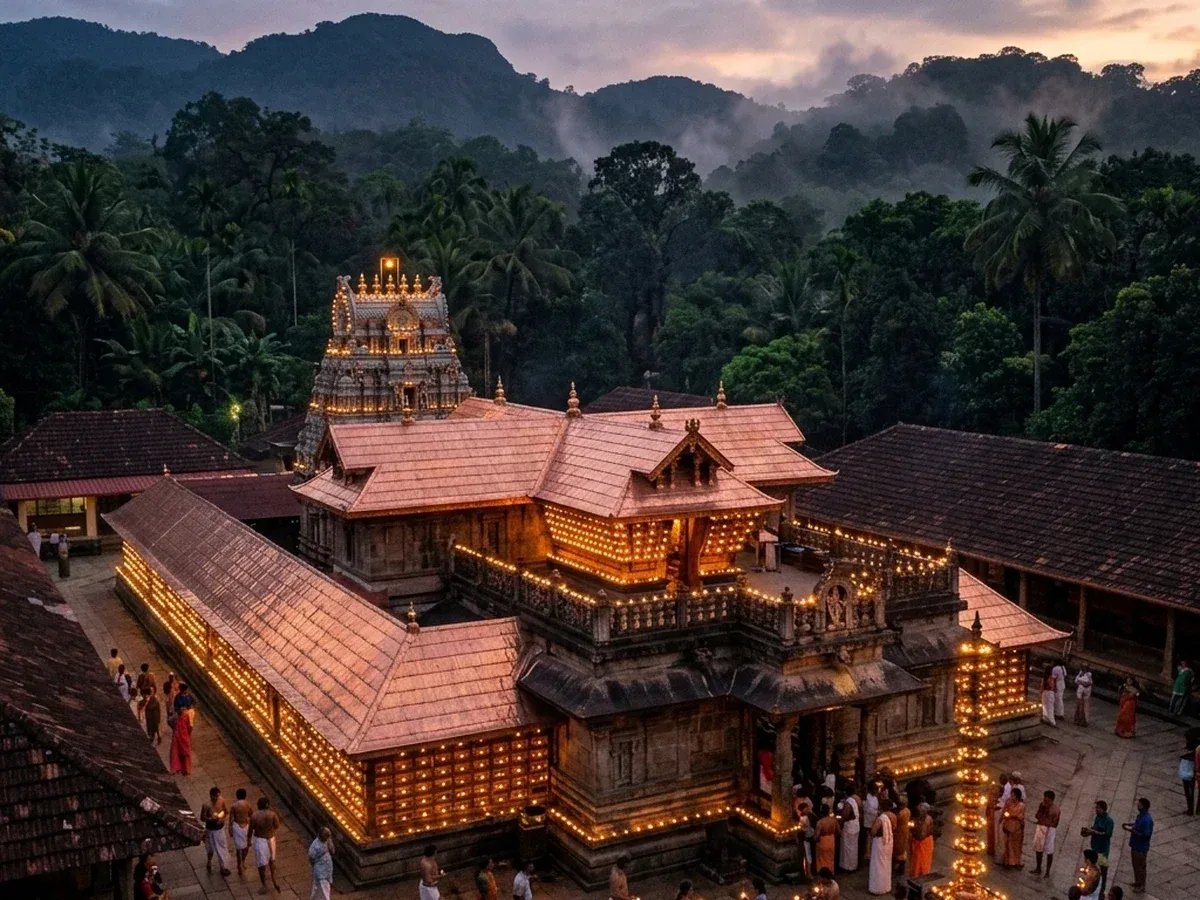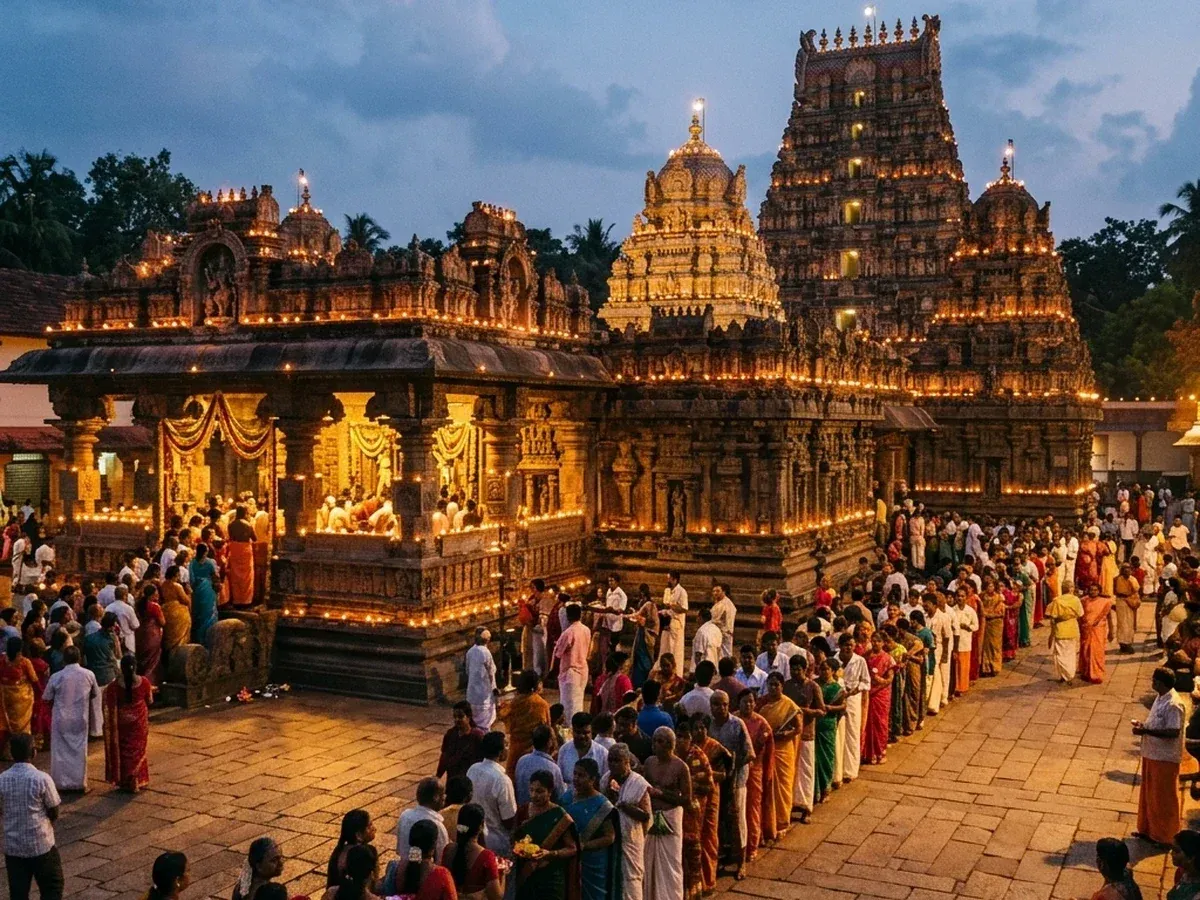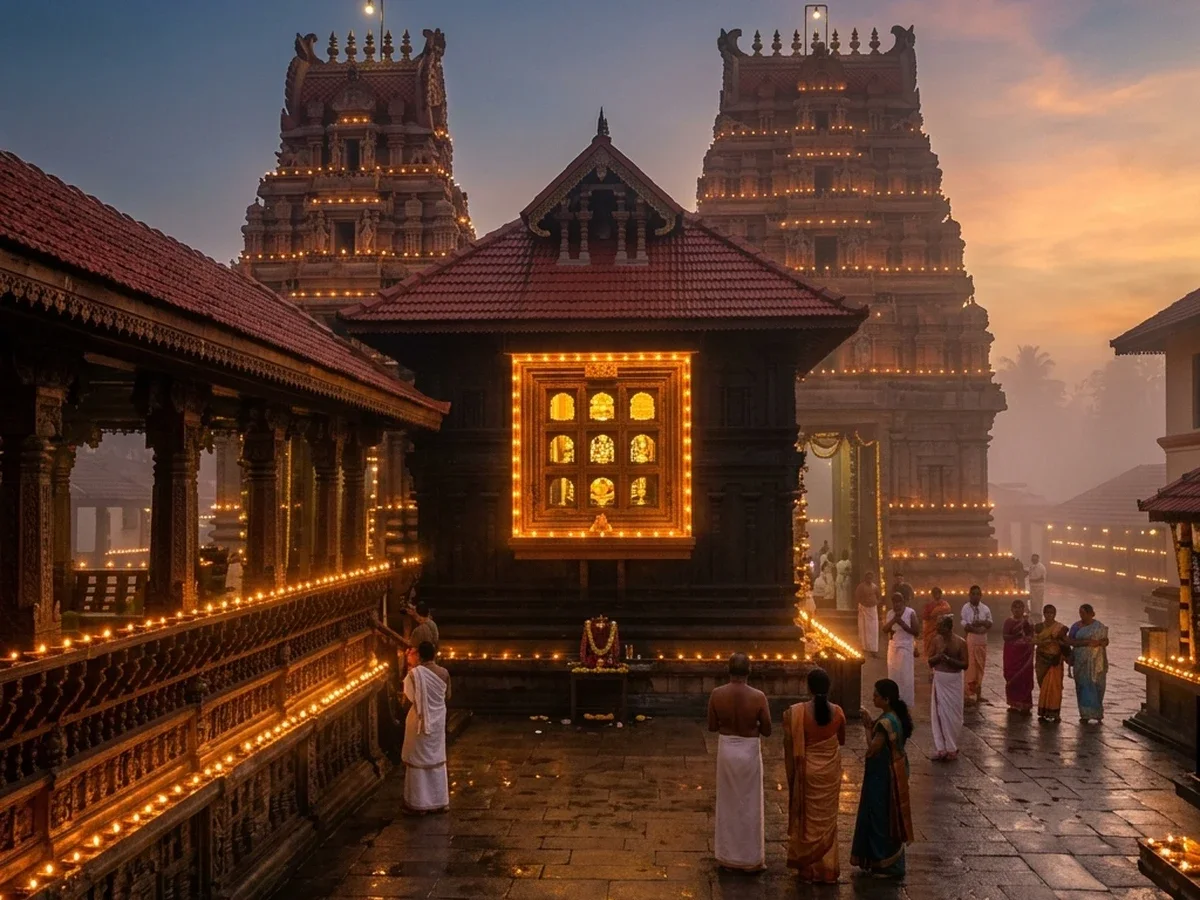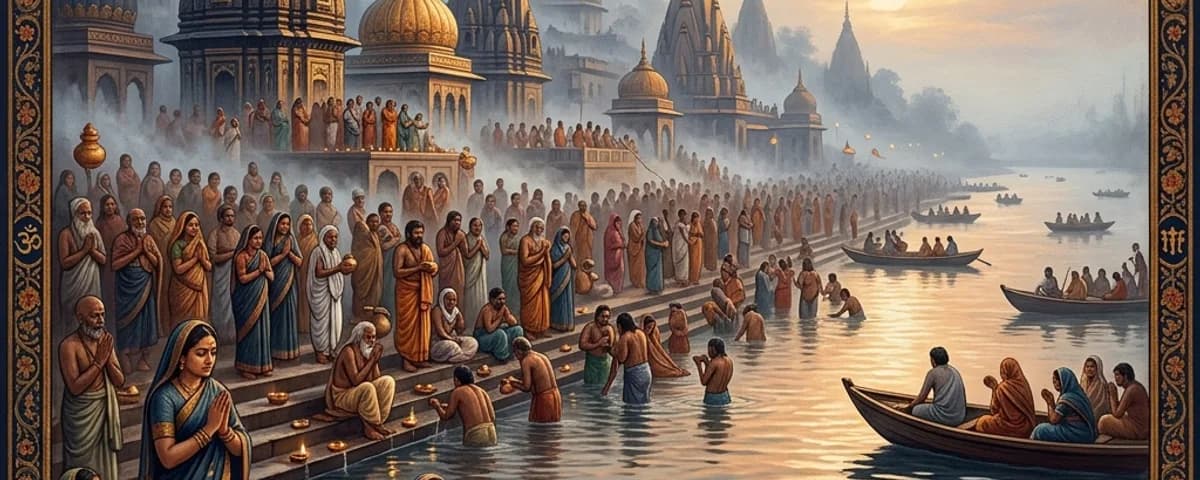
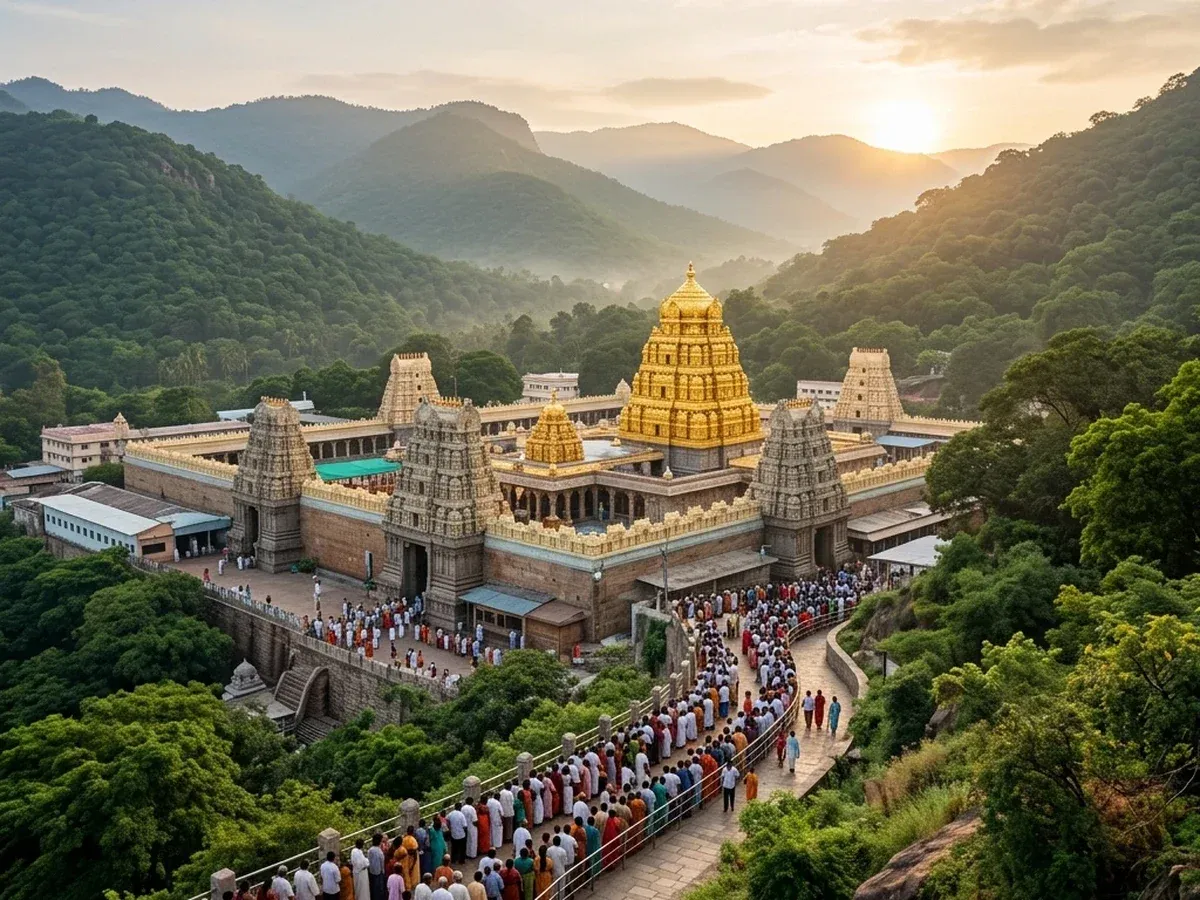
A temple in Sanatana Dharma is not a building — it is a kshetra established in scripture, with a recorded deity-formation story (svayambhu, sage-consecrated, manifested in answer to a vow), a Sthala Purana documenting the local legend, and a specific spiritual phala (fruit) it grants to pilgrims. 15 of the most scripturally-significant temples of Bharatavarsha — each with the full reference apparatus.
1
Tirumala Tirupati Sri Venkateshwara
Vaishnava — 108 Divya Desam, supreme Bhu-Vaikuntha
Deity — Sri Venkateshwara (Balaji) — a form of Vishnu / Lakshmi-Narayana
Location — Tirumala, Chittoor district, Andhra Pradesh (the 7th of the 7 hills — Saptagiri)
When established — Believed established at the start of Kali Yuga; the deity self-manifested (svayambhu) on the Venkatadri hill. The current pradhana-archaka tradition traces to Ramanujacharya (12th C), who codified the Pancharatra-agama worship here.
Scripture references
- Brahmananda Purana — the supreme source for the Venkateshwara-Lakshmi-Mahalakshmi story
- Skanda Purana — Venkatachala Mahatmya (detailed sthala purana)
- Varaha Purana — the Varaha-Venkateshwara relationship (Varaha is the older deity of the same hill)
- Bhavishyottara Purana — additional Venkateshwara prophecies for Kali Yuga
- Vishnu Purana — passing references
Sthala Purana — Venkatachala Mahatmya (Skanda Purana) + Sri Venkatesha Suprabhatam (Prativadi Bhayankaram Annan, 14th C)
How the deity took form here
Per the Brahmananda Purana: Vishnu (in his Venkateshwara form) descends to Tirumala to wed Sri Padmavati of the local kingdom. To do so he must borrow money from Kubera for the marriage — and stands ever-vigilant at Tirumala until devotees in Kali Yuga can repay the debt on his behalf (which is why the Tirupati hundi is the wealthiest in the world). The deity is svayambhu — no human hand carved it. Earlier the hill was the seat of Varaha, who graciously ceded the hilltop to Venkateshwara when the latter requested a place to stand.
Why famous
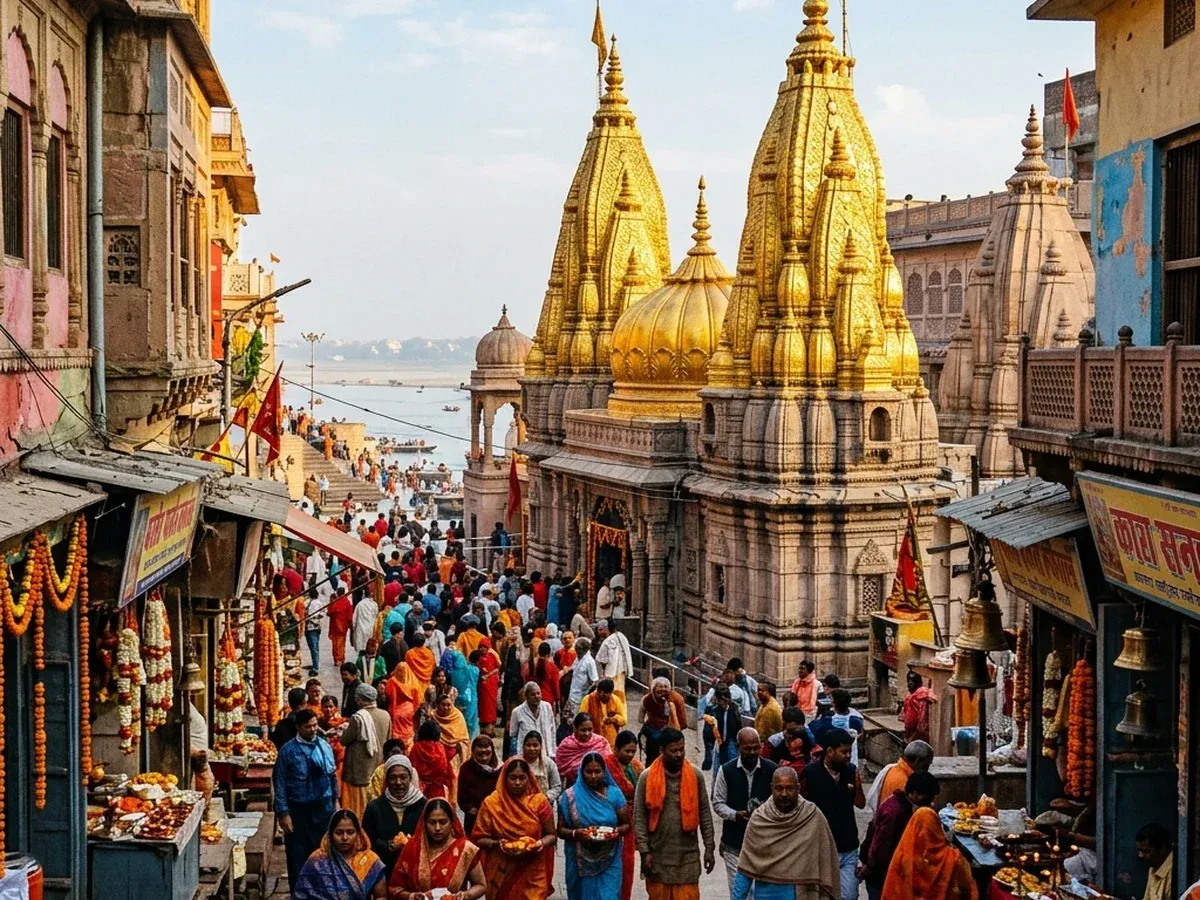
Most-visited Hindu temple in the world (~80,000 pilgrims daily, up to 200,000 on festival days). The wealthiest temple in any religion (hundi collections + jewellery donations). The "Bhu-Vaikuntha" (Vaikuntha on earth) of the Kali Yuga.
What pilgrims seek here (phala)
Believed to absolve all karma-debt — the more one offers at the hundi (whether money, hair, jewellery), the more one helps pay back Vishnu's wedding loan, and proportionate prarabdha-karma is annulled. Tirumala-darshan once in a lifetime is held to qualify the householder for moksha.
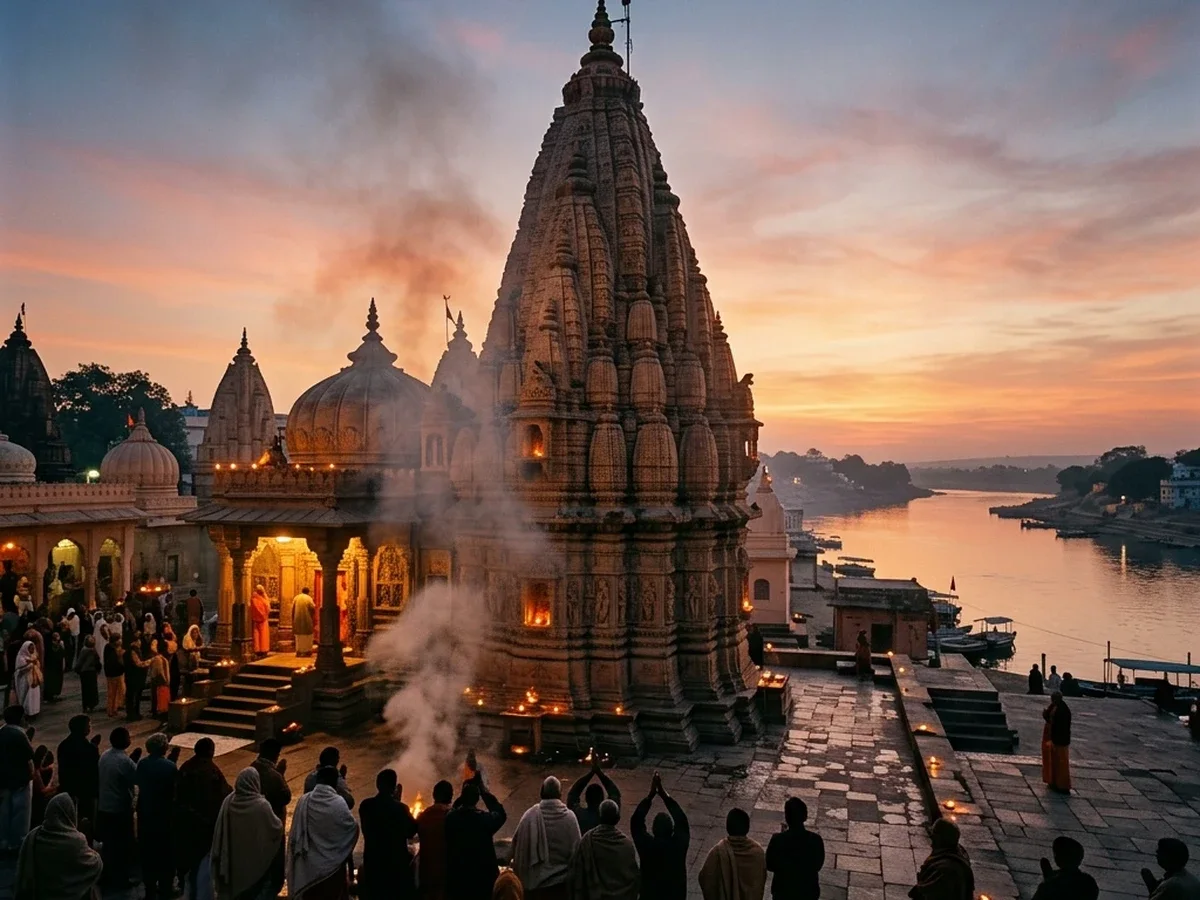
Deity — Sri Vishweshwara / Vishwanath — Shiva as "Lord of the Universe"
Location — Varanasi (Kashi), Uttar Pradesh — on the western bank of the Ganga
When established — Believed beginningless — the linga is said to predate the current Kalpa. Historically the current temple structure dates 1780 (Ahilyabai Holkar reconstruction) after multiple destructions; the linga itself is treated as svayambhu.
Scripture references
- Skanda Purana — Kashi Khanda (the longest Sthala Purana of any Hindu kshetra, ~15,000 verses across 100 chapters)
- Linga Purana — listings of the 12 Jyotirlingas with Kashi Vishwanath foremost
- Padma Purana — references to Kashi as a Mokshapuri
- Brahmavaivarta Purana — Vishweshwara stotras
- Mahabharata — Anushasana Parva (Bhishma extols Kashi)
Sthala Purana — Kashi Khanda (Skanda Purana) — by far the most detailed Sthala Purana in Hindu scripture
How the deity took form here
Per Kashi Khanda: Kashi is not part of the earth — it rests on Shiva's trishul (trident), suspended above the plane of pralaya. When all the worlds dissolve, Kashi alone remains. The linga of Vishwanath is svayambhu, the very tejas (radiance) of Shiva manifest. When Brahma + Vishnu once quarrelled over supremacy, Shiva appeared as a column of light infinite in both directions — Vishnu went down as Varaha to find the base, Brahma flew up as a swan to find the top; both failed. That column became the 12 Jyotirlingas, of which Kashi is the supreme. Shiva personally vowed to whisper the Taraka-mantra into the ear of every being who dies within Kashi — granting instant moksha.
Why famous
The supreme Mokshapuri of the 7 Mokshapuris (Ayodhya, Mathura, Haridwar, Kashi, Kanchi, Avantika/Ujjain, Dwarka). Kashi-marana (dying in Kashi) is held to grant immediate liberation. Has been continuously inhabited as a sacred city for over 3000 years.
What pilgrims seek here (phala)
Moksha. Specifically Kashi grants Taraka-moksha — the Taraka-mantra whispered by Shiva at death liberates the jiva without further sadhana. Pilgrims also seek relief from pitru-doshas (ancestor-related karmic burdens) by performing Pinda-daan at Manikarnika ghat.
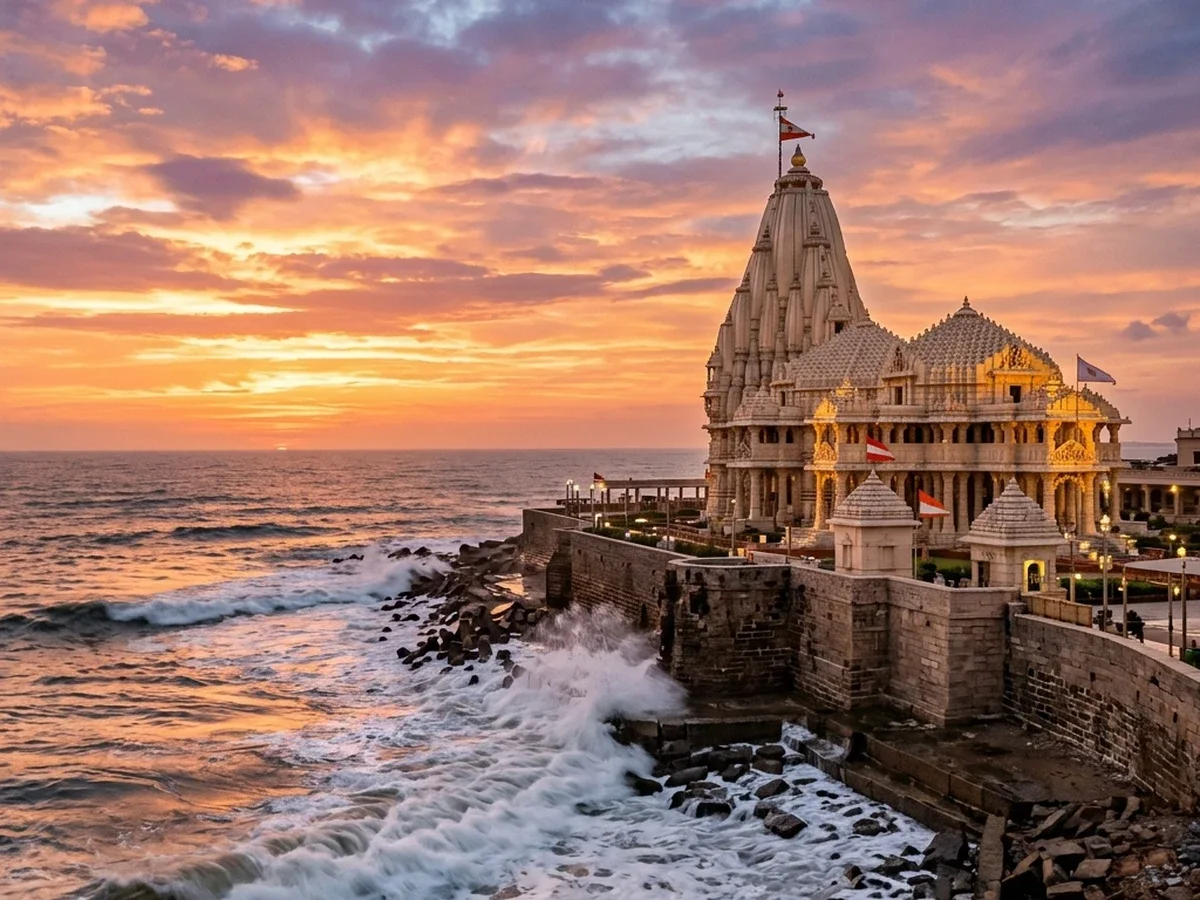
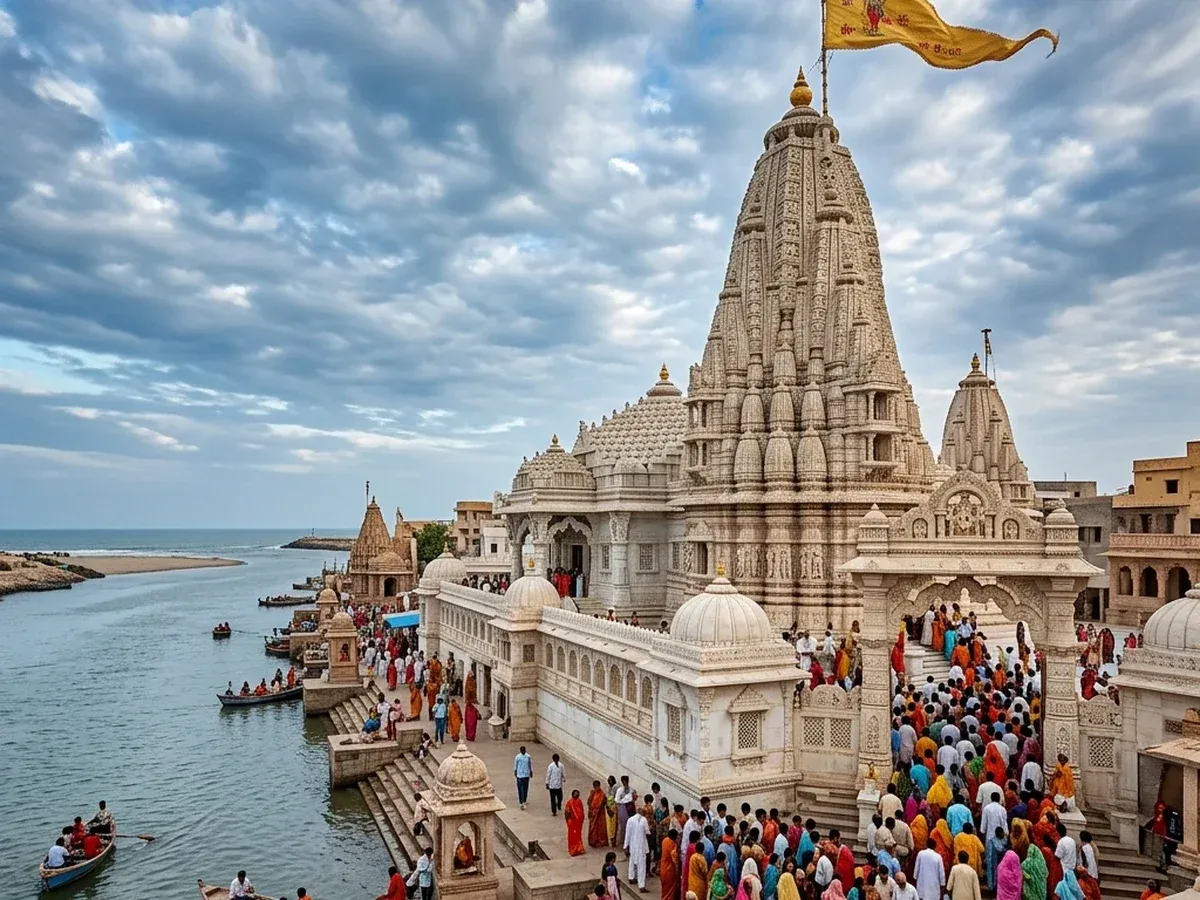
Deity — Sri Somnath / Someshvara — Shiva as "Lord of Soma (the Moon)"
Location — Prabhas Patan, Veraval, Gir Somnath district, Gujarat — on the Arabian Sea coast
When established — Believed established by Chandra (the Moon god) at the start of cosmic time. Repeatedly destroyed (Mahmud of Ghazni 1024, Alauddin Khilji 1296, Aurangzeb 1665) and rebuilt; current temple consecrated 1951 by Sardar Patel.
Scripture references
- Shiva Purana — Koti Rudra Samhita (first jyotirlinga listed)
- Skanda Purana — Prabhasa Khanda
- Bhagavata Purana 8.11 — Soma's curse + the Soma-vrata at Prabhas
- Mahabharata — Salya Parva (Krishna's departure from Prabhas)
Sthala Purana — Prabhasa Khanda (Skanda Purana) + the Somnath Mahatmya within the Shiva Purana
How the deity took form here
Per the Shiva Purana: Chandra (the Moon) had 27 wives — the 27 nakshatras, daughters of Daksha — but favoured only Rohini. The other 26 complained to Daksha, who cursed Chandra with kshaya-roga (consumption, wasting). Chandra fled to Prabhas-tirtha (the modern site), bathed in the sacred kund there, and worshipped a Shiva-linga he installed on the shore. Shiva appeared, accepted Chandra's devotion, and partially lifted the curse — granting Chandra waxing-and-waning instead of full destruction. The linga, henceforth called Somnath ("Lord of Soma"), became the first Jyotirlinga. The Bhagavata also notes Krishna ended his earthly lila here at Prabhas.
Why famous
The first of the 12 Jyotirlingas. Site of Krishna's departure-lila. One of the most-resilient sacred sites in history — destroyed 6 times by invaders, rebuilt 6 times, the current rebuild being the 7th. The "eternal Shiva" — surviving even Mahmud of Ghazni's storied destruction.
What pilgrims seek here (phala)
Believed to cure chronic illness (esp. wasting diseases — Chandra's phala). Also grants relief from doshas related to Chandra in one's kundli (mental disturbance, depression). Bathing in the Triveni Sangam at Somnath (Hiran + Kapila + Saraswati) before linga-darshan is the prescribed sequence.
4
Ramanathaswamy at Rameswaram
Shaiva — 1 of the 12 Jyotirlingas + the SETU (bridge) site of the Ramayana; also a Char Dham of the south
Deity — Sri Ramanatha — Shiva as "the Lord whom Rama worshipped"
Location — Rameswaram island (Pamban island), Ramanathapuram district, Tamil Nadu
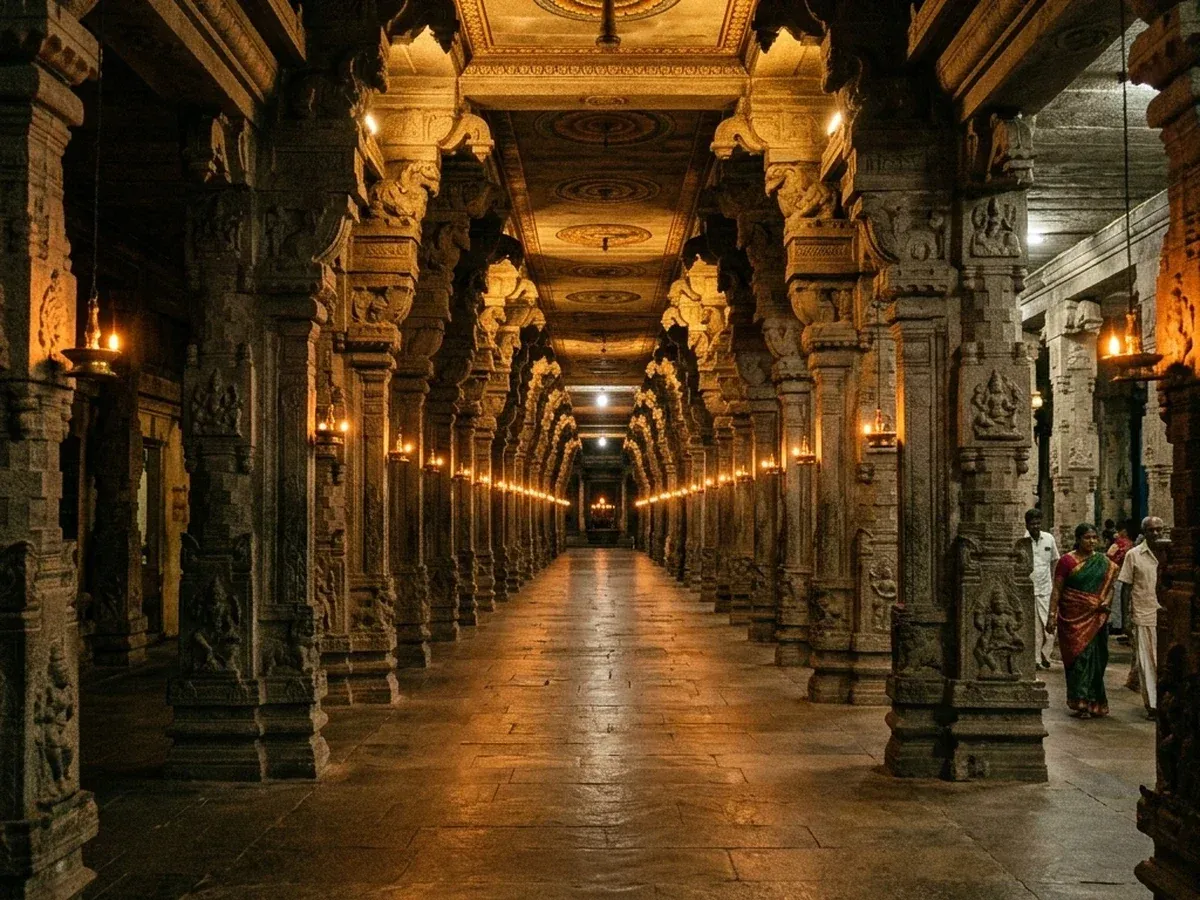
When established — Established by Sri Rama himself after the slaying of Ravana, on his return journey to Ayodhya. The current temple has the longest corridor of any Indian temple — 1212 m / 3850 ft of pillared cloisters.
Scripture references
- Skanda Purana — Brahma Khanda, Setu Mahatmya (detailed Sthala Purana)
- Ramayana — Valmiki, Yuddha Kanda 116 + Uttara Kanda passages
- Shiva Purana — Koti Rudra Samhita (jyotirlinga listing)
- Adhyatma Ramayana — Yuddha Kanda + Lanka-jaya episode
Sthala Purana — Setu Mahatmya (Skanda Purana, Brahma Khanda) — the foundational text of the Rameswaram tradition
How the deity took form here
Per the Ramayana + Setu Mahatmya: After slaying Ravana (who was a brahmana by birth) Rama incurred the Brahmahatya-dosha — the sin of killing a brahmana. To absolve it Rama, on his return through Rameswaram, decided to consecrate a Shiva-linga. He sent Hanuman to Kailasa to fetch a linga, but the time of muhurta drew near and Hanuman had not returned. Sita then formed a linga from the sea-sand on the spot — and Rama consecrated THAT linga, which is the primary Ramanatha-linga of the garbhagriha. When Hanuman returned with the Kailasa-linga he was upset; Rama, to honour him, installed the Hanuman-brought linga (Vishwa-lingam) right beside Ramanatha and decreed it must be worshipped first. To this day, archana protocol requires worshipping Vishwa-lingam first, Ramanatha-lingam second.
Why famous
(1) A Jyotirlinga, (2) the Setu-bandhana site where the vanara-army built the bridge to Lanka, (3) one of the 4 Char Dham of the southern circuit (Badrinath-Dwarka-Puri-Rameswaram), (4) home to 22 sacred kunds (theertham) inside the temple complex — bathing in all 22 in sequence is the prescribed yatra.
What pilgrims seek here (phala)
Absolves brahmahatya-dosha + any major sin (it absolved Rama himself). Combined Kashi-Rameswaram-yatra (carrying Ganga-jal from Kashi to abhisheka at Rameswaram, then carrying Rameswaram sand back to Kashi) is the supreme South-North pilgrimage — held to grant moksha.
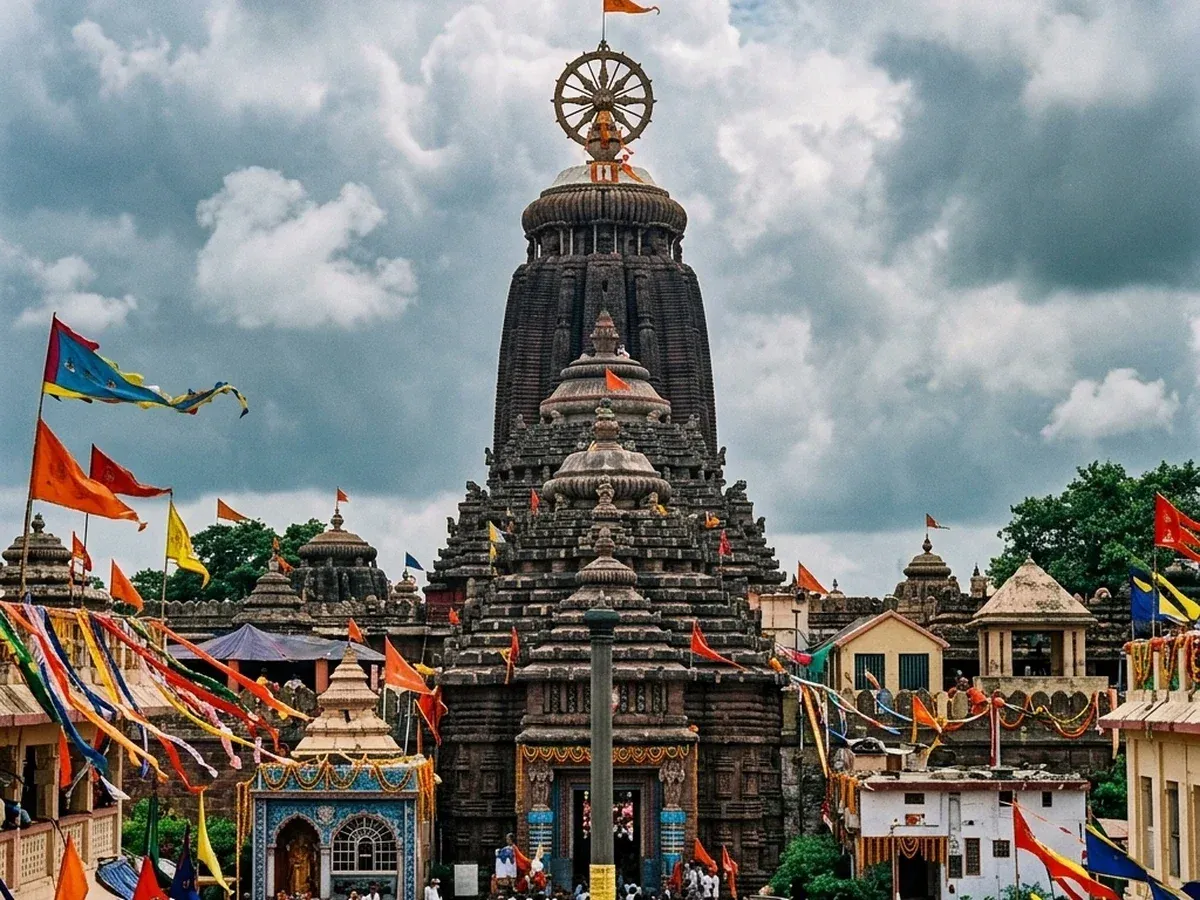
Deity — Sri Jagannath, Balabhadra, Subhadra — Krishna + Balarama + their sister Subhadra (Vishnu trinity)
Location — Puri, Odisha — on the Bay of Bengal coast
When established — Tradition holds Indradyumna, a king of Malava (later Avanti / Ujjain), established the temple in Treta Yuga at the instruction of Vishnu in a dream. The current temple structure was built by Anantavarman Chodaganga Deva of the Eastern Ganga dynasty in the 12th century.
Scripture references
- Skanda Purana — Purushottama Mahatmya (detailed Sthala Purana)
- Brahma Purana — Purushottama Kshetra Mahatmya
- Padma Purana — references to Purushottama-kshetra
- Narada Purana — additional Mahatmya
- Niladri Mahodayam (a later Sanskrit Mahatmya specific to Puri)
Sthala Purana — Purushottama Mahatmya (Skanda Purana) + Niladri Mahodayam
How the deity took form here
Per the Skanda Purana: King Indradyumna of Malava, hearing of a tribal deity called Nila-madhava worshipped by the Sabaras (tribal people) on the eastern coast, sent his minister Vidyapati to find it. The shrine was found but then disappeared. Vishnu appeared in Indradyumna's dream: "I will reappear as a log floating on the sea-shore. Carve me into 3 forms from that log." When the log floated ashore, only Vishvakarma (the divine architect) — disguised as an old carpenter — agreed to carve it, on condition no one disturb him until done. After many days of silence Indradyumna grew anxious + opened the door. Vishvakarma vanished, leaving the carvings incomplete — arms unfinished, feet unformed. Indradyumna was distraught; Vishnu reassured him: "This is my chosen form — large round eyes, abstract limbs. Install these and worship them as Jagannath." This explains the unique iconographic style of the Puri trinity — wholly different from any other Vishnu form.
Why famous
The Ratha Yatra (Chariot Festival) of Puri — three massive wooden chariots pulled by devotees through the streets each Ashadha Shukla Dwitiya, drawing over a million pilgrims. The deities themselves are unique — abstract wooden forms unique in the entire pantheon. One of the 4 Char Dham + 7 Mokshapuris. The deities are renewed every 12-19 years in a secret ritual called Nabakalebara.
What pilgrims seek here (phala)
Grants moksha as 1 of the 7 Mokshapuris. The Mahaprasada of Puri is famously consumed without restrictions of caste — any devotee can eat from the same plate as any other; this universal equality of prasada is considered a special grace.
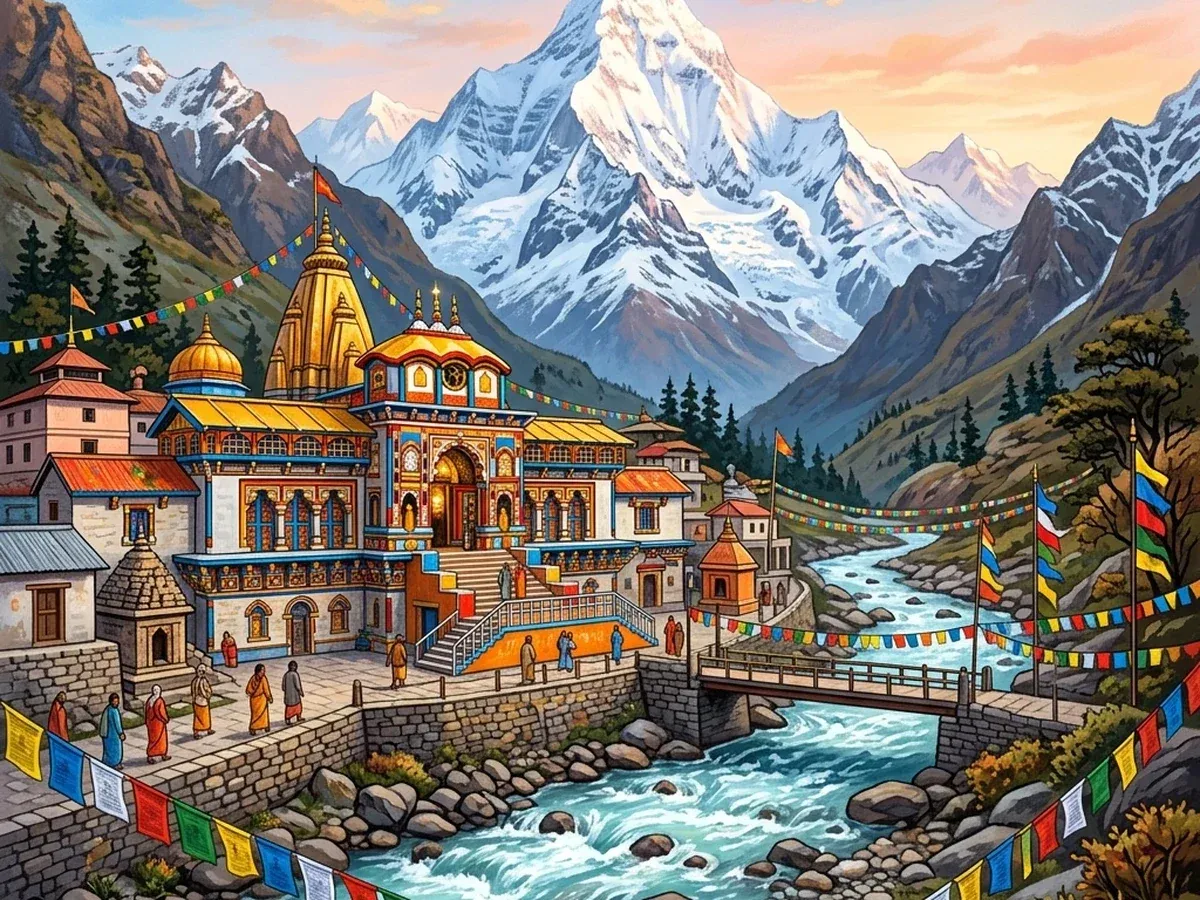
Deity — Sri Badri-Narayana — Vishnu in meditation as Nara-Narayana, accompanied by Lakshmi as Badri
Location — Badrinath, Chamoli district, Uttarakhand — at 3,300m elevation in the Garhwal Himalayas, between Nara + Narayana peaks, on the Alaknanda river
When established — Believed established by Nara + Narayana themselves in Satya Yuga as their tapasya-sthala. Re-discovered and re-consecrated by Adi Shankaracharya in the 8th century CE, who installed the current Saligram-shila murti retrieved from the Alaknanda river.
Scripture references
- Vishnu Purana — Badrika-ashrama as Nara-Narayana's tapas-sthala
- Skanda Purana — Badrika Kshetra Mahatmya
- Bhagavata Purana 3.4 + 10.87 — Nara-Narayana at Badari
- Mahabharata — Aranyaka Parva (Yudhishthira visits Badari)
- Padma Purana — additional Mahatmya
Sthala Purana — Badrika-Kshetra-Mahatmya (Skanda Purana)
How the deity took form here
Per the Bhagavata + Mahabharata: Vishnu took form as the twin sages Nara + Narayana, sons of Dharma + Murti, and performed tapasya at Badrika-ashrama. Lakshmi, unwilling to be apart, took the form of a badri (jujube) tree and provided shade for Narayana's meditation — hence the name Badrinath ("Lord under the Badri"). When Kali Yuga arrived + the kshetra fell into neglect, Adi Shankaracharya, on his digvijaya yatra in the 8th C, was directed by Vishnu in a dream to a Saligram-stone in the Alaknanda river. He retrieved the stone, which had self-formed as the Badri-Narayana murti, and re-consecrated it at the present garbhagriha.
Why famous
Northernmost of the 4 Char Dham. Closed for 6 months each year (Nov-Apr) when the Himalayan winter makes the site inaccessible. During closure, worship is transferred to Joshimath (the winter abode). The Tapt Kund (hot spring) at the foot of the temple — even at 3300m elevation surrounded by snow — is the prescribed pre-darshan bath. The garbhagriha icon is the only Saligram-shila murti among the major Vishnu temples.
What pilgrims seek here (phala)
Believed to grant moksha; the Padma Purana states a Badri-darshan once is equivalent to a hundred Ashvamedha-yajnas. Especially recommended for those approaching the final ashrama of life (vanaprastha + sannyasa). Combined with Kedarnath darshan = the supreme Himalayan yatra.
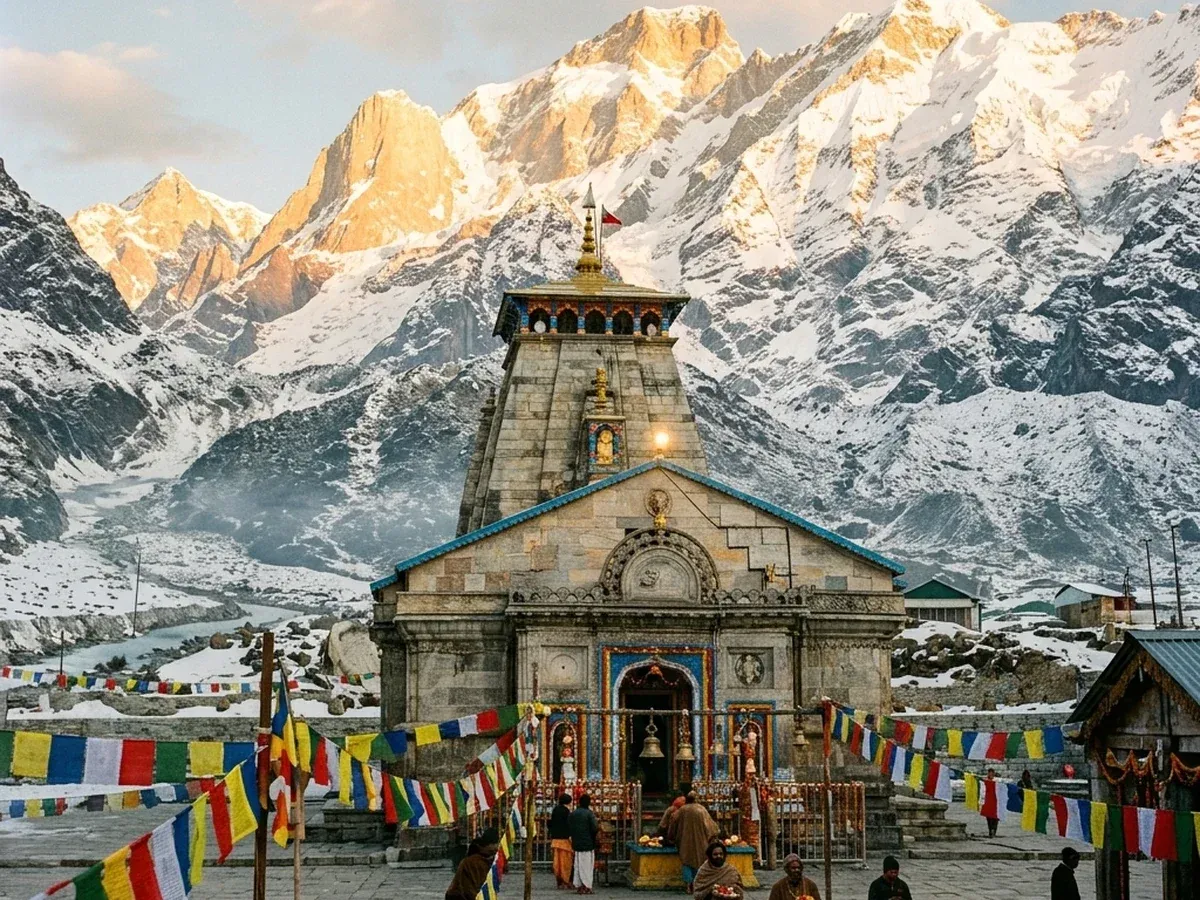
Deity — Sri Kedareshvara — Shiva as the back-hump of Nandi (the Bull)
Location — Kedarnath, Rudraprayag district, Uttarakhand — at 3,583m elevation in the Garhwal Himalayas, near the head of the Mandakini river
When established — Believed established in Mahabharata era when the Pandavas pursued Shiva (who was hiding in bull-form) and the rear hump of the bull manifested as the linga. Re-consecrated by Adi Shankaracharya in the 8th C, who is also believed to have attained samadhi at Kedarnath (his samadhi is behind the temple).
Scripture references
- Mahabharata — Anushasana Parva 17 (the Pandavas' pursuit of Shiva post-Kurukshetra)
- Skanda Purana — Kedarakhanda
- Shiva Purana — Koti Rudra Samhita (Jyotirlinga listing)
- Kedara Kalpa (a separate text within the Skanda corpus)
Sthala Purana — Kedarakhanda (Skanda Purana) — extensive Mahatmya of the entire Garhwal-Himalaya region with Kedarnath at the center
How the deity took form here
Per the Mahabharata: After the Kurukshetra war the Pandavas, burdened with the sin of killing kinsmen (jnati-vadha), sought Shiva for absolution. Shiva, displeased with the slaughter, refused to grant darshan and fled to the Himalayas in the form of a bull. The Pandavas pursued. Bhima recognised the bull, leaped forward, and tried to seize it by the tail. The bull tried to dive into the ground — but Bhima caught the hump on its back. Shiva, pleased by Bhima's persistence, agreed to manifest the linga at the spot of the hump — Kedarnath. The other parts of the bull manifested at the 4 Panch Kedar sites: Tungnath (arms), Rudranath (face), Madhyamaheshwar (navel), Kalpeshwar (hair).
Why famous
Most arduous of the major Char Dham — requires a 16km trek from Gaurikund (or helicopter). Closed 6 months a year (Nov-Apr); winter worship transferred to Ukhimath. Among the most ancient continuously-worshipped Shiva lingas. Site of Adi Shankaracharya's mahasamadhi behind the main temple. Survived the catastrophic 2013 floods that destroyed much of the surrounding village.
What pilgrims seek here (phala)
Absolves the heaviest sins including jnati-vadha (kin-killing — the sin the Pandavas sought relief from). Especially powerful for those who have caused deaths in war or accident. Combined Kedarnath + Badrinath darshan is the supreme Himalayan yatra (Kedar-Badri).
Deity — Sri Dwarkadhish — Krishna as "Lord of Dwarka", the city he ruled
Location — Dwarka, Devbhumi Dwarka district, Gujarat — on the Arabian Sea coast at the western tip of India
When established — Believed established by Krishna himself when he led the Yadavas from Mathura to Dwarka. The current Jagat Mandir temple is dated to the 16th C; preceding structures date much earlier; archaeological evidence on the seabed suggests an inundated city consistent with the Bhagavata narrative.
Scripture references
- Bhagavata Purana — Skandhas 10 + 11 (Krishna's establishment + ruling of Dwarka, the city's final submergence)
- Vishnu Purana — Dwarka chapters
- Mahabharata — Sabha Parva + Mausala Parva (Dwarka in the political-narrative)
- Harivamsa — extensive Dwarka section
- Skanda Purana — Dwarka Mahatmya
Sthala Purana — Dwarka Mahatmya (Skanda Purana) + Dwarkadhish Pratistha-vidhi texts
How the deity took form here
Per the Bhagavata: When Jarasandha repeatedly attacked Mathura, Krishna led the Yadavas westward and asked Vishvakarma to build a new city on land reclaimed from the sea — Dwarka, "the city with many gates". Krishna ruled here as Dwarkadhish for ~36 years, married 8 principal queens (Rukmini, Satyabhama, Jambavati, Kalindi, Mitravinda, Satya, Bhadra, Lakshmana) + 16,100 rescued princesses. After Krishna's departure at Prabhas, the city was reclaimed by the sea (the Bhagavata describes the submergence in vivid detail). The current Dwarkadhish temple is built on the elevated site where the original royal palace stood; the murti of Krishna here is held to be the original installed by his grandson Vajra.
Why famous
1 of the 4 Char Dham + 1 of the 7 Mokshapuris. Closely associated with Krishna's grihastha-lila as opposed to his Vrindavan-balalila. The Nageshvara Jyotirlinga (also one of the 12) is just outside Dwarka, allowing pilgrims to do both in one yatra. Archaeological surveys on the seabed off Dwarka (Bet Dwarka) have found submerged structures consistent with the Bhagavata story.
What pilgrims seek here (phala)
Grants moksha as 1 of the 7 Mokshapuris. Especially recommended for householders (since Dwarka represents Krishna's grihastha-phase). Pilgrims also visit Bet Dwarka (the island where Krishna actually lived) by boat — the inner sanctum there contains Krishna's personal worship-room.
9
Sri Meenakshi-Sundareshvara
Shaiva-Shakta — 1 of the 51 Shakti Pithas (Meenakshi); a Padal Petra Sthalam (Pandya region)
Deity — Sri Meenakshi (Parvati / Devi) + Sri Sundareshvara (Shiva) — the divine couple worshipped together
Location — Madurai, Tamil Nadu — on the banks of the Vaigai river in southern Tamil Nadu
When established — The original consecration is held in the Pandyan era of mythic antiquity (King Malayadhwaja Pandyan). The current massive temple complex with 14 gopurams was built in stages from the 6-7th C through the Nayaka period (17th C).
Scripture references
- Tiruvilaiyadal Puranam (Tamil) — by Paranjothi Munivar, 64 sacred lilas of Sundareshvara at Madurai
- Halasya Mahatmyam (Sanskrit) — Sanskrit Sthala Purana with same 64 lila content
- Skanda Purana — references to Halasya-kshetra
- Devi Bhagavata Purana — Meenakshi as a form of Para-Shakti
- Tirumurai (Nayanmar Tevaram) — Sambandar, Appar, Sundarar all sang of Madurai Sundareshvara
Sthala Purana — Tiruvilaiyadal Puranam (Tamil, Paranjothi Munivar) + Halasya Mahatmyam (Sanskrit) — the 64 sacred lilas of Sundareshvara at Madurai
How the deity took form here
Per the Halasya Mahatmyam: King Malayadhwaja Pandyan + Queen Kanchanamala were childless. They performed an intense putrakameshti yajna. From the homa-fire emerged not a son but a 3-year-old girl — with 3 breasts. A divine voice told the king: "Raise her as your daughter; the third breast will disappear when she meets her destined husband." Named Tatatakai (later Meenakshi — "fish-eyed", because her eyes were long and fish-shaped), she grew into a fierce warrior-queen, conquered the 8 directions, then arrived at Kailasa. Seeing Shiva there, her third breast disappeared — Shiva was her destined husband. Shiva came to Madurai as Sundareshvara ("the beautiful Lord") to marry her. The wedding is celebrated annually as the Chithirai festival — drawing over a million devotees. Meenakshi here is treated as the senior deity — the temple is named for her, the wedding is from her perspective.
Why famous
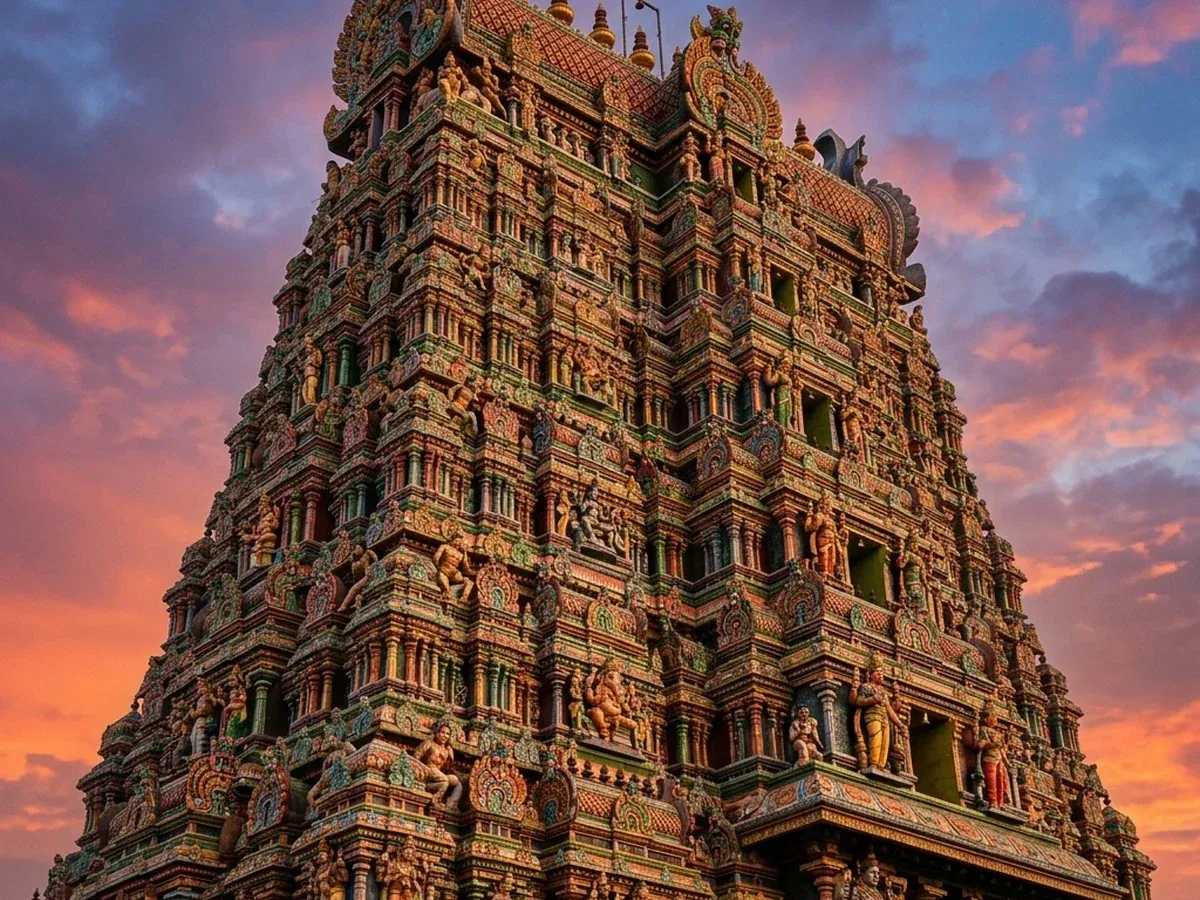
The most architecturally spectacular Dravida-style temple — 14 gopurams (gateway towers) including 4 outer gopurams over 50m tall, the 1000-pillar mandapam, the Pottramarai Kulam (Golden Lotus tank). One of very few major South Indian temples where the goddess is the senior deity. The annual Chithirai-tirukkalyanam (divine wedding) is among the largest religious gatherings in South India.
What pilgrims seek here (phala)
Marriage-blessing — unmarried women + men pray here for the right spouse, particularly during the Chithirai festival. Couples pray for marital harmony. Also a Shakti Pitha (Meenakshi as Shakti), so pilgrims with Devi-related vows visit. The Pottramarai Kulam is held to test the authenticity of poetry — a famous lila has the tank rising to drown false verses + sinking under good ones (origin of the Sangam-academy tradition).
10
Sri Ranganatha at Srirangam
Vaishnava — Bhuloka Vaikuntha; FIRST + foremost of the 108 Divya Desams; supreme seat of Sri Vaishnavism
Deity — Sri Ranganatha — Vishnu reclining on Adishesha, the cosmic serpent
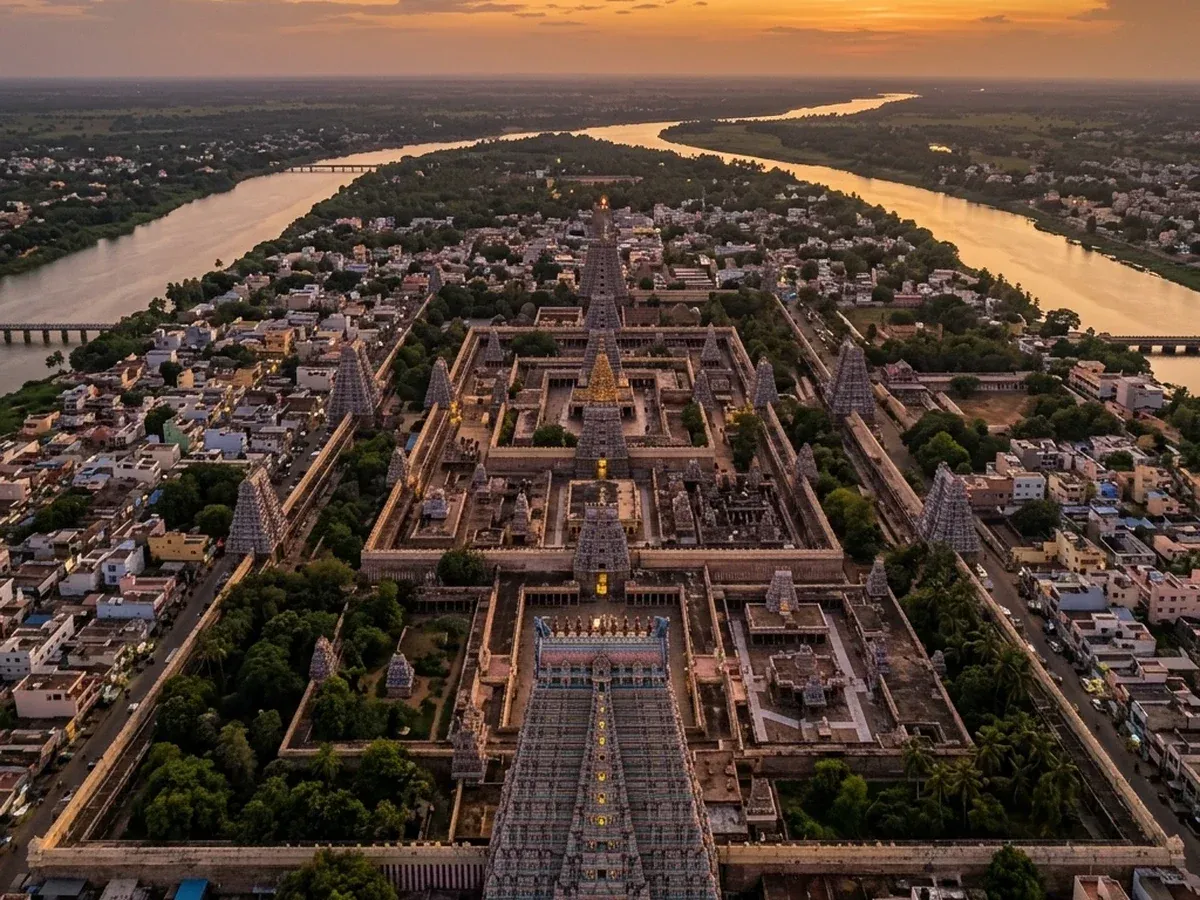
Location — Srirangam, an island in the Kaveri river, Tiruchirappalli (Trichy) district, Tamil Nadu
When established — Tradition holds the deity was originally worshipped by Brahma himself at Satyaloka; passed to Ikshvaku then Rama; gifted by Rama to Vibhishana of Lanka who, on his journey back to Sri Lanka, stopped at Srirangam where the deity refused to move further — establishing the kshetra. Current temple complex is the largest functioning Hindu temple in the world by area (~63 hectares, 7 prakaras / concentric walls, 21 gopurams).
Scripture references
- Brahmananda Purana — Sri Ranga Mahatmya
- Padma Purana — Srirangam Mahatmya
- Garuda Purana — references to Sri Ranganatha
- Divya Prabandham (Tamil) — the 12 Alvars' paasurams; nearly 200 paasurams are dedicated specifically to Srirangam
- Sri Vaishnava Acharya literature — Yamunacharya's Stotra Ratna + Ramanujacharya's Sri Bhashya + Gadya Trayam
Sthala Purana — Sri Ranga Mahatmya (Brahmananda Purana) — supplemented by the Koil Olugu (Tamil historical record of the temple, maintained continuously from the 12th C)
How the deity took form here
Per the Brahmananda Purana + the Koil Olugu: The deity (a self-manifested form of Vishnu reclining on Adishesha) was originally in Vaikuntha; given by Vishnu to Brahma. Brahma worshipped it at Satyaloka. After the appearance of the Ikshvaku dynasty Brahma gifted the deity to King Ikshvaku; it then passed down through the dynasty to Sri Rama himself. Rama, after the Lanka-war, gave the deity to Vibhishana (the Rakshasa-king of Lanka and devotee of Vishnu). Vibhishana started carrying it home; en route he stopped to rest by the Kaveri at the island of Srirangam. He set the deity down — but Vishnu, who had told Vibhishana he would not move once set down, did not move. Vibhishana was distraught; Vishnu reassured him: "I shall always face south, looking toward Lanka, so you may daily come and see me." To this day the Sri Ranganatha murti faces south (unusual — most temples face east), specifically to face Lanka, in keeping with Vishnu's promise to Vibhishana.
Why famous
Largest functioning Hindu temple in the world by total area. The first + foremost of the 108 Divya Desams. The supreme seat of the Sri Vaishnava sampradaya — Ramanujacharya lived + taught here for many decades + his preserved body (as a continually-cared-for jiva-samadhi) is in a shrine within the temple complex. Closely associated with the Alvars — Andal's "marriage" with Sri Ranganatha is a famous Vaishnava narrative.
What pilgrims seek here (phala)
Considered the supreme moksha-kshetra for Vaishnavas. The Vaikuntha Ekadashi darshan at Srirangam (in Margashirsha / December-January) — when the Paramapada-vasal (gateway of the supreme abode) is opened only once a year — is held to grant Vaikunthavasa to the soul. Major Sri Vaishnava acharyas continue to give upadesha at Srirangam.
11
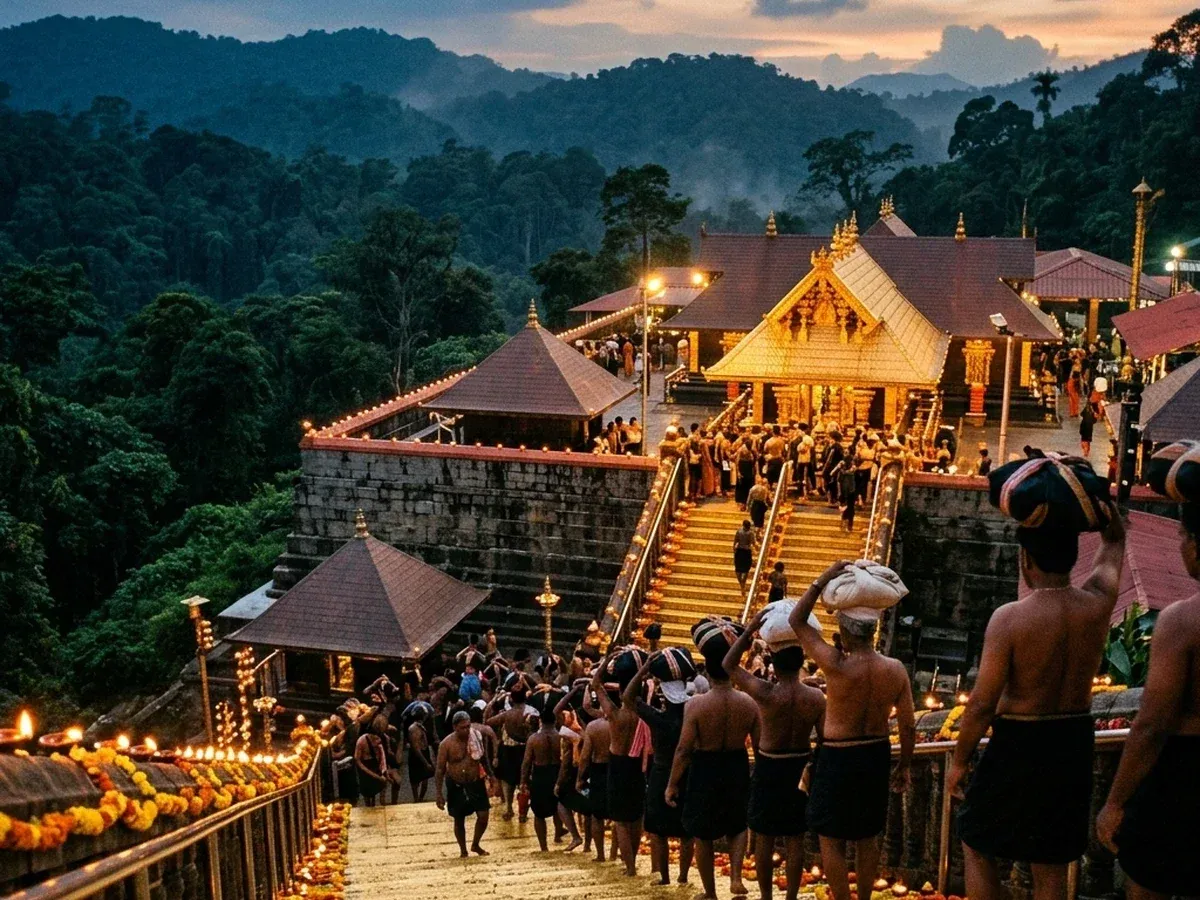
Sri Dharma-Sastha at Sabarimala
Hari-Hara — son of both Vishnu (as Mohini) + Shiva; an avatar of Dharma-Sastha worshipped pan-South-Indian
Deity — Sri Ayyappa Swami / Dharma-Sastha / Hariharaputra — son of Hari (Vishnu) + Hara (Shiva)
Location — Sabarimala hill, in the Periyar Tiger Reserve, Pathanamthitta district, Kerala — accessed by a steep forest trek
When established — Tradition holds the deity was consecrated by Parashurama (the 6th avatar of Vishnu, the founder of Kerala) on the Sabari hill after the lifetime-mission of the prince Manikandan. The current pratistha (consecration) is held to have been done in the late kali yuga by Manikandan himself before his disappearance into the murti.
Scripture references
- Skanda Purana — references to Dharma-Sastha + Hariharaputra
- Bhutanatha Upakhyana (a Tamil-Malayalam Sthala Purana)
- Bhagavata Purana 8.12 — Mohini-Shiva episode (Ayyappa's parental origin)
- Sabarimala Sthala Purana — Malayalam local tradition recording the Manikandan story
Sthala Purana — Sabarimala Sthala Purana + Bhutanatha Upakhyana — the Manikandan-Pandalam narrative
How the deity took form here
Per the Bhagavata: when the devas + asuras churned the cosmic ocean (samudra-manthan), Vishnu took the form of Mohini (the enchantress) to trick the asuras. Shiva, on a later occasion, saw Mohini and was attracted; from their union was born a child, Hariharaputra (also called Dharma-Sastha, Manikandan, Ayyappa). The child was abandoned + found by the (childless) Raja of Pandalam (a small kingdom in Kerala) on a riverbank, with a bell (mani) around his neck — hence "Manikandan" (he with the bell-neck). The Raja raised him as his prince. When the queen (jealous of Manikandan replacing her own later-born son) feigned illness curable only by tigress's milk, Manikandan went to the forest, conquered the demoness Mahishi (sister of Mahishasura) en route, and returned riding a tiger. He then revealed his divine identity, agreed to bless the Pandalam line, and shot an arrow that landed on Sabarimala — there he installed himself as the deity. The 41-day mandala-vrata pilgrimage of black-clad pilgrims walking through the forest to reach the temple is the most-distinctive observance.
Why famous
One of the largest pilgrimage gatherings in the world — during the Mandala-Makaravilakku season (Nov-Jan) up to 50 million pilgrims visit. The 41-day vrata + 18-step ascent (the Pathinettam Padi) before darshan is the most-strictly observed pilgrimage discipline in modern India. The Makara Jyothi (a celestial light visible on Makara Sankranti night from across the valley) is the festival climax.
What pilgrims seek here (phala)
Grants discipline + spiritual fortitude — the 41-day vrata is the supreme training in self-control. Believed to free the pilgrim of accumulated sins of the year. Pilgrims report particular efficacy for breaking long-standing addictions + harmful habits (the 41-day austerity itself does much of the work). The pilgrimage requires brahmacharya + vegetarianism + barefoot conduct + black + blue dress throughout.
12
Sri Mahakaleshwar at Ujjain
Shaiva — 1 of the 12 Jyotirlingas; 1 of the 7 Mokshapuris (as Avantika)
Deity — Sri Mahakala — Shiva as "the Great Time" / "Lord of Death itself"; the only south-facing (dakshinamukhi) Jyotirlinga
Location — Ujjain, Madhya Pradesh — on the Shipra (Kshipra) river; one of the 7 Mokshapuris (= Avantika)
When established — Believed beginningless — Mahakala has been worshipped at Ujjain through every yuga. The current temple structure was rebuilt by Ranoji Shinde (Scindia) in 1734 after multiple destructions; the linga itself is considered svayambhu.
Scripture references
- Shiva Purana — Koti Rudra Samhita (Jyotirlinga listing)
- Skanda Purana — Avantika Khanda (Ujjain Sthala Purana)
- Padma Purana — Avantika Mahatmya
- Matsya Purana — Ujjayini as a sacred Mokshapuri
- Brahma Purana — additional Ujjain Mahatmya
Sthala Purana — Avantika Khanda (Skanda Purana) — the Sthala Purana of Ujjain with detailed Mahakala narratives
How the deity took form here
Per the Shiva Purana: A demon named Dushana terrorised the city of Avantika (Ujjain), particularly the brahmana Vedapriya + his sons who maintained continual Shiva-worship there. Dushana attacked the brahmanas. They prayed intensely to Shiva. From the very earth itself burst forth Shiva in his Mahakala form — vast, terrifying, "Time itself", swallowing the demon. The grateful brahmanas requested he remain there as the protective deity of the city. The linga that emerged is svayambhu. The unique feature: the Mahakala linga is dakshinamukhi (south-facing) — south being the direction of Yama / death. This is the only Jyotirlinga among the 12 that faces south, signifying Mahakala's status as the conqueror of Yama himself.
Why famous
The only south-facing (dakshinamukhi) Jyotirlinga — facing the direction of Yama, signifying lordship over death. The Bhasma Aarti — the daily 4 AM ritual in which the linga is anointed with sacred ash (originally cremation-ground bhasma) — is the most-distinctive worship of any Jyotirlinga + is unique to Mahakaleshwar. Ujjain also hosts the Kumbh Mela once every 12 years (the Simhastha Kumbh — one of the 4 Kumbh sites). One of the 7 Mokshapuris (as Avantika).
What pilgrims seek here (phala)
Mahakala protects from akala-mrityu (untimely death). The Bhasma Aarti darshan is held to be especially powerful for those facing serious illness or accidents. Ujjain is also the prime meridian of classical Hindu astronomy (Aryabhata + later Bhaskara II both used Ujjain as longitude zero) — so the kshetra is associated with jyotisha + with mastering one's grahas.
13
Sri Mookambika at Kollur
Shakta — supreme Devi-kshetra of the Karnataka coastal region; consecrated by Adi Shankaracharya
Deity — Sri Mookambika Devi — Adi-Shakti as the slayer of Mookasura, with Saraswati on one side + Lakshmi on the other; in essence Lakshmi-Saraswati-Parvati unified
Location — Kollur, Udupi district, Karnataka — on the Sauparnika river at the foot of Kodachadri hill, in the Western Ghats
When established — Believed consecrated by Adi Shankaracharya in the 8th C, who installed the Sri Chakra at the foot of the Devi murti + established Sri-Vidya worship here. The kshetra itself is held to be from the era of the asura Mookasura — pre-Shankara.
Scripture references
- Skanda Purana — Sahyadri Khanda (the Sthala Purana of the entire Konkan-Karnataka coast)
- Devi Bhagavata Purana — references to Mookambika as Adi-Shakti
- Markandeya Purana — Mookambika as a form of Chandi
- Adi Shankaracharya's Mookambika-stotra
Sthala Purana — Sahyadri Khanda (Skanda Purana) — Mookambika-kshetra section
How the deity took form here
Per local tradition + the Sahyadri Khanda: A demon named Kamhasura performed tapas to Shiva for boons. Knowing the asura would misuse the boons, Devi (as Saraswati) struck him mute — hence "Moo-kasura" ("the mute Moo-kasura"). The asura, despite being mute, attacked the devas. Devi manifested at Kodachadri hill, slew him, and at his dying request agreed to be eternally known by his name + worshipped at the site of his slaying. Adi Shankaracharya, on his digvijaya, came to Kollur to worship Devi; she appeared + agreed to follow him to Sringeri (where he was establishing the matha) on condition he not look back. At Kollur, near the present temple site, Shankara faltered + looked back; Devi froze in that spot, declaring "I shall stay here. You may install a second murti at Sringeri." Shankara consecrated the Sri Chakra at her feet + established the present worship. The murti has 3 distinctive features: 1 face but representing the unified Lakshmi-Saraswati-Parvati; a Jyotirlinga emerging from a side of the murti (combining Shiva + Shakti); and the Sri Chakra at the base, making it a complete Sri-Vidya peetha.
Why famous
Among the supreme Sri-Vidya peethas in India (with Kanchi Kamakshi + Madurai Meenakshi). The combined Shiva-Shakti murti is unique. Sringeri Sharada Peetham acharyas continue the original Shankara connection to this day. The Kodachadri hill — a 4-hour trek from the temple — is where Devi originally appeared + where Shankara is said to have meditated; pilgrims climb it for the ultimate darshan.
What pilgrims seek here (phala)
Grants vidya (knowledge), wealth, and protection — covering all three Devis. Especially recommended for those starting any major learning (vidyarambham), seeking financial restoration, or beginning a Devi sadhana. The 41-day Mookambika vrata is a common observance among South Indian families.
14
Sri Manjunatha at Dharmasthala
Shaiva — uniquely administered by a Jain-by-birth Heggade family + worshipped by Hindus, demonstrating sarva-dharma harmony
Deity — Sri Manjunatha — Shiva (in the form of a linga said to be from Kadri / Mangaluru), worshipped together with the Daiva guardians of the kshetra
Location — Dharmasthala, Belthangady taluk, Dakshina Kannada, Karnataka — on the Netravati river
When established — Tradition traces to ~800 years ago (12th C) when the four guardian daivas (Kalarahu, Kalarkayi, Kumaraswamy, Annappa) appeared to the Pergade family + requested they establish a shrine where dharma (justice + righteousness) would be maintained for all faiths.
Scripture references
- Local sthala-perumai (Tulu + Kannada oral tradition, later written)
- Sahyadri Khanda (Skanda Purana) — passing references to the region
- Manjunatha-stotra texts
Sthala Purana — Dharmasthala-sthala-perumai (Tulu + Kannada) — recorded in writing in the modern era; oral tradition older
How the deity took form here
Per local tradition: ~800 years ago, the four guardian-daivas of the region appeared to Birmanna Pergade + his wife Ammu Ballalathi (a Jain couple) at their house in Nelyadi Beedu. The daivas demanded the Pergades convert their house into a shrine + ensure free annadana (food) + arbitration of disputes (dharma) for everyone regardless of caste or faith. The Pergades agreed. Later, a Shaiva Vaishnava acharya from the south, Vadiraja Tirtha, visited + suggested installing a proper Shiva-linga; he travelled to Kadri (Mangaluru) + brought the Manjunatha-linga from there. Hindu archakas of the Madhva tradition perform the worship; Jain Heggade family administers; Daivas guard. The annadana (free meals) here is famous — every visitor regardless of religion or status is fed without question.
Why famous
Living model of sarva-dharma harmony — Jain family administers, Vaishnava Madhva acharyas perform worship of a Shiva-linga, Daivas guard, devotees from every faith come. Famous for its annadana — feeds 30,000-50,000 meals per day continuously. The Heggade family's pratigna (vow) is that no one who enters Dharmasthala will leave hungry or with an unresolved dispute. Includes a Jain Bahubali statue + a famed manuscript-collection / hospital / educational institutions.
What pilgrims seek here (phala)
Resolves disputes (the Dharmasthala daivas are invoked by those in lawsuits, family disputes, business conflicts — a sankalpa here is considered binding). Grants the merit of annadana to those who participate in the kitchen. Believed especially powerful for sarva-dharma vows and inter-faith reconciliation.
Deity — Sri Krishna as Bala-Krishna (child-Krishna) holding a churn — facing west, viewable only through a 9-aperture window (Kanakanakindi)
Location — Udupi, Karnataka — on the coast of the Arabian Sea, near Mangaluru
When established — Consecrated by Sri Madhvacharya in 1238 CE. Madhvacharya is held to have rescued the murti from a sinking ship off the Karnataka coast, recognising it as the original Bala-Krishna murti carved by Vishvakarma + worshipped by Devaki + Rukmini themselves.
Scripture references
- Madhva-vijaya (Narayana Panditacharya, 14th C) — Madhvacharya's biography + the Udupi consecration narrative
- Sumadhva-vijaya commentaries
- Bhagavata Purana — references to Bala-Krishna form + Rukmini's worship of the same
- Skanda Purana — passing reference to the western kshetras of Karnataka
Sthala Purana — Embedded in the Madhva-vijaya + the Sumadhva-vijaya texts
How the deity took form here
Per the Madhva-vijaya: A merchant-ship from Dwarka, carrying a sacred Krishna-murti (originally worshipped by Rukmini herself, sealed inside a clay-cake for protection), was caught in a storm off the western coast of Karnataka. The ship began to sink. Madhvacharya, then in his meditation on the Malpe beach, sensed the cargo. He walked into the sea — calmed the storm by his presence — guided the ship safely to shore. The grateful captain offered Madhvacharya any cargo. Madhvacharya asked only for one heavy clay-cake the captain considered worthless ballast. He broke it open + revealed the original Bala-Krishna murti within — Krishna as a 6-year-old child holding the churning-stick of butter. He installed it at Udupi facing WEST (unusual — most temples face east) — because, per tradition, a devotee named Kanakadasa, of low caste, was barred from the front entrance by orthodox brahmanas; Krishna, to grant Kanakadasa darshan, rotated himself within the garbhagriha to face Kanakadasa's back-window. To this day pilgrims view the murti through that west-facing 9-aperture window (the Kanakana-kindi) before entering for direct darshan.
Why famous
Supreme seat of Dvaita Vedanta (Madhva's philosophy). The 8 ashta-mathas of Udupi rotate the temple administration in a 2-year cycle (Paryaya) — each acharya gets paryaya once every 16 years; the changeover (Paryaya-mahotsava) is a major event drawing thousands. The west-facing murti + the Kanakana-kindi story — celebrating Krishna's love for the low-caste devotee — is a beloved Bhakti-narrative. Udupi cuisine + the famous Udupi sambar originated from temple kitchens here.
What pilgrims seek here (phala)
Grants the supreme grace of Krishna in his bala (child) form. Especially associated with childhood blessing (parents bring children for first-rice etc.). The Kanakana-kindi darshan is held to be the supreme demonstration of Krishna's availability to all regardless of caste or background.