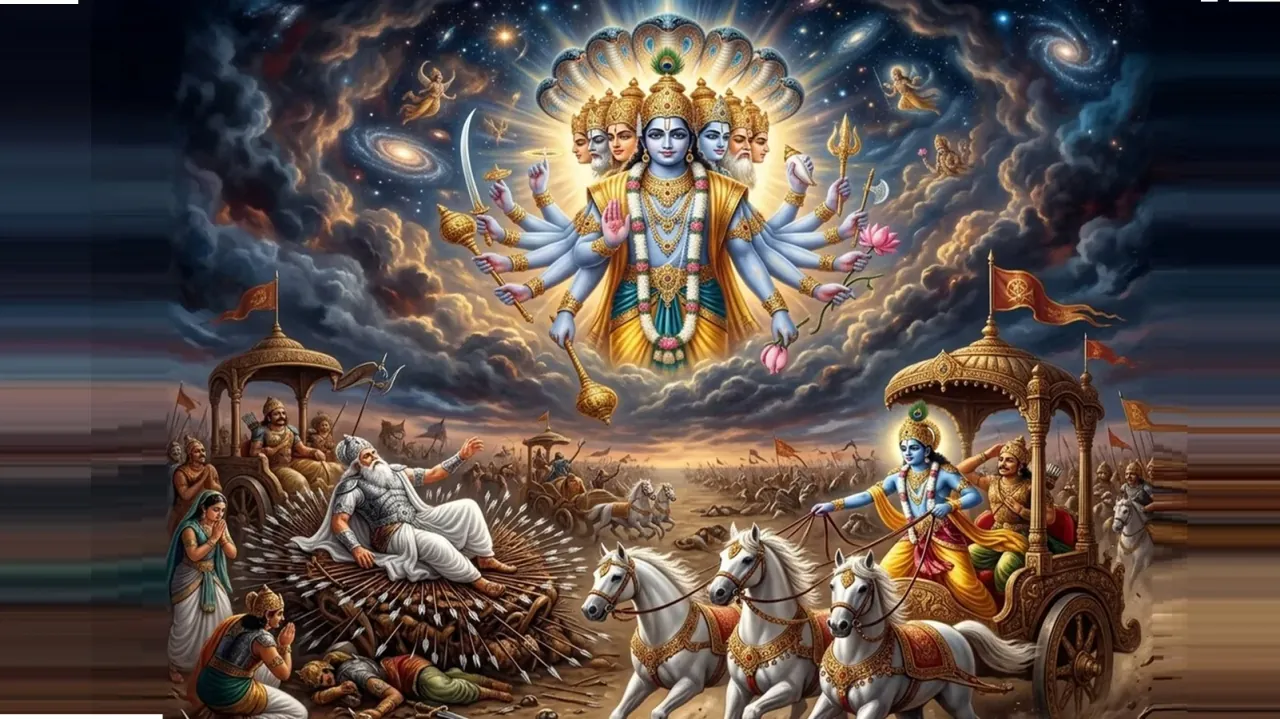
The Mahabharata + Ramayana are not just narratives - they contain entire ethical + philosophical treatises. Vidura Niti (the counsellor\'s code), the Yaksha Prashna (Yudhishthira\'s answers to 36 cosmic questions), Bhishma\'s Shanti Parva teachings, Rama\'s teachings to Bharata, and Hanuman\'s words in Sundara Kanda. Below: selected gems with Sanskrit + English meaning + context.
Vidura Niti (Mahabharata Udyoga Parva)
Vidura was the half-brother of Dhritarashtra + Pandu - born of a maidservant, his caste-status was lowly but his wisdom was supreme. He served as chief counsellor of Hastinapura through 3 generations. His night-long teaching to a sleepless Dhritarashtra (Udyoga Parva 33-40) is one of the most-cited classical ethical texts.
सुलभाः पुरुषा राजन् सततं प्रियवादिनः।
अप्रियस्य च पथ्यस्य वक्ता श्रोता च दुर्लभः॥
O King, men who speak only pleasingly are easy to find. But the speaker - and the listener - of unpleasant TRUTH that is useful - both are rare.
Context - A counsellor's plea to be heard even when delivering uncomfortable advice. The Kauravas wanted only flattery; Vidura insisted on truth.
अद्य कार्यमिति प्रोक्तं श्वो वा कुर्यामिति यः कथम्।
धर्मं तस्य न पश्यन्ति कालो हि कारयेत् सकृत्॥
When dharma calls for action today - but a person says "I shall do it tomorrow" - the dharma does not see his action. The right moment comes only once.
Context - On procrastination. Dharma has its own timing; missed opportunities cannot be reclaimed.
Never abandon dharma - not from desire, fear, or greed; not even for the sake of life itself. Dharma is eternal; happiness + sorrow are temporary. The soul is eternal; its causes (karma) are temporary.
Context - The supreme conclusion of Vidura's ethics. Dharma trumps survival, security, wealth, pleasure - everything.
A man who seeks prosperity should abandon six faults: excessive sleep, drowsiness, fear, anger, laziness, and procrastination.
Context - A practical list. Anyone serious about achievement must vanquish these six. Modern self-help in 32 syllables.
अष्टौ गुणाः पुरुषं दीपयन्ति प्रज्ञा च कौल्यं च दमः श्रुतं च।
पराक्रमश्चाबहुभाषिता च दानं यथाशक्ति कृतज्ञता च॥
Eight qualities make a man shine: wisdom, good lineage, self-control, learning, valour, brevity of speech, charity according to capacity, and gratitude.
Context - Vidura's catalogue of virtues that make a person estimable. Useful as a checklist for self-development.
यो न हृष्यति न द्वेष्टि न शोचति न काङ्क्षति।
शुभाशुभपरित्यागी भक्तिमान् यः स मे प्रियः॥
He who does not rejoice, does not hate, does not grieve, does not crave - abandoning both good + bad - who is full of devotion - that one is dear to me. (Quoting Vasudeva's teaching in BG 12.17.)
Context - Vidura links to the Gita teaching of equanimity (samattva). The ideal sthitaprajna.
The Yaksha Prashna (Mahabharata Vana Parva 297-298)
In the Mahabharata Vana Parva (chapters 297-298), the Pandavas in their forest exile arrive at a magical lake. The 4 younger brothers (Sahadeva, Nakula, Arjuna, Bhima) successively drink the water without permission from its guardian - a Yaksha (sometimes interpreted as Yama, Dharma in disguise) - and fall dead. Yudhishthira arrives last + agrees to answer the Yaksha's questions before drinking. 36 cosmic questions. His answers reveal the totality of dharma. He passes; the Yaksha reveals himself + restores the 4 brothers.
Q - kiṃ svit guru-tara-bhūmer? - What is heavier than the earth?
A - mātā guru-tarā bhūmer - A mother is heavier (greater) than the earth.
Q - kiṃ svit uccatara-cābhrāc? - What is higher than the sky?
A - pitā uccatara-cābhrāc - A father is higher than the sky.
Q - kiṃ svit dhīkṣat-tara-trad? - What is faster than the wind?
A - manaḥ dhīkṣat-taraṃ tasmāt - The mind is faster than the wind.
Q - kiṃ svit bahu-tara-cātmā? - What is more numerous than even straw?
A - tasmāc cintā bahu-tarī - Worries are more numerous (than even straw).
Q - kim āścaryaṃ? - What is the greatest wonder?
A - ahanyahani bhūtāni gacchantīha yama-ālayam | śeṣāḥ sthāvaramicchanti kim-āścaryam ataḥ param -
"Day after day, beings depart to Yama's abode. The rest believe they will live forever. What is more wonderful than this?"
Q - kaḥ panthāḥ? - What is the path (of dharma)?
A - tarko 'pratiṣṭhaḥ śrutayo vibhinnāḥ; nāsau munir yasya mataṃ na bhinnam | dharmasya tattvaṃ nihitaṃ guhāyāṃ; mahā-jano yena gataḥ sa panthāḥ -
"Logic is unstable. Scriptures differ. Sages disagree. The essence of dharma is hidden in a cave. The path is the one trodden by the great souls."
Significance - The Yaksha Prashna is considered the seed of all dharma-shastra. Yudhishthira's answer about the "greatest wonder" - that everyone watches others die yet believes they will not - is THE classic Hindu reflection on mortality. The "path of the great" answer is the foundation of mahajano-yena-gatah-sa-panthah ethics: when in doubt, follow the path of the noble.
Bhishma\'s Shanti Parva teachings
After the Kurukshetra war, Bhishma lay on his bed of arrows for 58 nights - choosing his time of death (his boon of icchamrityu). Yudhishthira sat by his side, and Bhishma delivered the entire Shanti Parva + Anushasana Parva (200+ chapters covering rajadharma, varnashrama-dharma, moksha-dharma, daana-dharma). The largest didactic section in any classical text.
Rajadharma (duties of a king)
अहिंसा सत्यवचनं सर्वभूतहितं परम्।
नार्थोऽपि बाधनीयोऽन्यैः न द्वेष्यश्च परोऽपि च॥
Non-violence, truth-speaking, the welfare of all beings - these are supreme. Another's wealth must not be obstructed; even an enemy must not be hated.
The world is conquered by forgiveness. Forgiveness is the cause of all (good). The supreme tejas (radiance) is in forgiveness. The wise one moves freely everywhere because of it.
Source: Shanti Parva 26.4-6
On dharma when in doubt
धर्मस्य सूक्ष्मा गतिः। (and:) महाजनो येन गतः स पन्थाः।
The path of dharma is subtle. Follow the path trodden by the great souls (mahajano yena gatah sa panthah).
Source: Mahabharata (cited at multiple places, Vana Parva + Shanti Parva)
I cannot transgress my father's feet - the king of mighty valour. Even unwilling, I shall fulfil his word in every way.
Context - Rama to Bharata in the forest. The supreme Maryada Purushottama moment - keeping a promise even when the original promisor is dead and the kingdom is being offered back.
I treat Guru as a father; my mother (who gave the gift of the throne); Bharata as a son; and Shatrughna as my younger brother (whom I also love).
Context - Rama's relational ethics. Each family member treated according to dharma-relationship, not according to politics.
On Vibhishana's asylum
सकृदेव प्रपन्नाय तवास्मीति च याचते।
अभयं सर्वभूतेभ्यो ददाम्येतद्व्रतं मम॥
Anyone who comes even once with the words "I am yours" - to him I shall grant freedom from fear of all beings. This is my vow.
Context - Vibhishana, Ravana's brother, surrendered to Rama. Some advisors warned that he might be a spy. Rama said this - refusing to refuse asylum even at his own risk. The supreme Sharanagati doctrine.
Hanuman in Sundara Kanda
Hanuman in Sundara Kanda is the model bhakta + the model envoy + the model servant. His humility, his courage, his eloquence, his strength - all are exemplary.
दूतोऽहं रामकर्मार्थं हनुमान् वातजः कपिः।
I am an envoy, here for Rama's work - Hanuman, the wind-born monkey.
Context - Hanuman's self-introduction to Sita at Ashoka Vatika. Just 8 words capture his entire identity - purpose (envoy for Rama), name (Hanuman), origin (wind-born), and form (monkey). No more.
राम राम कथारक्तं हनुमन्तं नमाम्यहम्।
I bow to Hanuman, ever-absorbed in Rama-Rama-katha.
Context - Devotional verse celebrating Hanuman's sole occupation - listening to + speaking + thinking Rama-katha (Rama's story).