By Sevasannidhi LLP·Updated 22 May 2026Reviewed: Verses and locations cross-checked against Shiva Purana Koti Rudra Samhita (chapters 14–32)
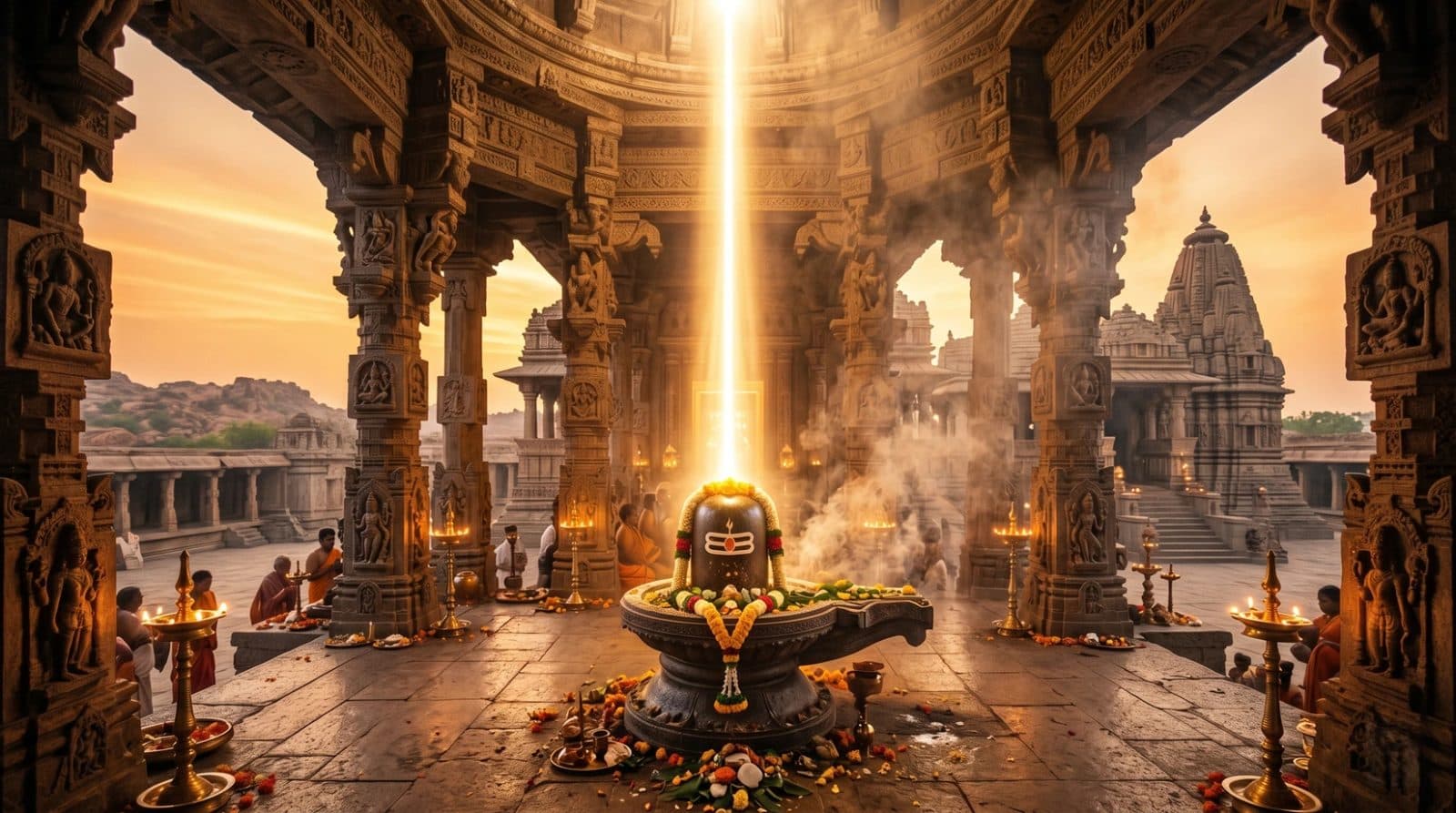
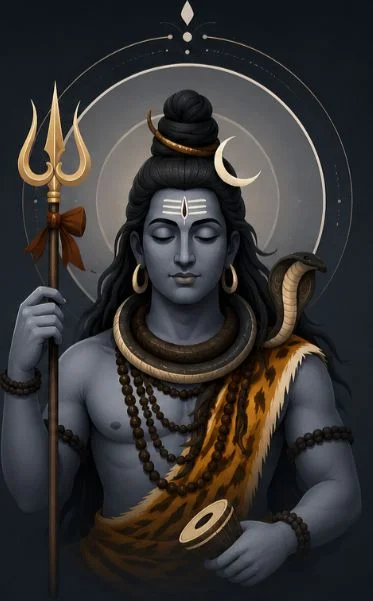
The word jyotirlinga (ज्योतिर्लिङ्ग) means "linga of light" — jyotis (divine radiance) + linga (the cosmic sign of Shiva). According to the Koti Rudra Samhita of the Shiva Purana (chapters 14–32), Shiva himself swore to remain at exactly 12 places in India until the end of the universe (pralaya) — in the form of a self-manifested (svayambhu) pillar of light. Unlike human-consecrated lingas, these 12 were never installed by any priest or king; they emerged on their own.
The orthodox sequence (per Shiva Purana) is: Somnath · Mallikarjuna · Mahakaleshwar · Omkareshwar · Kedarnath · Bhimashankar · Kashi Vishwanath · Trimbakeshwar · Vaidyanath · Nageshwar · Rameswaram · Grishneshwar. Completing darshan of all 12 is said to grant moksha. The verse most widely recited: "Saurashtre Somnath cha Shrishaile Mallikarjunam / Ujjayinyam Mahakal-am Omkaramamalesh-varam…"
1
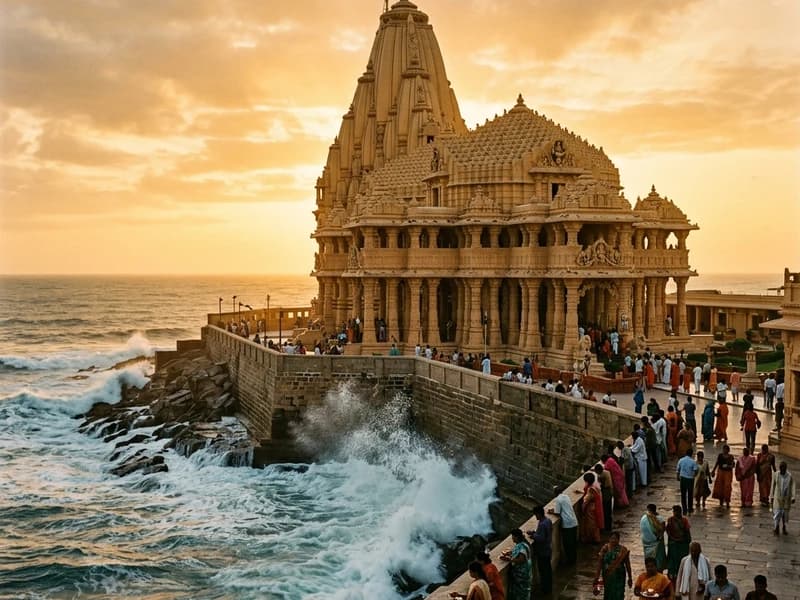
Somnathसोमनाथ
Gir Somnath district, Gujarat (Veraval, on Arabian Sea coast)
Deity — Somnath Jyotirlinga — Shiva as 'Lord of the Moon'
Legend — Chandra (Moon-god) was cursed by Daksha (his father-in-law) with consumption for favouring Rohini over his other 26 wives (Daksha's daughters). Chandra did tapas to Shiva at Prabhasa. Shiva agreed to wane-and-wax (the bright + dark fortnight). Chandra installed this Jyotirlinga in gratitude — hence 'Soma-natha' (Lord of Soma/Moon).
Deity intent — Removes diseases of body + mind (Chandra was cured of consumption here). Especially venerated for moon-related afflictions in horoscopes (Chandra dosha).
Festival — Maha Shivaratri (Feb-Mar). Kartik Purnima (Nov) — lamp-floating on the Triveni sangam (Hiranya + Saraswati + Kapila rivers).
Visit tip — Sound-light show 'Jay Somnath' every evening (7:45 pm) narrated by Amitabh Bachchan. Don't miss the Sardar Patel memorial inside the trust complex.
2
Mallikarjuna (Srisailam)मल्लिकार्जुन
Nallamala hills, Nandyal district, Andhra Pradesh (banks of the Krishna river)
Deity — Mallikarjuna Jyotirlinga (Shiva) + Bhramaramba Devi (Shakti Peetha — neck of Sati). Rare double — Jyotirlinga + Shakti Peetha in one complex.
Legend — After Kartikeya lost the 'race-around-the-cosmos' to Ganesha (who circled his parents instead), an angered Kartikeya departed for the Kraunch Mountain (Srisailam). Shiva + Parvati came to console him — they took the form of a jasmine-linga (Mallika = jasmine; Arjuna = white) to remain near Kartikeya. Mallikarjuna is Shiva-Parvati combined.
Deity intent — Heals strife between parents + children; harmony in family. Grants the comfort that Kartikeya received here. Doubles as Devi-darshan (rare).
Festival — Maha Shivaratri (Feb-Mar) Brahmotsavam — 11 days. Ugadi.
Visit tip — Sparsha-darshan (touching the linga) is permitted on payment of a small fee — extremely rare among Jyotirlingas. Closest railhead Markapur Road; road through forest closes after dusk.
3
Mahakaleshwarमहाकालेश्वर
Ujjain, Madhya Pradesh (banks of Shipra river — one of the 7 Mokshapuris + Kumbh Mela kshetras)
Deity — Mahakal — Shiva as 'Lord of Time'. The ONLY south-facing Jyotirlinga (Dakshinamukhi).
Legend — A boy named Shrikar in Avantika was a great Shiva-devotee. When the demon Dushana attacked Avantika threatening to destroy the dharma, Shiva burst out of the earth as Mahakal — reduced Dushana to ash. He stayed at the prayer of the people.
Deity intent — Conquers untimely death (akala-mrityu). Grants mastery over time (kala). The single most powerful Jyotirlinga for averting deaths-by-accident, fatal-illness, premature loss.
Festival — Maha Shivaratri. Sawan Somvar (Mondays of Shravana — month-long procession of Mahakal's silver Sawari through Ujjain). Naga Panchami.
Visit tip — Bhasma-Aarti (4 AM) requires online booking 1-2 days advance (Shri Mahakaleshwar Mandir Prabandh Samiti site). Men: dhoti only, bare-chest. Women: saree. Free queue is 4-6 hrs in Shravana — book a 250 Rs VIP slot if time-poor.
4
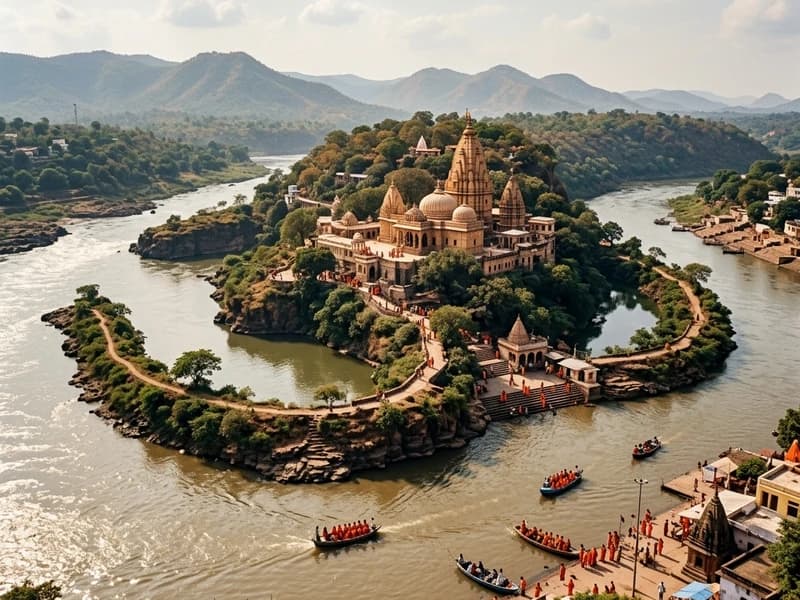
Omkareshwarओङ्कारेश्वर
Mandhata island, Khandwa district, Madhya Pradesh (on Narmada river — the island is shaped like the Om / ॐ symbol)
Deity — Omkareshwar (Shiva on the island) + Mamleshwar (Shiva on the south bank). Both are the Jyotirlinga — pilgrimage to both is required.
Legend — King Mandhata (Ikshvaku dynasty) did tapas on this island. Shiva appeared. Separately, devas + asuras worshipped Shiva, who split into two — Omkareshwar (for devas) on the island and Mamleshwar (for asuras, also called Amareshwar/Pranava) on the bank.
Deity intent — Removes accumulated paap (sin) — the Narmada at Omkareshwar is the only river whose mere darshan (not bath) liberates. Grants self-realisation (the Om is the seed-syllable of Brahman).
Festival — Maha Shivaratri. Kartik Purnima — Narmada Jayanti. Nag Panchami.
Visit tip — You must visit BOTH the island (Omkareshwar) AND the south bank (Mamleshwar) — pilgrims often skip Mamleshwar (incomplete darshan). Bridge or boat. Stay overnight to do the 7-km parikrama of the island at dawn.
5
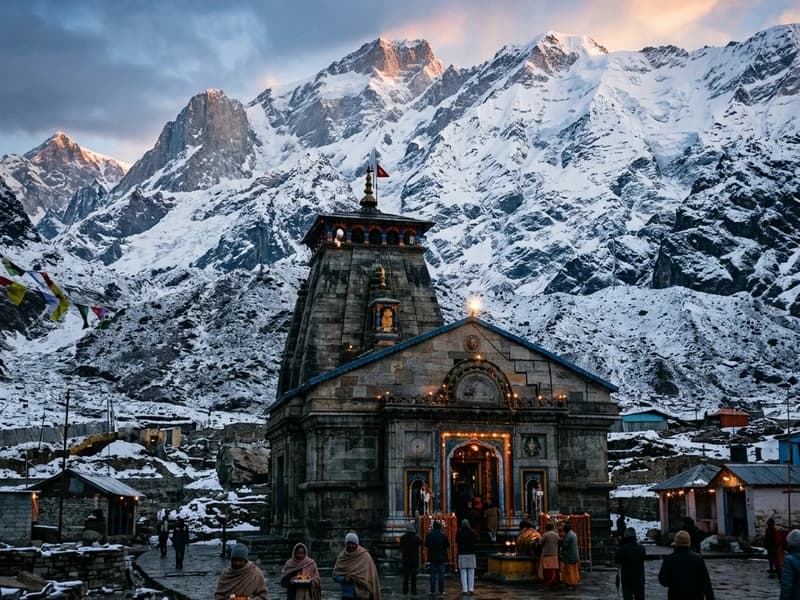
Kedarnathकेदारनाथ
Rudraprayag district, Uttarakhand (Garhwal Himalaya, 3,583 m, source-region of Mandakini)
Deity — Kedarnath Jyotirlinga — Shiva as the conical-back of a buffalo (the only Jyotirlinga in this form)
Legend — After Kurukshetra, the Pandavas sought Shiva to expiate the killing of kinsmen (gotra-vadha) + a teacher (Drona). Shiva, displeased, hid in Kedar as a bull. Bhima recognised him and grabbed the bull's hump — the hump remained at Kedar; the other 4 parts manifested at the Panch Kedars (Tungnath = arms, Rudranath = face, Madhyamaheshwar = navel, Kalpeshwar = hair).
Deity intent — Atones for the gravest sins — even the killing of one's own kin. Grants liberation to those who undertake the arduous trek as tapas.
Festival — Opening yatra (Apr-May, Akshaya Tritiya). Closing (Nov, Bhai Dooj). Maha Shivaratri.
Visit tip — 16 km trek from Gaurikund (helicopter from Phata 6-min). Closes Nov-Apr (deity shifted to Ukhimath/Omkareshwar temple). Acclimatize 1 night at Sonprayag — altitude sickness is real above 2500 m.
6
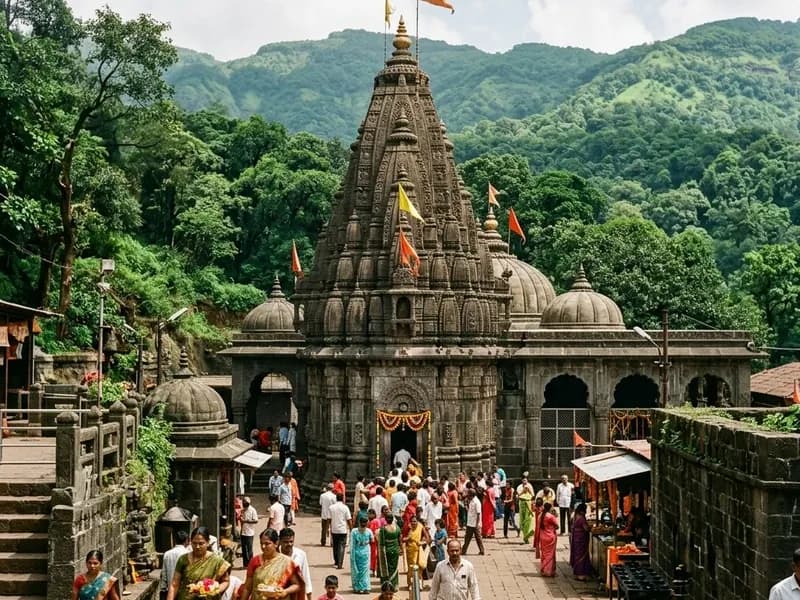
Bhimashankarभीमशङ्कर
Sahyadri (Western Ghats), Pune district, Maharashtra (source of Bhima river)
Deity — Bhimashankar Jyotirlinga — Shiva who slew Bhima-asura
Legend — Bhima — son of the rakshasi Karkati + the demon Kumbhakarna (Ravana's brother) — was furious to learn his father had been slain by Rama. He vowed to destroy all Vishnu-bhaktas. He defeated Indra + began tormenting King Sudakshina, a Shiva-devotee. As Sudakshina was about to be killed, Shiva burst out as Bhimashankar + reduced the asura to ash. Shiva's sweat formed the Bhima river.
Deity intent — Destroys mountainous obstacles (Bhima = great). Especially for victory over unjust adversaries.
Festival — Maha Shivaratri. Karthik Purnima.
Visit tip — Best by road from Pune (110 km). Monsoon (Jul-Sep) is dazzling but landslide-prone. Carry warm clothes — early-morning fog at 1000 m altitude.
7
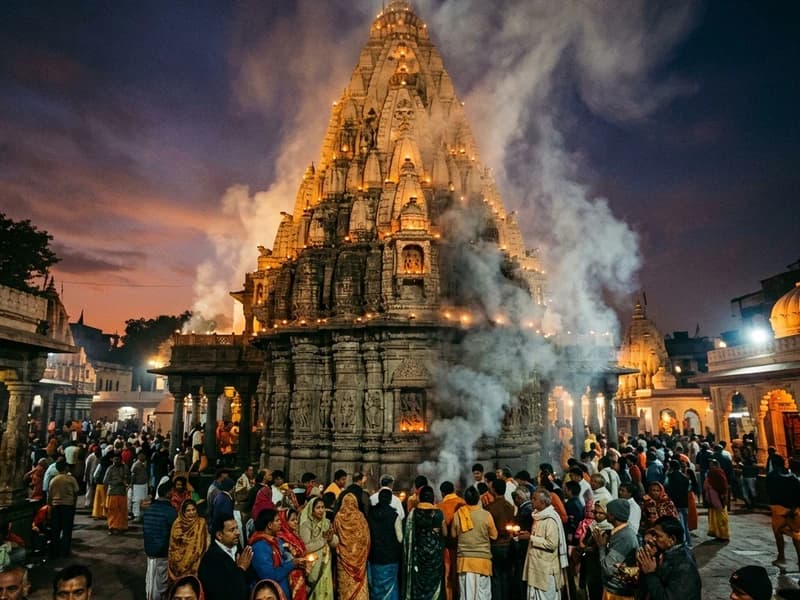
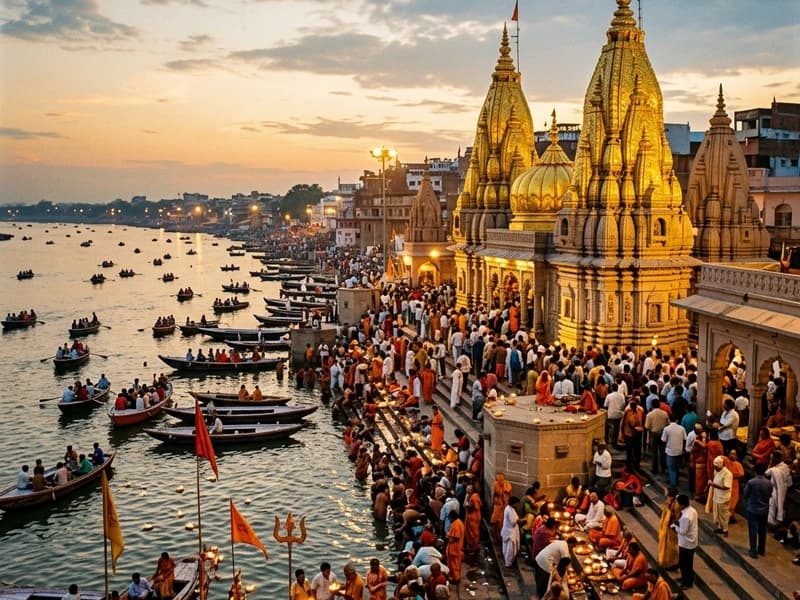
Kashi Vishwanathकाशी विश्वनाथ
Varanasi (Kashi), Uttar Pradesh (on the ghats of the Ganga)
Deity — Vishwanath / Vishveshwara — Shiva as 'Lord of the Universe'. Goddess Annapurna (food-giver) is the consort, in her own adjacent temple.
Legend — Kashi is on the trident (trishul) of Shiva — not on the earth. It is jara-marana-rahita (untouched by old age + death). Shiva declared Kashi 'avimukta' (never abandoned) — even at pralaya, Kashi remains. The linga is self-manifested.
Deity intent — GUARANTEED LIBERATION. Anyone who dies in Kashi (Maranam Mangalam) is whispered the Tarak-mantra (Ram nama) into the right ear by Shiva himself — instant moksha, no rebirth. The supreme Hindu pilgrimage goal.
Festival — Maha Shivaratri. Dev Diwali (Kartik Purnima — million-lamp ghat-lighting). Sawan Somvar processions.
Visit tip — Visit Kal-Bhairava FIRST (he is the Kashi-Kotwal, holds the keys). Sparsha-darshan inside garbhagriha permitted but extreme crowd in Shravana. Don't miss Manikarnika Ghat — the cremation-ghat where Shiva whispers the Tarak.
8
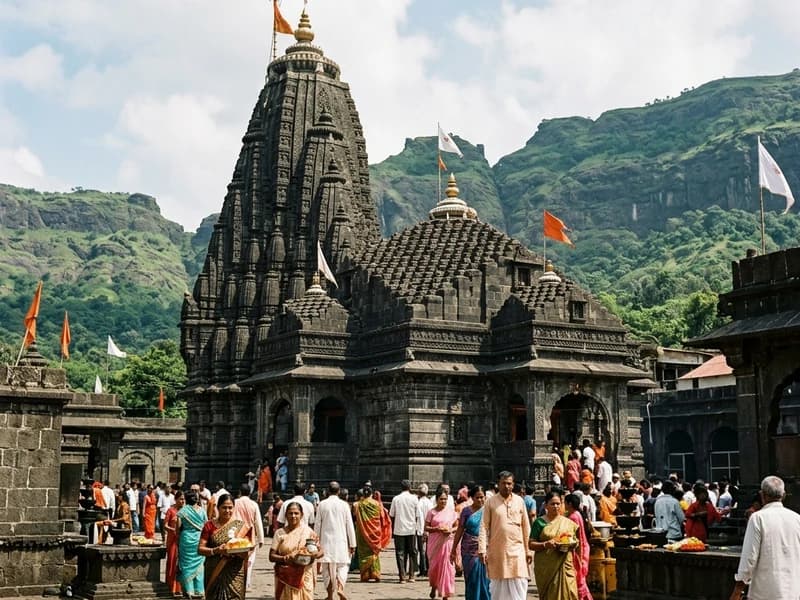
Trimbakeshwarत्र्यम्बकेश्वर
Nashik district, Maharashtra (source of Godavari river, foothills of Brahmagiri)
Deity — Trimbakeshwar Jyotirlinga — Tri-mukha-linga (3-faced): Brahma, Vishnu, Rudra in one linga. The ONLY 3-faced Jyotirlinga.
Legend — Sage Gautama, falsely accused of killing a cow (it was actually a maya-cow created by jealous brahmanas), did penance to Shiva on Brahmagiri. To wash off the cow-killing sin, he asked Shiva to bring the Ganga south — Shiva released his locks; Godavari (Dakshin Ganga) emerged. Shiva remained as Trimbakeshwar (3-faced — for Brahma, Vishnu, Rudra) at her source.
Deity intent — Removes ancestral debts (pitru-rina). The single most powerful Jyotirlinga for performing NarayanaNagbali + Tripindi Shraddha + Kalsarpa Dosha nivaran rituals (eradication of snake-curse).
Festival — Maha Shivaratri. Kumbh Mela (every 12 years — next 2027). Tripindi Shraddha — performed daily for non-festival days.
Visit tip — Book a panda (priest) for KalSarpa-Dosha or NaraynaNagbali only via the Sansthan office — touts overcharge wildly (Rs. 500 actual; touts ask Rs. 25000+). Brahmagiri Pradakshina is 12 km — start 4 AM.
9
Vaidyanath (Baidyanath Dham)वैद्यनाथ
Deoghar district, Jharkhand (orthodox claim per Shiva Purana). Disputed alternative — Parli Vaijnath, Beed, Maharashtra.
Deity — Vaidyanath — Shiva as 'Physician of the cosmos'. Linga installed by Ravana himself.
Legend — Ravana did tapas at Kailasa, cutting his own 9 heads as offerings. As he was about to sever the 10th, Shiva — pleased and impressed — appeared, restored his heads + granted him a Jyotirlinga to take back to Lanka. Condition: 'Do not place it on the ground en route'. Vishnu (worried this would make Ravana invincible) sent Varuna to make Ravana need to urinate. Ravana handed the linga to a cowherd-boy (Vishnu in disguise) — who placed it on the earth at Deoghar. The linga immobilized. Ravana, defeated, pressed his thumb into it — Deoghar means 'House of God'.
Deity intent — Heals chronic + incurable illnesses (Vaidya = physician). Pilgrims come specifically for healing of cancer, mental illness, persistent disease. Considered the supreme 'medical' Jyotirlinga.
Festival — Shravani Mela (Jul-Aug — month-long kanwar yatra). Maha Shivaratri.
Visit tip — Pilgrims must first take Gangajal from Sultanganj (Bihar) and walk barefoot 108 km in saffron — the kanwar yatra. If time-short, do the short kanwar (5 km from Jasidih). Aurangzeb-era inscriptions visible on the panchsool.
10
Nageshwarनागेश्वर
Devbhumi Dwarka district, Gujarat (12 km from Dwarka, on the Arabian Sea coast)
Deity — Nageshwar Jyotirlinga — Shiva as 'Lord of the Serpents'
Legend — A great Shiva-devotee, the merchant Supriya, was captured along with his family by the demon Daruka. In captivity, Supriya continued chanting 'Om Namah Shivaya' + persuaded fellow-prisoners. Daruka tried to kill him; Shiva burst from the earth as Nageshwar, granted Supriya a Pashupatastra (weapon), and Supriya destroyed the demon. Shiva remained as Nageshwar — protector against serpents + poisons.
Deity intent — Protects from snake-bites, poisons (vish), and toxic relationships. Removes effects of black-magic + Naga-dosha in horoscopes.
Festival — Maha Shivaratri. Naga Panchami (Shravana — special snake-puja).
Visit tip — Pair with Dwarka (12 km) + Bet-Dwarka. Sparsha-darshan permitted at certain hours.
11
Rameswaram (also a Jyotirlinga)रामेश्वरम्
Pamban island, Ramanathapuram district, Tamil Nadu (see Char Dham above)
Deity — Ramanathaswamy Jyotirlinga — Shiva as 'Lord of Rama' (same as Char Dham entry)
Legend — See Char Dham above. Rama installed the linga before crossing to Lanka.
Deity intent — Removes brahma-hatya. Grants forgiveness of unforgivable sins.
Festival — Maha Shivaratri. Brahmotsavam. Thirukalyanam.
Visit tip — See Char Dham above. Bath in all 22 tirthas in one morning is the orthodox practice.
12
Grishneshwarघृष्णेश्वर
Verul (Ellora), Aurangabad district, Maharashtra (300 m from the Ellora UNESCO caves)
Deity — Grishneshwar Jyotirlinga — Shiva who restored the devotee Ghushma's son
Legend — Ghushma, the 2nd wife of brahmana Sudharma, was a great Shiva-devotee. She daily made 101 clay-lingas, worshipped them, and dropped them in a pond. Sudeha (the 1st wife), envious, killed Ghushma's son in his sleep + dumped the body in the pond. Ghushma, unshaken, continued her puja. When she went to immerse the lingas the next day — her son emerged ALIVE from the pond. Shiva appeared. Ghushma asked only that her sin-fully-sister be forgiven. Shiva remained as Ghrishneshwar (named for Ghushma).
Deity intent — Removes envy + petty malice (jealousy from family). Grants restoration of lost children, lost loved ones. Forgiveness for those who wronged us.
Festival — Maha Shivaratri.
Visit tip — Combine with Ellora caves (5-min walk) + Daulatabad fort (15 km) + Bibi-Ka-Maqbara. Men must remove shirt for sparsha-darshan.
Pilgrimage Circuit Notes
South circuit (6 days): Somnath → Nageshwar → Trimbakeshwar → Bhimashankar → Grishneshwar → Omkareshwar → Mahakaleshwar — covers Gujarat + Maharashtra + MP in a loop.
North circuit: Kashi Vishwanath (Varanasi) + Vaidyanath (Jharkhand) + Kedarnath (Uttarakhand) can be combined as a north pilgrimage.
Rameswaram is both a Char Dham and a Jyotirlinga — southern terminus, ideally visited last for the full merit (purna punya).
Kedarnath, Badrinath: Temple open only Apr/May – Nov. Plan only in the open season.