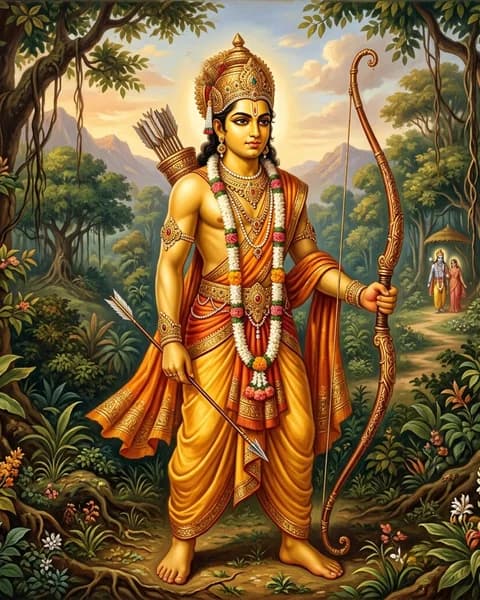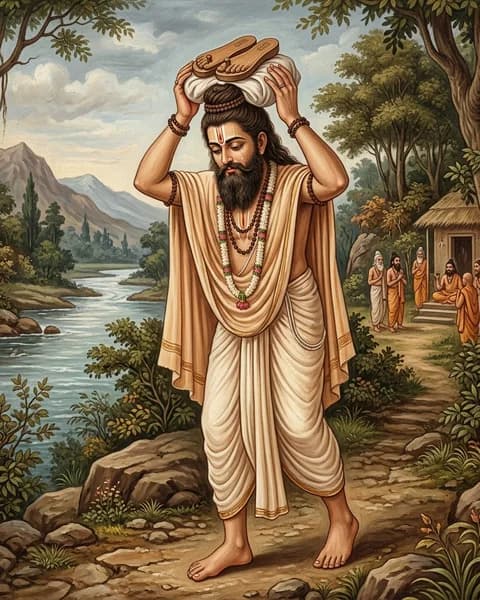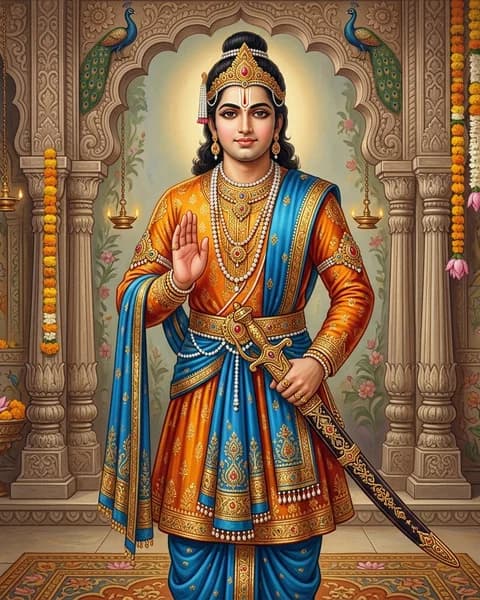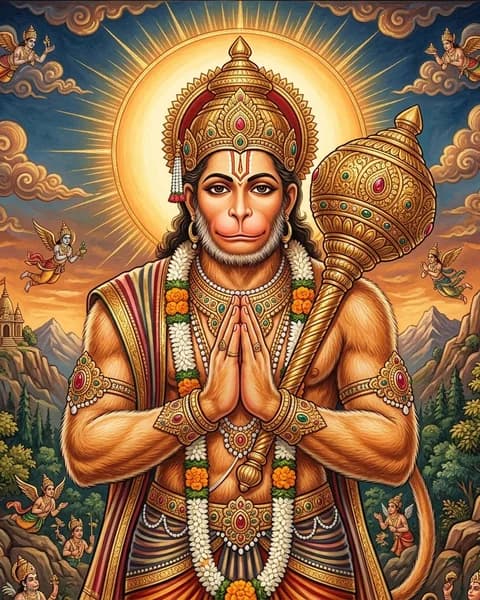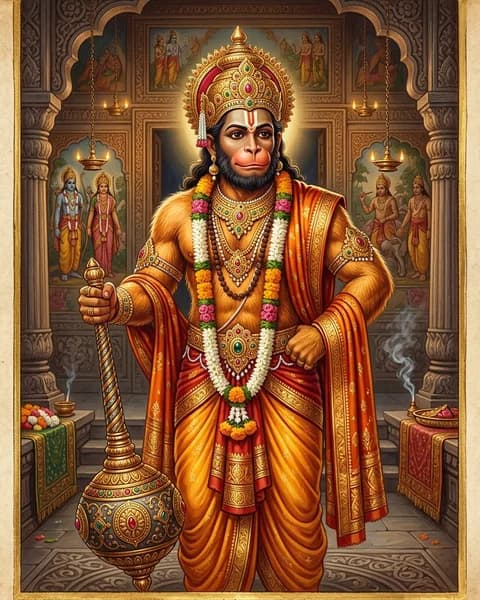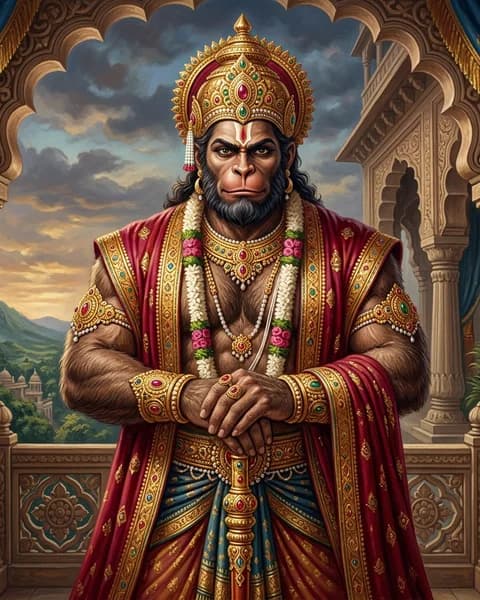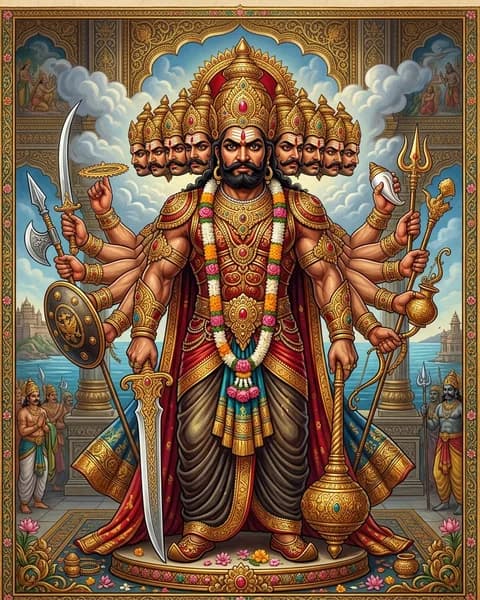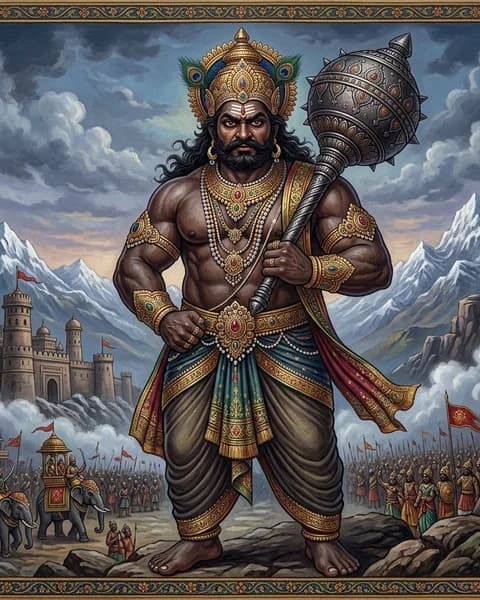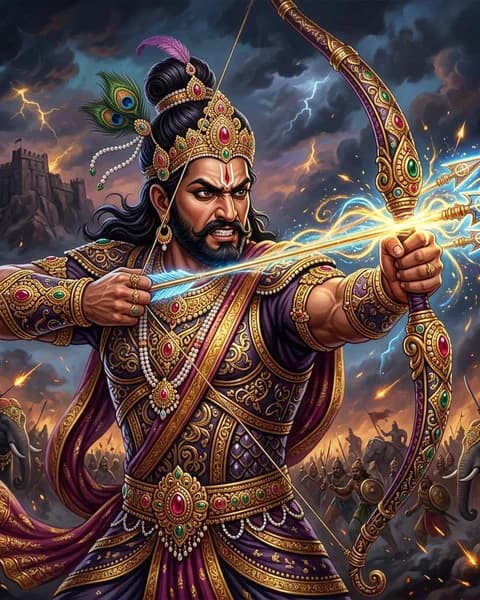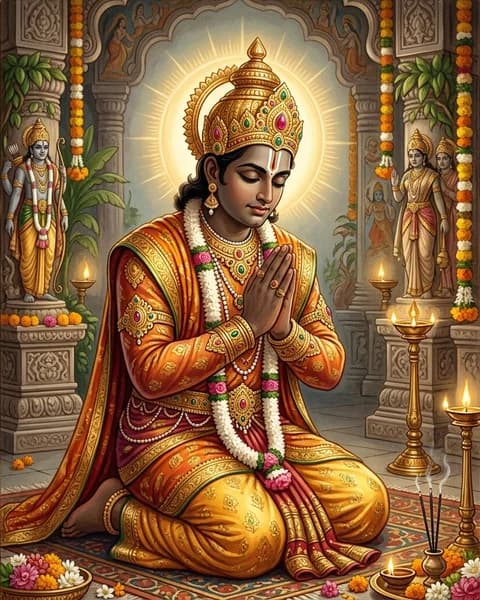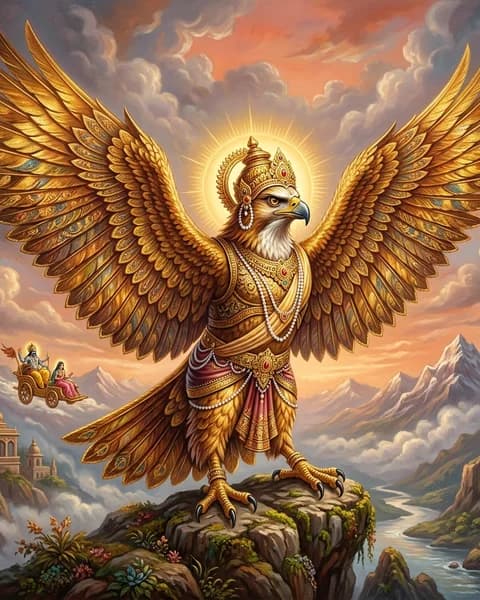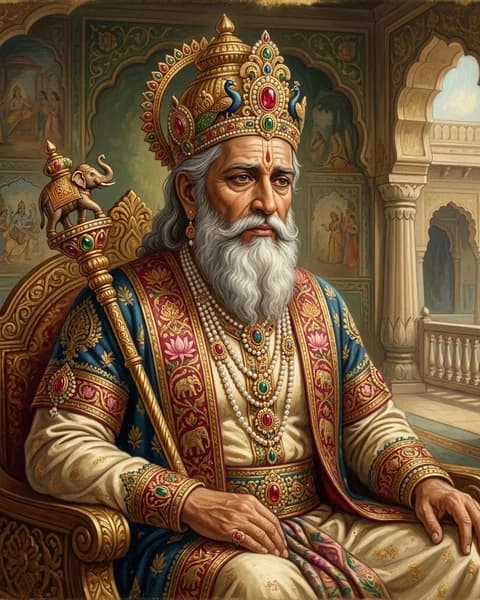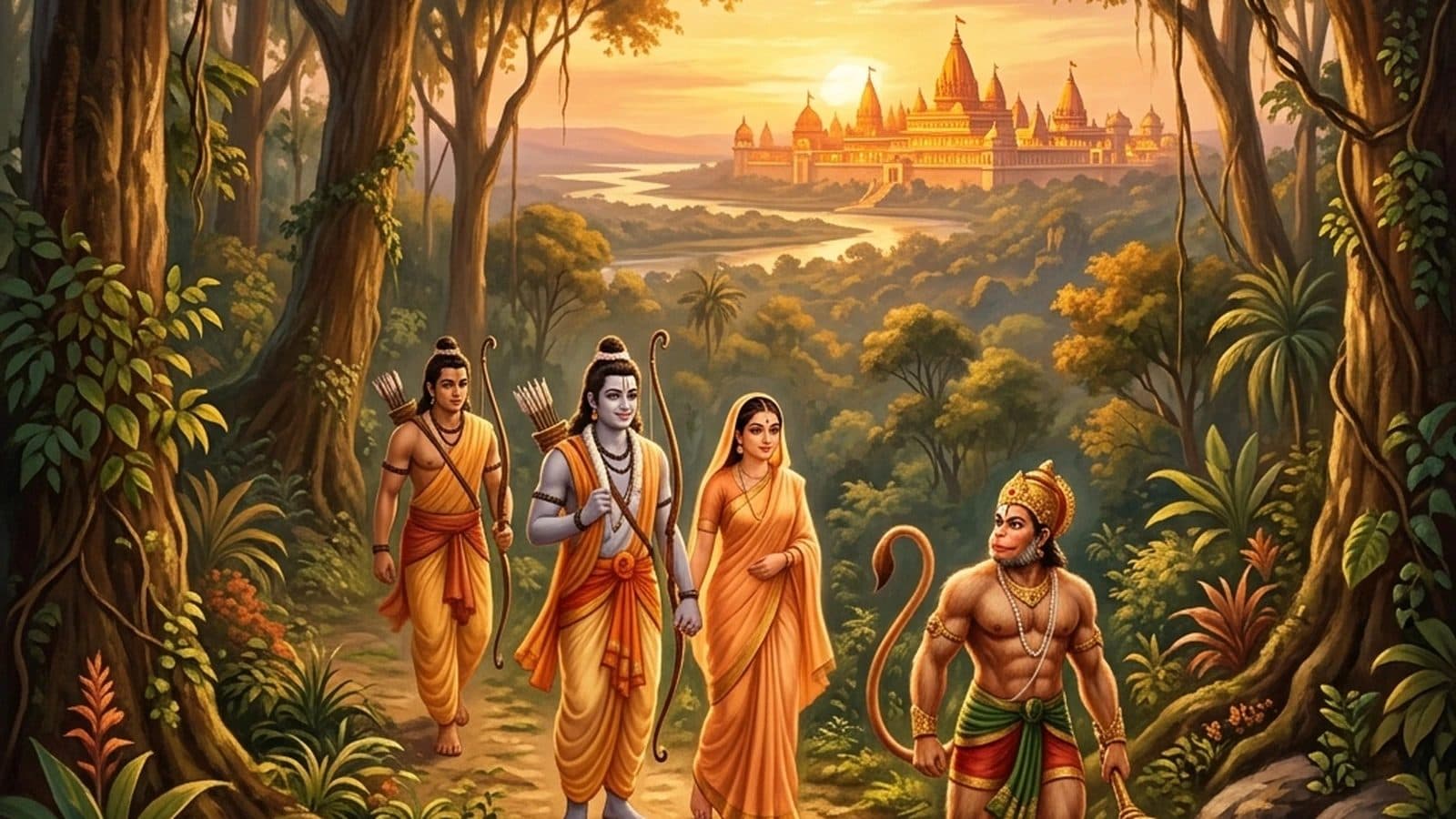
Valmiki Ramayana — 7 kandas, 24,000 shlokas. 17 central characters profiled below with birth, feats, fate, and dharmic lesson. Plus a 11-event detailed map of Sundara Kanda — the most-recited single kanda of the Ramayana (Hanuman\'s leap to Lanka + finding Sita + burning Lanka).
Sundara Kanda ("the beautiful kanda") is the only kanda named after a quality, not a place — said to be so beautiful that even hearing it grants moksha. It covers Hanuman\'s leap to Lanka, his search for Sita, the burning of Lanka, and his return. The most-recited kanda for any new venture or to overcome fear / depression.
№ 1
The leap from Mahendra mountain
After Jambavan reminds Hanuman of his powers, Hanuman climbs Mahendra mountain at the southern shore of the Indian ocean. He swells to enormous size, presses down on the mountain (which sinks into the earth), and leaps. The leap is ~100 yojanas (~1300 km) across open sea to Lanka.
Significance — Hanuman's leap is one of the most-described moments in all of Sanskrit literature. Valmiki devotes ~30 verses to it. The leap is the supreme metaphor for spiritual breakthrough — leaving the known shore, mid-air with no support, reaching the unknown.
№ 2
Encounter with Mainaka
A mountain (Mainaka) rises from the ocean to offer Hanuman a resting-place. Hanuman, touched by the offer but not stopping, touches the mountain in salutation (not landing) and continues.
Significance — Even in mid-leap, Hanuman does not break his vow. The detail shows his unwavering focus on Rama's mission.
№ 3
Encounter with Surasa
A rakshasi (Surasa, the mother of nagas) demands to swallow Hanuman as her food. Hanuman first swells in size; she swells more. Then he shrinks to the size of a thumb, enters her mouth, comes out. She blesses him.
Significance — Intelligence over force. Hanuman could have fought Surasa but solved her by tactic — the supreme buddhi-mata-varishtam (most-intelligent) quality.
№ 4
Encounter with Simhika
Simhika the shadow-grasping rakshasi catches Hanuman's shadow. Hanuman pierces her body, kills her.
Significance — Force when warranted. Hanuman's discernment of when to bypass + when to confront.
№ 5
Encounter with Lankini
On reaching the shore of Lanka, Hanuman shrinks to cat-size to enter the city by night. Lankini (the city-guardian) appears + blocks his path. Hanuman strikes her with a single light blow + she falls. Recovering, she recognises that her fall fulfils an ancient prophecy: when she falls, Lanka will fall.
Significance — The blow that breaks the city's magical defence. Lankini's prophecy-recognition is the moment Lanka's fate is sealed.
№ 6
Search through Lanka
Hanuman roams Lanka by night, observing the rakshasa lifestyle (which Valmiki describes in detail — luxury, music, drinking, women). Goes through Ravana's palace. Finds Mandodari, mistakes her for Sita briefly. Searches every quarter.
Significance — Patient search. Hanuman never gives up — searches every room of every palace despite immense risk.
№ 7
Finding Sita at Ashoka Vatika
Hanuman finally finds Sita in the Ashoka grove, surrounded by guarding rakshasis. She is gaunt, dressed in single garment, refusing food. Hanuman climbs a tree above + observes. Witnesses Ravana approaching Sita + threatening her with death if she doesn't consent within 2 more months. Witnesses Sita's unwavering refusal.
Significance — The mission's climax — Sita found alive. Sita's pativrata-strength tested + proven.
№ 8
Hanuman's self-introduction to Sita
After Ravana leaves, Hanuman drops a ring (Rama's) at Sita's feet from above. Sita is amazed. Hanuman descends, introduces himself: "Dootoham Ramakarmartha hanuman vatajah kapih" — "I am an envoy, here for Rama's work — Hanuman, the wind-born monkey." He shows Rama's signet ring as proof.
Significance — The supreme self-introduction in 8 Sanskrit words. Sita knows him + the ring is Rama's.
№ 9
Sita refuses to leave with Hanuman
Hanuman offers to carry Sita back on his back. Sita refuses: (1) she will not voluntarily touch another man's body; (2) Rama himself must come to rescue her, kill Ravana, and reclaim her — anything less would diminish his honour. She gives Hanuman her chudamani (hair-jewel) as proof of meeting.
Significance — Sita's dharmic verdict. She insists on the FULL restoration of dharma — not a private rescue but a public victory. This decision sets up the war.
№ 10
Burning of Lanka
Before leaving, Hanuman wants to assess Lanka's defences. He destroys the Ashoka grove deliberately to draw attention. Rakshasa-soldiers attack; Hanuman kills countless. Eventually captured + brought to Ravana. Ravana orders his tail set on fire. The rakshasas wrap oil-soaked cloth around it + light it. Hanuman shrinks + escapes the bonds + uses the burning tail to set fire to every rooftop of Lanka.
Significance — Reconnaissance + intimidation in one act. Hanuman now knows every street of Lanka (he's been carried through it) + has demonstrated to Ravana that his envoy alone can burn the city.
№ 11
Return leap
Hanuman extinguishes the fire on his tail in the ocean. Leaps back to Mahendra. Arrives + tells Jambavan + Angada: "DRISHTA SITA" — "I have seen Sita." The simplest, most direct delivery of a 5-month mission.
Significance — "Drishta Sita" — those 2 words electrify the vanara army. The decision to march to Lanka is taken.