Anugita proper (ch. 16-50)
Krishna's teachings on jnana, karma, sannyasa. Largely a re-statement of the Bhagavad Gita with more elaboration. Discusses the gunas in greater detail.
Two important but less-known texts. The Anugita - Krishna\'s 3rd Gita to Arjuna post-Kurukshetra (Mahabharata Ashvamedhika Parva 16-92). The Hatha Yoga Pradipika - Swatmarama\'s 15th C foundational hatha-yoga text behind every modern asana lineage.
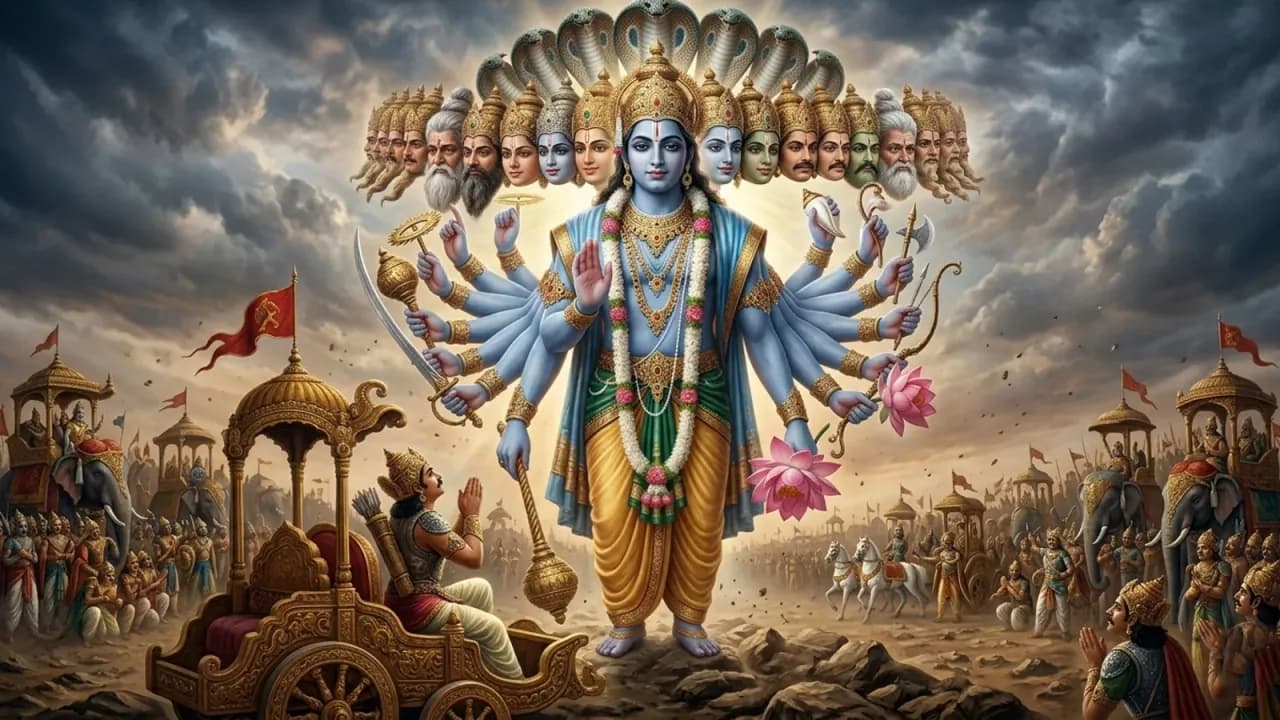
Setting - The Pandavas have won Kurukshetra. Yudhishthira is crowned at Hastinapura. Arjuna comes to Krishna at his palace and says: "Krishna, before the war you taught me a supreme philosophy. I followed it then. Now after the war, please repeat it." Krishna replies: "I cannot - I spoke in a yoga-state. Those exact words are gone. But I shall give you the essence again - anugita (the after-gita)."
Importance - Demonstrates: even Krishna cannot reproduce a perfect divine teaching twice in identical form. Each delivery is unique. The Bhagavad Gita's 700 verses, given in vibhuti-yoga, were a one-time grace. The Anugita's 36 chapters are the same truth in less-condensed form.
Why less-studied - The Bhagavad Gita is studied; the Anugita is not. Because: less compressed = less powerful for memorisation; covers more ground but in less-iconic verses; lacks the dramatic setting (battlefield, vishada, vibhuti-darshan). Yet for those who have studied the BG, the Anugita is essential - it fills in what the BG omitted.
Krishna's teachings on jnana, karma, sannyasa. Largely a re-statement of the Bhagavad Gita with more elaboration. Discusses the gunas in greater detail.
A brahmana-Kashyapa-vyadha (hunter) story embedded - same archetype as the Vyadha Gita. The unlettered hunter teaches the educated brahmana the true dharma. Anti-caste teaching.
A long discourse on the nature of the guru-disciple relationship. Defines the qualifications of both.
A brahmana teaches his wife about para-vidya + apara-vidya (higher + lower knowledge). The wife-as-disciple model.
Krishna's final words to Arjuna before the Pandavas' departure: maintain dharma, perform the Ashvamedha (which the Pandavas then do).
न शक्यं तन्मया भूयस्तथा वक्तुमशेषतः। परं हि ब्रह्म कथितं योगयुक्तेन तन्मया॥
It is not possible for me to repeat that (Bhagavad Gita) exactly. I spoke that supreme Brahman from a yoga-state.
★ Krishna's honesty. Even God cannot mechanically reproduce a divine inspiration. The teaching of the moment is the teaching of the moment.
Author - Swami Swatmarama (15th C). Disciple of Goraknath's lineage (Nath sampradaya).
Structure - 4 chapters (upadeshas): Asana (16 asanas), Pranayama + Shatkarmas (cleansing) + Pranayama proper, Mudra + Bandha (10 mudras + 3 bandhas), Samadhi.
Why important - The foundational text of modern Hatha Yoga. Almost every modern asana lineage (Iyengar, Ashtanga Vinyasa, Sivananda, Bihar) traces to HYP via Krishnamacharya. Patanjali's Yoga Sutras give the 8 limbs in principle; HYP gives the practical techniques.
Philosophy - Hatha = "Ha" (sun, ida nadi) + "tha" (moon, pingala nadi). Hatha Yoga = the yoga of bringing the two opposing flows into the central Sushumna. Once Sushumna is active, kundalini rises + samadhi follows.
67 verses. The first limb of hatha. Lists 16 important asanas - Swastika, Gomukha, Vira, Kurma, Kukkutta, Uttana-Kurma, Dhanura, Matsya, Pashchimo, Mayura, Shava, Siddha, Padma, Simha, Bhadra, and the supreme: Siddhasana. Pre-conditions: pure place, vegetarian diet, moderate eating, brahmacharya. Pratyahara, dharana, dhyana, samadhi come naturally after asana.
मिताहारं विना यस्तु योगारम्भं तु कारयेत्। नानारोगो भवेत्तस्य किञ्चिद्योगो न सिध्यति॥ - "Without moderate diet, one who attempts yoga gets various diseases; no yoga succeeds."
78 verses. The 6 shatkarmas (cleansing techniques) - Dhauti (cleansing with cloth), Basti (lower-tract), Neti (nasal-thread), Trataka (gazing), Nauli (abdominal-churning), Kapalbhati (skull-shining). The 8 kumbhakas (breath-retentions): Surya Bhedana, Ujjayi, Sitkari, Sheetali, Bhastrika, Bhramari, Murccha, Plavini. Each kumbhaka has its own benefits + cautions.
चले वाते चलं चित्तं निश्चले निश्चलं भवेत्। योगी स्थाणुत्वमाप्नोति ततो वायुं निरोधयेत्॥ - "When breath moves, mind moves; when breath is still, mind is still. The yogi attains stability. Therefore restrain the breath."
130 verses. The 10 mudras: Maha Mudra, Maha Bandha, Maha Vedha, Khechari, Uddiyana, Mulabandha, Jalandhara, Viparita Karani, Vajroli, Shakti-chalana. The 3 main bandhas: Mula bandha (root-lock), Uddiyana bandha (abdominal-lock), Jalandhara bandha (throat-lock). Khechari mudra (turning the tongue back into the throat) is the supreme - said to grant siddhis + immortality.
अद्य प्रभृति में देह मोक्षदेहो भविष्यति। मा भूद्बाह्य परिज्ञानं नैव बाह्ये प्रसार्यते॥ - "From today, my body is the body-of-moksha. Let there be no external knowledge; let there be no external projection."
114 verses. The fruit of all asana + pranayama + mudra + bandha. 4 stages of nada-yoga (sound-meditation) - arambha, ghata, parichaya, nishpatti. The yogi hears inner sounds (anahata-nada) growing subtler - first bell-like, then conch, then drum, then flute, finally silence. In silence - samadhi. The supreme.
न गन्धं न रसं रूपं न च स्पर्शं न निःस्वनम्। नात्मानं न परं वेत्ति योगी युक्तः समाधिना॥ - "Smell not, taste not, form not, touch not, sound not, self not, other not - the yogi knows none - joined in samadhi."
Predecessors - Goraknath (founder of Nath sampradaya, ~10-11th C). Matsyendranath (Goraknath's guru). Both considered fountainheads of hatha yoga.
Modern lineage - Krishnamacharya (1888-1989) - the most influential 20th-C hatha-yoga teacher. His students: BKS Iyengar (Iyengar yoga), Pattabhi Jois (Ashtanga Vinyasa), TKV Desikachar (Viniyoga), Indra Devi (first Western female practitioner). Their students + sub-students = essentially all modern yoga.
Other classical texts - Goraksha Shataka (Goraknath, ~100 verses). Shiva Samhita (~17th C). Gheranda Samhita (~17th C). Together with HYP these 4 are the foundational hatha-yoga corpus.